Struggling to calculate your exact Bulk Children’s Books Book Landing Cost Calculator without getting burned by unexpected port fees? After 10+ years of manufacturing and exporting books to the US, we have perfected the exact logistics formula. Here is the definitive guide to locking in your true DDP price.
The total landing cost for bulk children’s books is the sum of the FOB manufacturing price, ocean freight, insurance, last-mile delivery, and mandatory customs surcharges. While books are duty-free, you must still add the Merchandise Processing Fee and Harbor Maintenance Fee to your total.
But the standard formula is only half the battle. Want to know the hidden “weight-out” trap that inflates board book shipping costs by up to 30%? Keep reading to discover the exact prepress adjustments that will permanently protect your profit margins.
The True Landed Cost Formula for Printed Books

At its core, identifying your exact total import cost requires the strict application of the board book landed cost. However, the variables within this formula are frequently manipulated by middle-tier suppliers aiming to make their initial bids look more attractive.
$$Total\ Landed\ Cost = C_{FOB} + C_{Freight} + C_{Insurance} + C_{Customs} + C_{LastMile}$$
For the broader production path, review this print books in bulk benefits before you finalize specifications, supplier selection, and budget expectations.
While the mathematics are straightforward, the execution is where the danger lies. Many suppliers abuse the DDP (Delivered Duty Paid) incoterm.They provide a consolidated, low-ball “Logistics Fee” that conveniently omits destination port realities. This aggressive under-quoting artificially deflates the $C_{Customs}$ and $C_{LastMile}$ variables.
Ryan Petersen, founder of the digital freight forwarding giant Flexport, has extensively documented that true logistics costs are routinely obscured by a severe lack of data visibility. When businesses lack real-time tracking and a granular breakdown of destination fees, logistics morphs from a predictable operational expense into a critical margin-killing blind spot.
To survive the modern supply chain, you must learn to read a DDP quote like an auditor. Here is exactly how an amateur quotation differs from a professional, margin-protected quotation.
The DDP Reality Check: Amateur vs. Professional
| Logistics Variable | The “Fake” DDP Quote (High Risk) | The True Factory DDP Quote (Zero Risk) |
|---|---|---|
| Ocean Freight | Quoted solely on theoretical CBM volume. | Quoted on physical weight limits and pallet yield. |
| Customs Clearance | Bundled as a vague “Handling Fee.” | Explicitly itemizes MPF, HMF, and Customs Bond fees. |
| Compliance Risk | Assumes the buyer will handle CPSIA paperwork. | Includes ASTM F963 lab testing and CPC certification pre-departure. |
| Destination Fees | Excludes PierPass, Clean Truck Fees, and Demurrage. | Guarantees all port terminal surcharges are absorbed by the supplier. |
| Last-Mile Delivery | Assumes standard commercial loading dock access. | Pre-calculates Lift-Gate and Residential Delivery surcharges. |
Quick Guide: If your priority is predictable pricing, choose The True Factory DDP Quote; if you face unexpected invoices, avoid quotes that bundle handling into a single fee.
If your current supplier’s quote looks like the middle column, your financial model is already compromised.
The “Zero-Duty” Illusion in U.S. Customs
The most dangerous assumption in sourcing printed materials is believing that a 0% tariff equates to zero customs fees. This single misunderstanding destroys more project budgets than any other logistics error.
Under HS Code 4901.99.00 (and 4903.00.00 specifically for children’s picture and coloring books), printed books do indeed enter the United States duty-free. However, this zero-duty status absolutely does not exempt your shipment from mandatory U.S. Customs and Border Protection (CBP) surcharges.
Even without standard import tariffs, a legitimate commercial shipment will inevitably trigger two unavoidable federal costs. First is the Merchandise Processing Fee (MPF), which is calculated at 0.3464% of your total commercial value.While there is a minimum charge of $31.67, it caps out at $614.35 per entry. Second is the Harbor Maintenance Fee (HMF), assessed at exactly 0.125% of the cargo value, specifically targeting ocean freight arrivals.
However, the most lethal financial trap at the port is not taxation—it is regulatory compliance.
The CPSIA Compliance Redline
The U.S. Consumer Product Safety Commission (CPSC) operates with absolute zero tolerance for undocumented children’s products entering the country.Their import directives are brutally clear: failing to provide a valid Children’s Product Certificate—backed by third-party CPSC-accepted laboratory testing—will trigger an immediate customs hold.
Real-World Experience: The $1,200 “Savings” Disaster
In early 2025, a purchasing manager approached us to salvage a failed logistics operation. On a previous run of 50,000 interactive sound books, he had opted for a discount freight broker to save $1,200 on the total DDP price. Because the broker was ignorant of the publishing sector’s legal thresholds, they shipped the containers without securing the required ASTM F963 heavy metal ink tests or the button-battery safety certificates.
CBP flagged the container upon arrival at the Port of Long Beach. Because the broker could not produce the CPC paperwork, the cargo was detained. Once the brief 4-day “Free Time” expired, the port began levying severe demurrage penalties.
At a rate of $250 per day in terminal detention fees, the container sat in purgatory for two weeks while the buyer scrambled to arrange emergency lab testing in the US. The initial $1,200 savings evaporated instantly, replaced by nearly $3,500 in unrecoverable port fines.
A competent 10+ year manufacturing partner understands that DDP is not merely a shipping term; it is a strict legal framework. The CPC testing costs must be baked into the upfront quote, ensuring the cargo clears customs the moment the vessel docks.
The “Weight-Out” Trap for Board Books
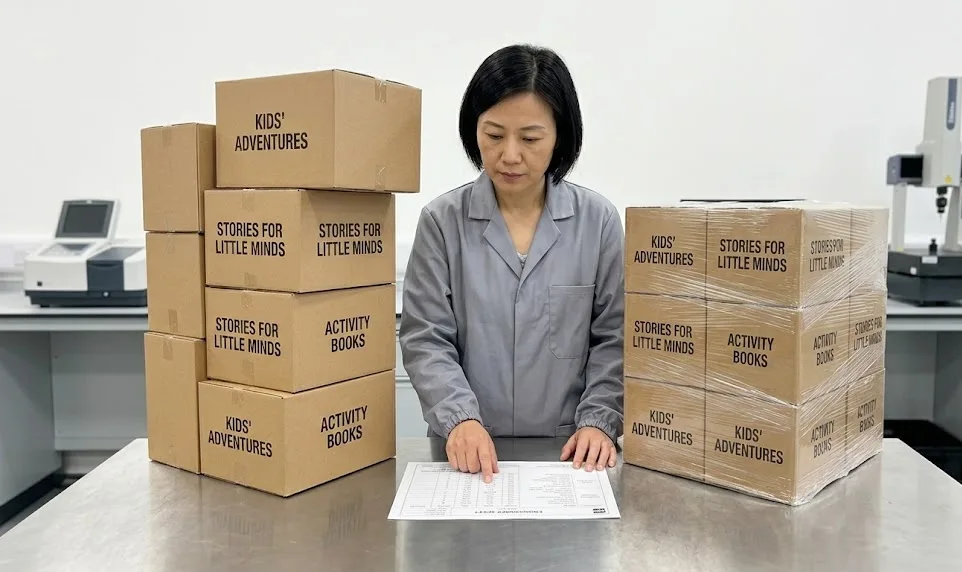
If you are printing children’s board books, using a generic logistics calculator will actively sabotage your budget. Most online LCL (Less than Container Load) calculators assume ocean freight is priced purely by physical volume, measured in Cubic Meters (CBM).
While the “Volume-Out” metric applies perfectly to importing lightweight goods like apparel or plastic toys, it is a catastrophic baseline for children’s publishing.
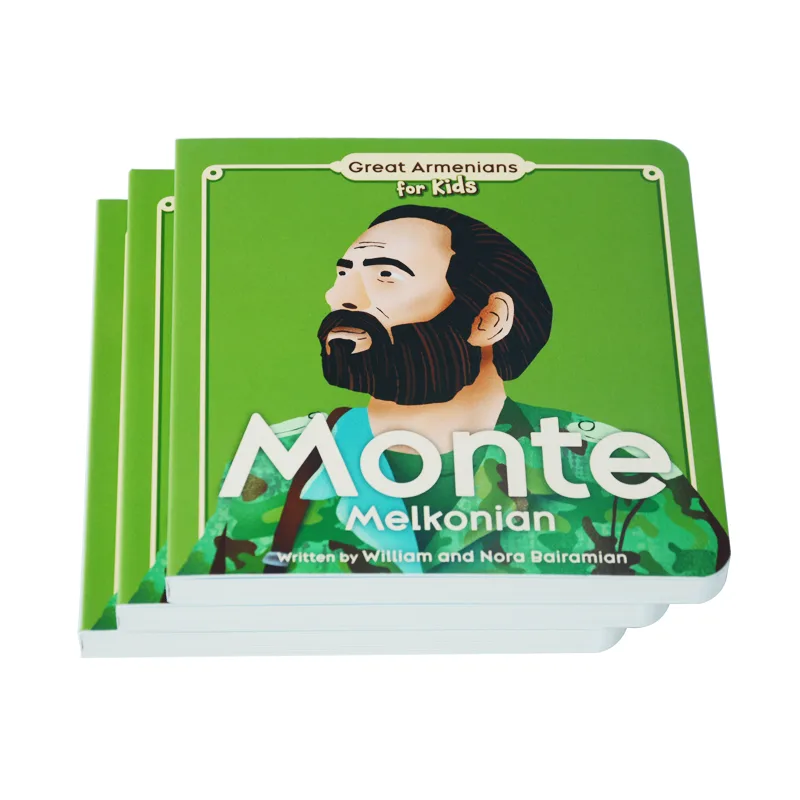
Board books are constructed from multiple layers of high-density greyboard, glued and pressed together. They possess incredible physical density. The hardcore industry reality is that shipping board books is never a matter of volume; it is entirely a matter of weight.
Consider the physics of a standard 20-Foot Full Container Load (20FT FCL). The physical interior holds approximately 28 to 33 CBM. However, U.S. highway transportation laws and chassis weight limitations strictly cap the actual legal payload at roughly 18,000 kilograms.
When loading densely packed board books, the container will smash through that 18,000 kg weight ceiling when it is only filled to 15 or 18 CBM. The container will look half empty, but it is legally maxed out.If an inexperienced purchasing manager projects their freight costs by dividing the total logistics bill by a theoretical 28 CBM volume, their budget will instantly suffer a 30% to 40% deficit.
Unexperienced procurement teams routinely calculate shipping using standard cubic volume, failing to realize that high-density children’s board books will legally max out a container’s weight limit long before filling its physical space.
Reverse-Engineering the Last Mile
To achieve absolute margin protection, you must stop designing books in a vacuum. You must reverse-engineer your prepress layout directly from the physical constraints of U.S. fulfillment centers, which is crucial when calculating Kickstarter shipping costs or long-term retail distribution budgets.
Ready to Protect Your Publishing Margins?
Stop guessing your true logistics overhead. Let our production experts analyze your book specifications and provide a fully transparent, binding DDP landed cost quote with zero hidden fees.
Moisture and Delivery
Beyond customs and container weights, there are secondary physical and logistical threats that cheap DDP quotes actively ignore. A seasoned buyer must anticipate these hidden landmines before signing a purchase order.
The Physics of Moisture Shock
Ocean transit is a brutal environment for printed paper products. As cargo vessels cross the equator, internal container temperatures routinely spike above 60°C (140°F), coupled with violent fluctuations in humidity.This phenomenon, known as “Moisture Shock,” is the primary cause of severe paper warping in high-density board books.
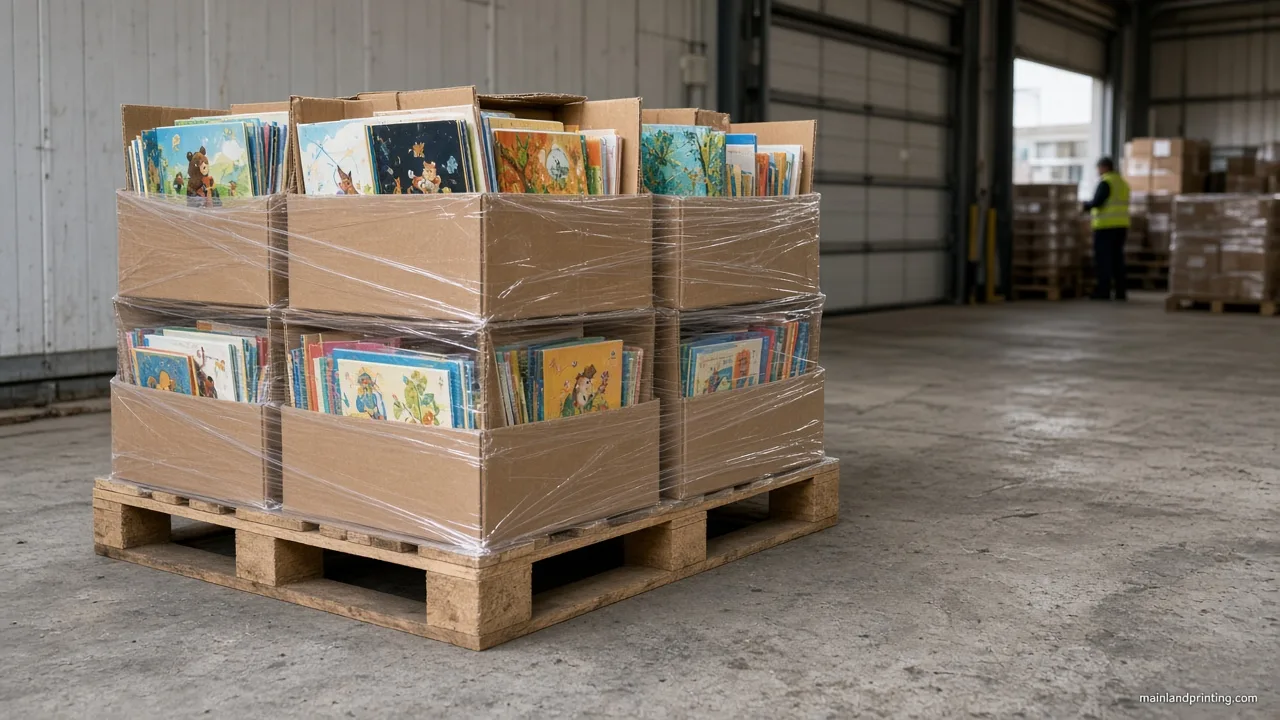
If your supplier utilizes cheap, untreated master cartons without inner protection, you are risking a 10% to 15% defect rate upon arrival.High-end printing manufacturers neutralize this threat by implementing strict China book printing logistics protocols: wrapping books in vacuum-sealed shrink wrap and embedding industrial-grade silica gel desiccants inside every double-walled corrugated carton. This adds mere cents to the manufacturing side but saves thousands of dollars in unsellable, warped inventory.
The Last-Mile Access Trap
Freight forwarders love to quote standard dock-to-dock delivery. But what happens if your Kickstarter fulfillment center or independent warehouse does not possess an elevated loading dock?
If a 53-foot truck arrives and the driver is forced to use a mechanical lift-gate to lower the pallets to ground level, the trucking company will retroactively bill a “Lift-Gate Surcharge.” If the delivery address is zoned commercial but borders a residential neighborhood, they will apply a “Residential Surcharge.” A robust factory DDP quote investigates the physical layout of your destination address beforehand, ensuring these access fees are absorbed into the initial contract, not passed back to you as a surprise invoice.
Andrea Fleck-Nisbet, CEO of the Independent Book Publishers Association (IBPA), has continually stressed that supply chain volatility is the single greatest existential threat to independent publishing margins. Protecting those margins requires moving away from fragmented, multi-vendor quoting and partnering exclusively with manufacturers who can provide guaranteed, end-to-end landed cost models.
The 2026 DDP Quote Audit Checklist
To survive in this B2B landscape, you need a concrete framework to evaluate supplier proposals. Do not accept a single lump-sum figure. Force your supplier to answer for the nuances. Use this exact checklist to audit your next children’s book printing cost estimate:
- Is CPSIA Lab Testing Included? Demand explicit written confirmation that ASTM F963 heavy metal and phthalate testing (conducted by a CPSC-accepted lab) is included in the unit cost.
- Is the Quote Based on Volume or Weight? For board books, ensure the logistics calculation is constrained by the 18,000 kg container limit, not the 28 CBM volume limit.
- Are MPF and HMF Itemized? The quote must acknowledge that while the books are duty-free (HS 4901.99), the Merchandise Processing Fee and Harbor Maintenance Fee are fully covered by the supplier.
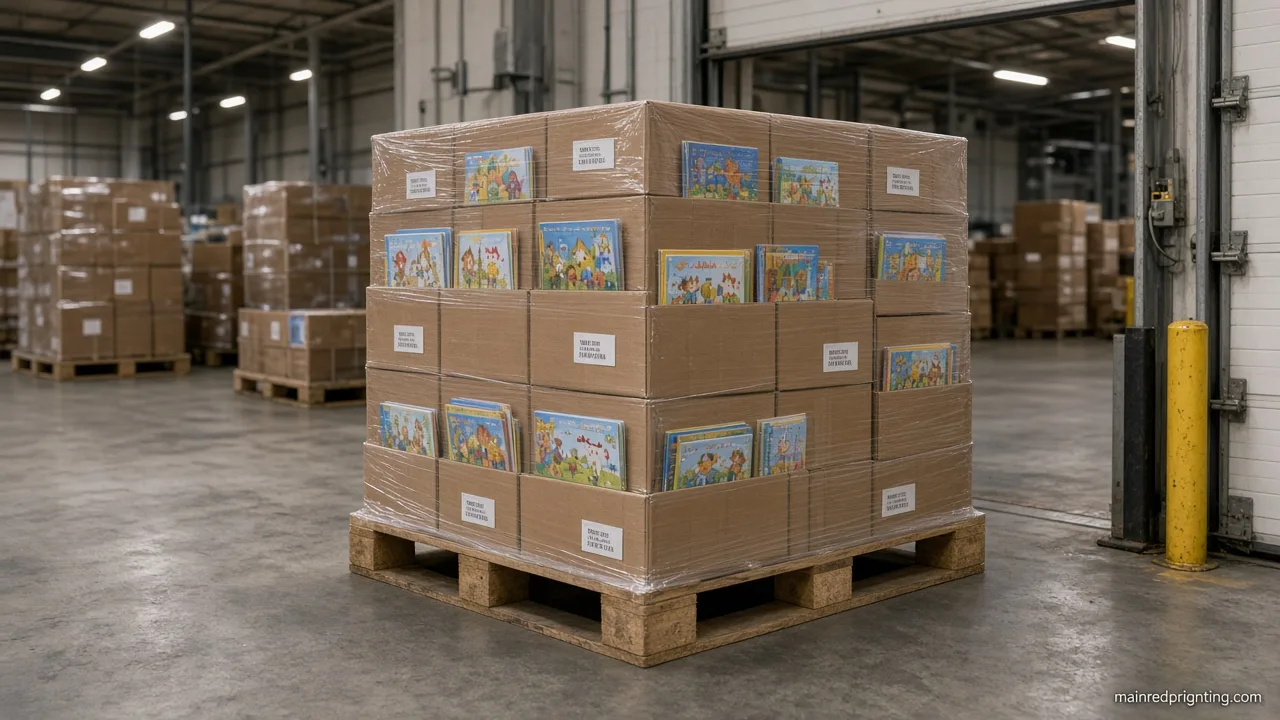
- Does the Pallet Yield Match US Standards? Verify that the carton dimensions are engineered to sit perfectly flush on a 48″ x 40″ pallet without any edge overhang.
- Is Last-Mile Surcharging Pre-Calculated? Ensure the delivery terms explicitly state whether lift-gate service, inside delivery, or residential surcharges have been factored into the final mile.
- What is the Moisture Prevention Protocol? Check the packaging specs for shrink-wrapping and desiccant inclusion to prevent cross-equatorial moisture shock.
Secure Your Margins with a 10+ Year Manufacturer

Your role as a purchasing manager is not to gamble on logistics; it is to secure profitability and deliver flawless execution to your executive team. Do not let a fragmented, black-box logistics quotation destroy your next major publishing run or delay a critical retail launch.
As a source manufacturer with over a decade of technical printing and direct-to-US export expertise, Mainland Printing understands that a reliable supply chain is your ultimate competitive advantage.We do not deal in vague volume estimates. We do not offload terminal port liabilities onto our clients. We deliver absolute financial precision, built on reverse-engineered prepress layouts, bulletproof CPSIA compliance, and mathematically flawless DDP modeling.
Landed cost on custom children’s book printing adds duty and freight to a per-unit price that already carries safety-certified inks.
Stop guessing what your final invoice will look like. Partner with a children’s book printing factory that engineers your logistics alongside your physical product.