If your first quote request only says “8.5 x 11, full color, please quote,” you will almost always get a number that changes later. The real issue is not how fast you receive a quote. It is whether the quote still holds after prepress review, proof rounds, packaging decisions, and shipping terms are confirmed.
A reliable book printing quote depends on spec completeness before price comparison: when trim size, page count, paper, binding, finishing, pack-out, and Incoterm are all locked in the same baseline, you can compare suppliers fairly and avoid low-price offers that become expensive after revisions and logistics are added.
You will find a practical RFQ input pack, a quote normalization table, hidden-cost risk signals, and a pre-PO confirmation script you can reuse with any printer. Use these tools to reduce back-and-forth, shorten decision cycles, and protect your budget before deposit.
The RFQ Input Pack US Buyers Should Send in One Email
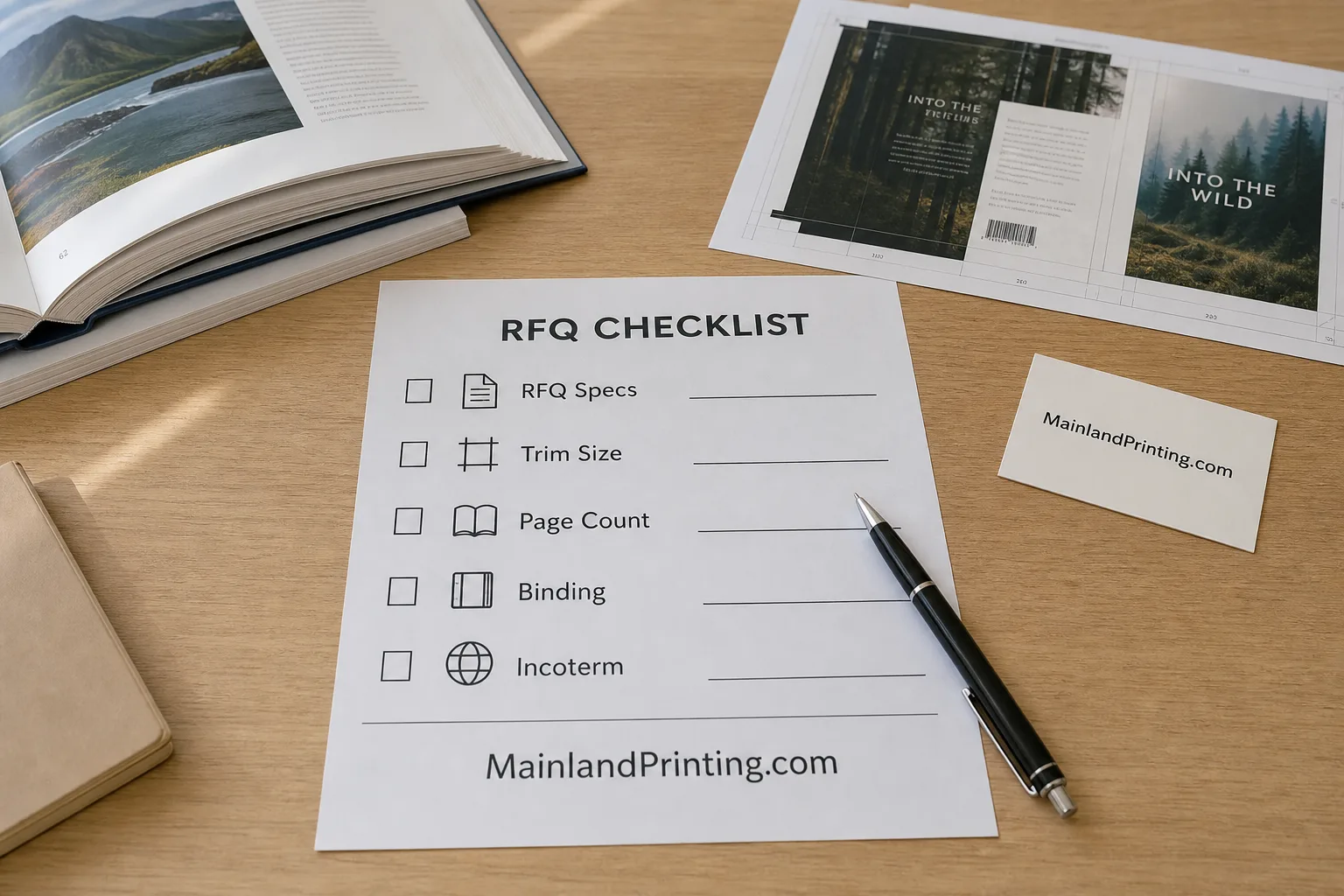
A good quote starts with a good input package. Many delays happen because buyers send specs in fragments: trim size today, binding tomorrow, carton requirement next week. Every fragment creates a fresh assumption, and every assumption can shift unit price, setup cost, and lead time.
Send one consolidated RFQ with all production-critical fields. When a supplier sees a complete package, the first quotation is usually closer to final invoice conditions and easier to benchmark against other offers.
| Spec Block | Pass (Quote-Ready) | Fail (Likely Requote Trigger) |
|---|---|---|
| Core format | Trim size, final page count, color profile scope | Estimated pages, “about A4,” no clear color plan |
| Materials | Cover stock + text stock + finish (matte/gloss/soft touch) | “Recommend paper” with no range or target feel |
| Binding | Hardcover/casebound, sewn vs. not sewn, board thickness | Only “hardcover” stated |
Quick guide: if any row is still “Fail,” treat the quote as preliminary only.
Buyer takeaway: Use a Pass/Fail gate before price comparison: if trim tolerance, MOQ tiers, and shipping terms are not confirmed, keep the quote in draft status.
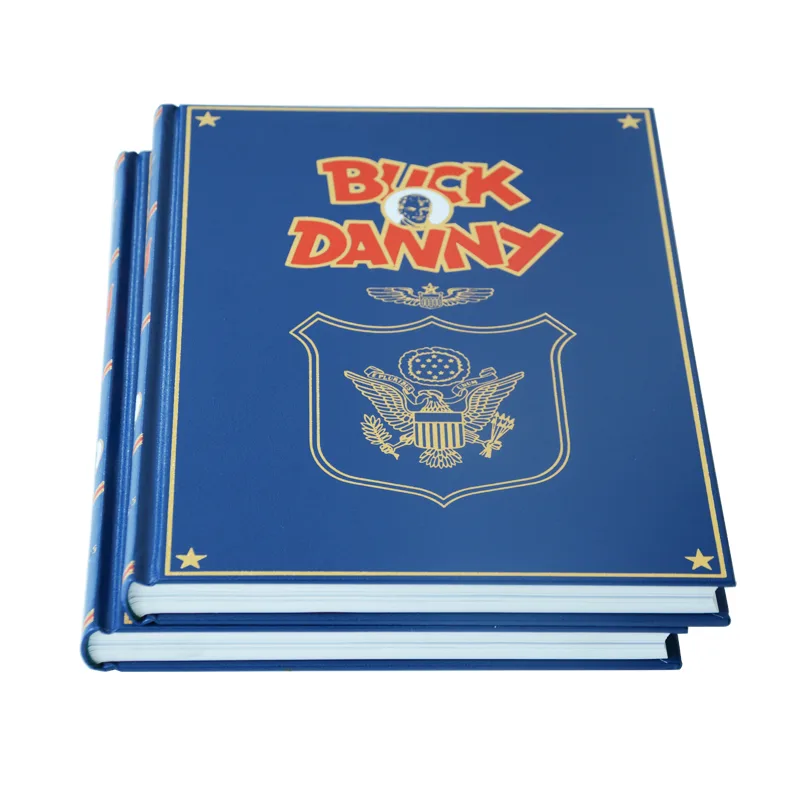
When your team plans a premium-format run, use the specification structure from hardcover book printing requirements as your baseline, then send your custom differences on top of that baseline.
For tighter prepress predictability, specify trim size tolerances (for example, ±1 mm), target MOQ tiers (such as 500 / 1000 / 3000), and expected proof turnaround windows (for example, 7-12 days) before the first quote is issued.
How to Normalize Two Quotes Before You Compare Prices
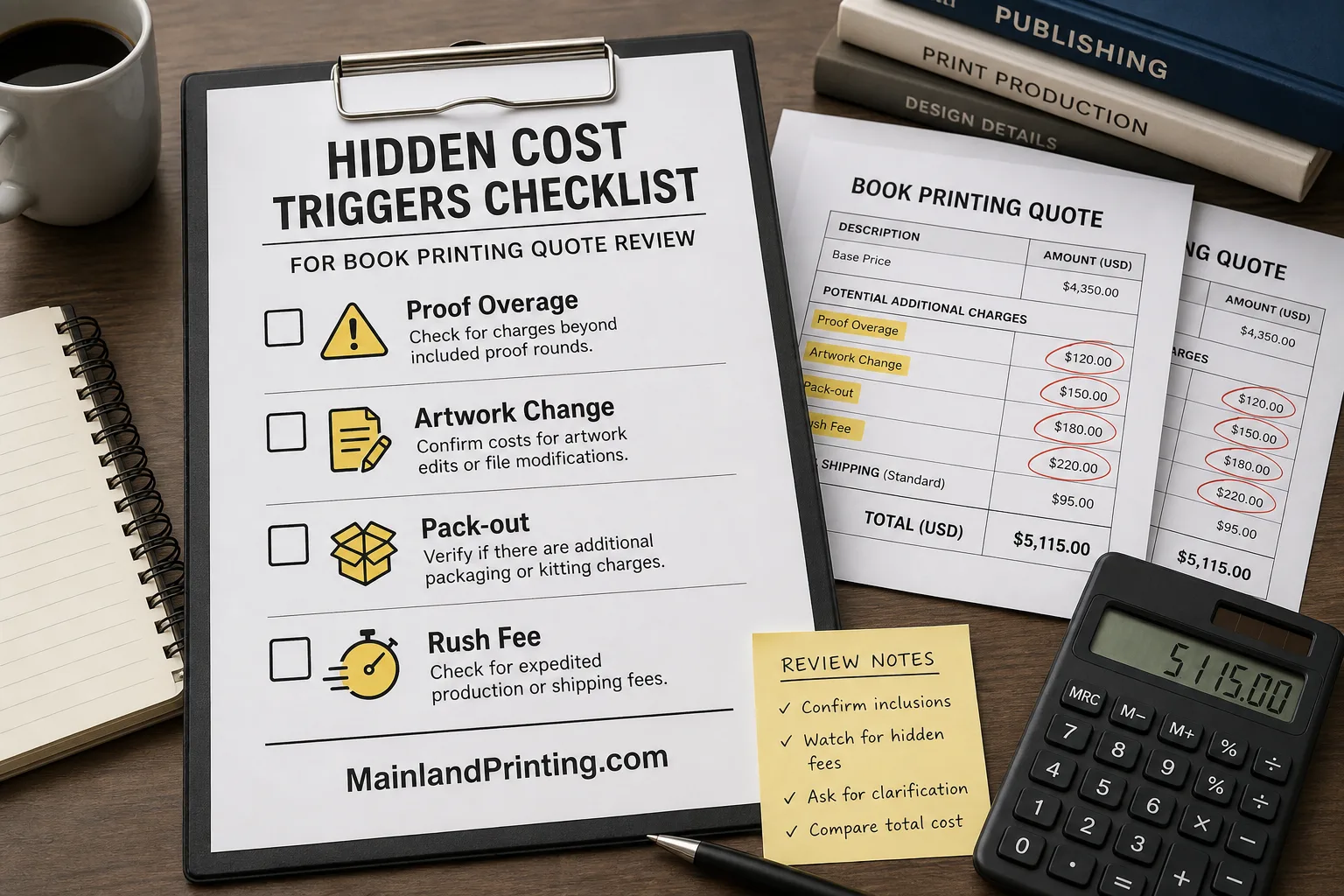
Normalization means forcing all suppliers to quote from the same production assumptions. Without normalization, you are not comparing suppliers. You are comparing different products disguised as the same product.
| Comparison Field | Quote A | Quote B | Decision Note |
|---|---|---|---|
| Trim / page count | Exact | Exact | Comparable |
| Paper and finish | 128gsm + matte | 120gsm + gloss | Not comparable until aligned |
| Shipping term | FOB | DDP | Need landed-cost baseline |
For term interpretation, use Incoterms 2020 rules so your quote comparison reflects real responsibility boundaries.
Red flag: if one supplier quotes 7 days sample lead time and another quotes 14 days but your launch date has no buffer, that gap is not administrative; it is a schedule risk that can convert into rush fees later.
Need a Comparable Quote Package, Not Just a Fast Number?
Share your trim, page count, binding, finishing, and shipping terms in one spec sheet, then request a normalized quote response format.
Hidden Cost Triggers Most Quote Pages Skip
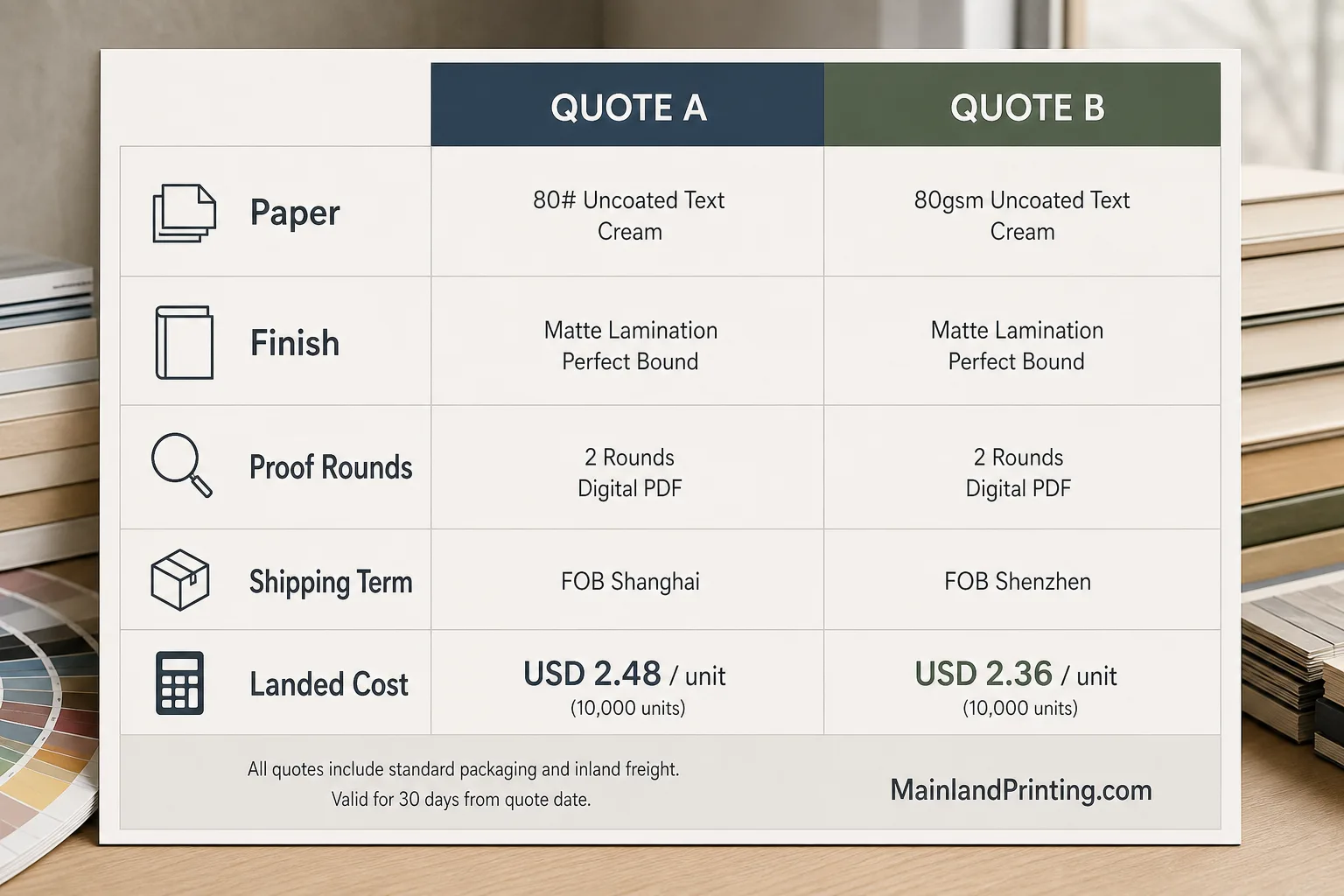
Most quote pages do not clearly state what happens when project scope changes after the first approved file. Yet in real production, scope changes are normal. What matters is whether your quote defines change boundaries in advance.
- Proof-round overage: ask how many rounds are included and per-round surcharge after that cap.
- Late artwork swap: clarify whether replacement files after imposition trigger reset charges.
- Pack-out change: carton split updates can alter labor and freight cubic metrics.
- Schedule compression: rush windows may move your project to surcharge lanes.
Before PO release, ask for a one-page cost trigger matrix listing each trigger, its fee basis, and approval gate. This document is often more useful than negotiating a lower headline unit price.
A Practical Total Landed Cost Model for US Buyers
When teams evaluate overseas printing, they often compare FOB numbers directly against delivered domestic numbers. This creates decision noise. Use a landed-cost model with consistent scope on both sides: production, packing, freight, customs-related steps, domestic final-leg handling, and rework reserve.
For import-process checkpoints and documentation context, align assumptions with US basic import export guidance before booking.
Model your landed cost with measurable blocks: production, export handling, freight, customs, and domestic leg. Then add a small rework reserve percentage so quote review reflects operational reality, not perfect-case assumptions.
Before final approval, verify paper GSM and binding assumptions, measure critical dimensions on sample dummies, and check color tolerance expectations (such as Delta-E acceptance windows) in writing.
The Pre-PO Confirmation Script That Prevents Requote Loops
- Confirm final approved spec revision and attachment version.
- Confirm included proof rounds and overage fee method.
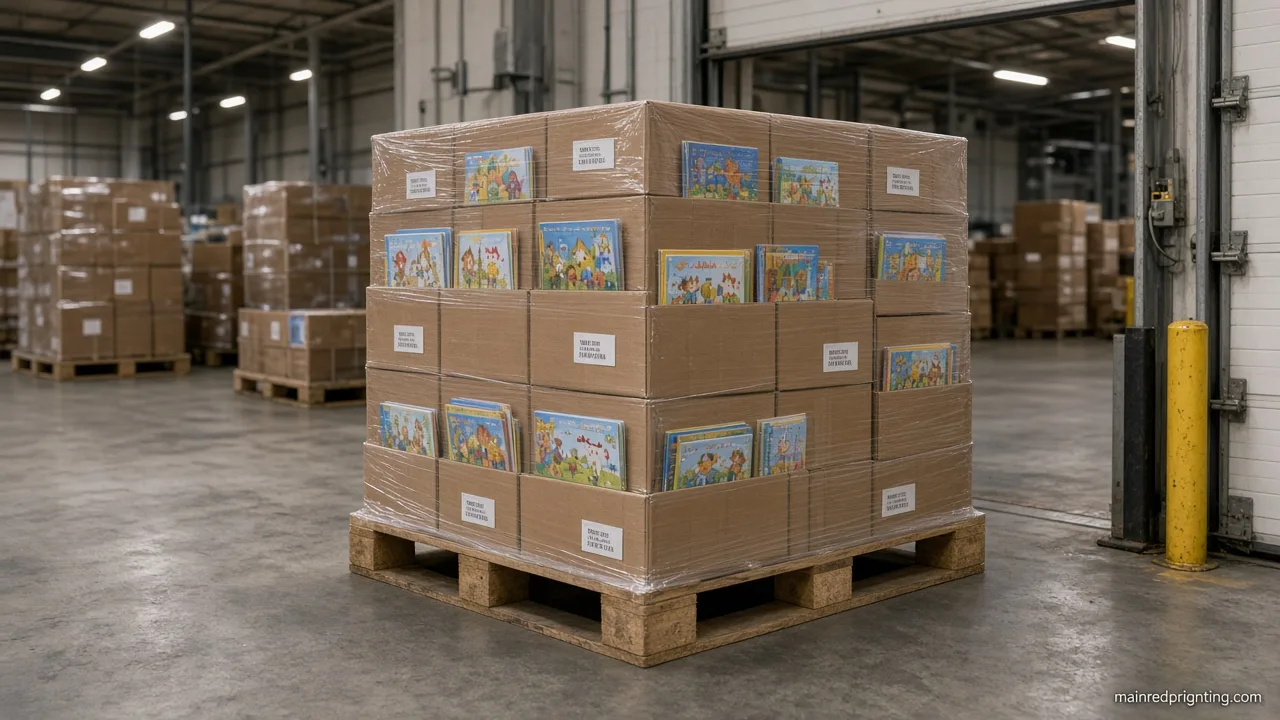
- Confirm carton configuration, label rules, and pallet requirement.
- Confirm Incoterm and destination in writing.
- Confirm change-order path and approval SLA.
Run this script in one shared email thread and ask for explicit acknowledgment line by line.
If your project also includes child-focused formats, align board thickness and edge safety requirements with your children book printing specification notes before final approval.
Frequently Asked Questions
What minimum specs should I send before requesting a quote?
At minimum: trim size in mm, final page count, color scope, paper targets, binding type, finishing map, MOQ tiers, carton rule, destination, and Incoterm.
Why do two quotes with similar unit price still differ in final invoice?
Because included scope can differ: proof rounds, change-order rules, packing assumptions, and logistics ownership often drive the invoice delta.
How many proof rounds should be included?
Most teams should lock at least one physical proof and one revision allowance in writing; beyond that, ask for clear per-round overage fees.
When should I freeze specs and release deposit?
Release deposit only after quote baseline, change-order path, and shipping responsibility are confirmed in one final sign-off thread.
Choose a Quote You Can Operate, Not Just Win
A winning quote is operationally executable from prepress through delivery, with fewer assumptions and cleaner handoffs. Score each supplier on completeness, comparability, and change governance, not only unit price.
If your procurement lead and production coordinator cannot explain the quote in the same way, you are not ready to approve. Resolve ambiguity before deposit, not after print starts.