Book buyers ask for DDP because it sounds like the printer handles everything — freight, customs, duty, delivery to the warehouse. That promise is real, but only some DDP quotes actually deliver it. Many “DDP” offers bundle freight and forwarding, then quietly leave the customs bond, ISF filing, or last-mile drayage on the buyer’s side.This guide breaks down what a real DDP quote for book printing from China should spell out, where vague quotes hide cost, and how to compare DDP against FOB and EXW without getting burned.
DDP means the supplier is responsible for freight, US customs clearance, import duty, and final delivery to your door — and the risk lives in which cost layers your specific quote actually includes, not in the Incoterm itself. Two DDP quotes can look identical on the top line and differ by 15 to 25 percent once you unpack the small print.
Want to see exactly which line items a complete DDP book quote must spell out, and the signals that a “DDP” offer is actually FOB in disguise? The framework below walks through it line by line.
Buyer takeaway
Do not compare DDP quotes as one number. Compare what is bundled, what is excluded, and which party is legally the importer of record.
- If the quote looks high: ask whether port handling, customs bond, ISF, duty, and last-mile delivery are all included, or whether some layers will be invoiced after clearance.
- If the quote looks low: check whether freight is ocean LCL assumed, whether duty is estimated at zero for HTS 4901, and whether customs broker fees are listed at all.
- If this is a reorder: confirm the freight rate is still valid for the new volume, and that packaging and palletization match the first shipment’s customs filing.
What DDP Actually Means for Book Buyers
Under Incoterms 2020 rules, DDP (Delivered Duty Paid) places the maximum responsibility on the seller.The supplier must deliver the goods to the named place in the buyer’s country, clear them for import, pay all duties and taxes, and hand them over ready to be unloaded. For a US-bound book shipment, that means the supplier owns every step from the printing facility in China to your warehouse dock in the US.
That sounds clean, but DDP only works if the supplier has a US customs entity, a forwarder with a US broker partner, and a contract for board book warehouse delivery. A small book printer without those relationships often sells DDP by subcontracting — and every subcontracted layer is a place a cost can hide or a delay can stall.
The reverse is also true. A capable supplier with a true door-to-door DDP setup absorbs customs risk, bonds the shipment properly, and removes your need to file an Importer Security Filing with US Customs and Border Protection yourself. That is what you are paying for.
The 7 Cost Layers Inside a Real DDP Quote
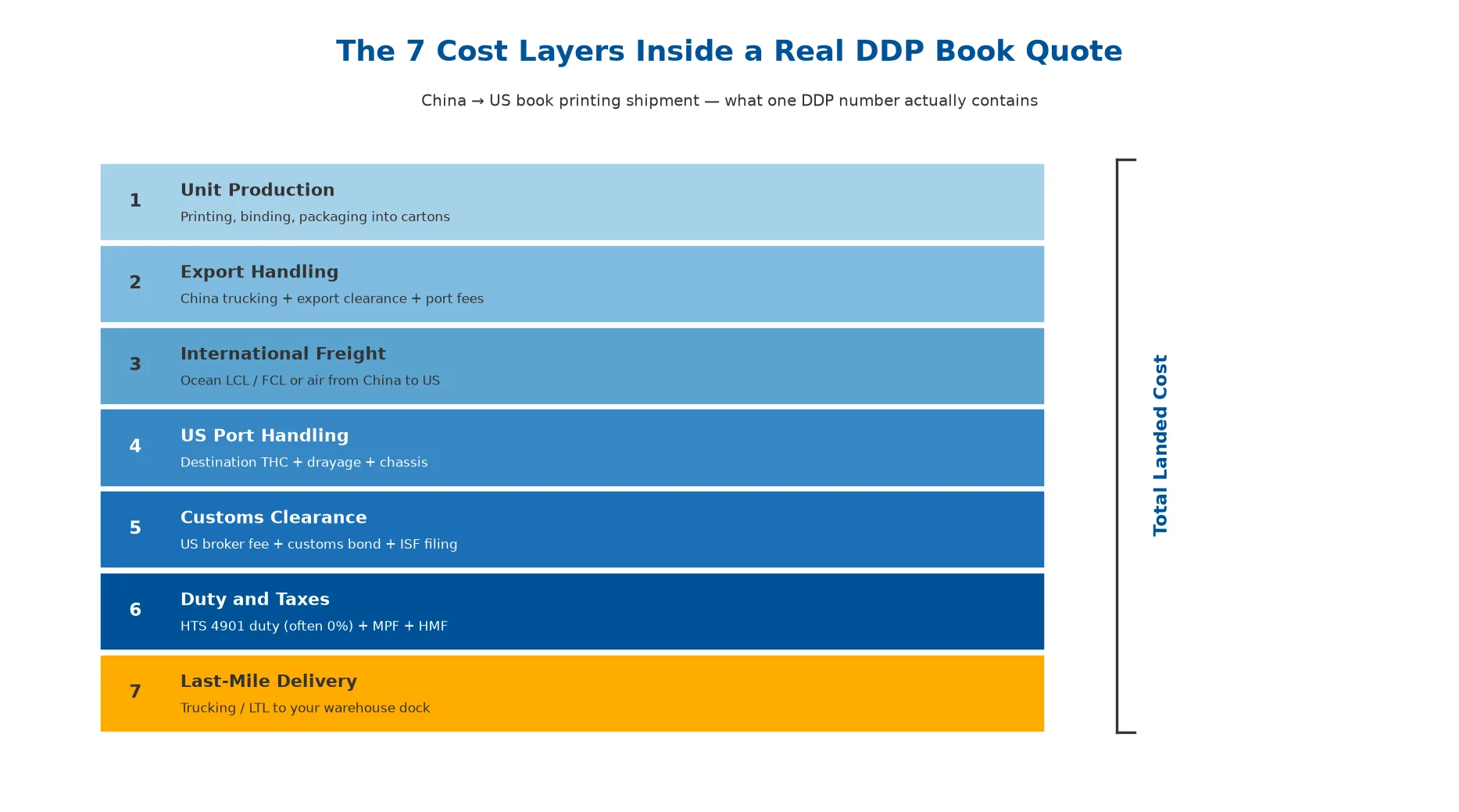
A complete DDP quote is not one number — it is seven layers stacked together. If any layer is missing, the “DDP” price is incomplete and you will be invoiced later.
| # | Cost Layer | What It Covers | Hidden When |
|---|---|---|---|
| 1 | Unit production | Printing, binding, packaging into cartons | Standard finish only; specialty upgrades skipped |
| 2 | Export handling | China domestic trucking, export clearance, port handling | Lumped into freight with no breakdown |
| 3 | International freight | Ocean LCL/FCL or air from China to US port or airport | Quoted as LCL when FCL is cheaper above ~15 CBM |
| 4 | US port handling | Destination THC, demurrage buffer, chassis, drayage | Left as “buyer’s account” on the invoice |
| 5 | Customs clearance | US broker fee, customs bond, ISF, HTS classification | Bond quoted as single-entry only, not continuous |
| 6 | Duty and taxes | US import duty under HTS 4901, MPF, HMF | HTS code chosen loosely; children’s book misclassified |
| 7 | Last-mile delivery | Trucking or LTL from port to your warehouse | Delivered only to port, not to door — DDP in name only |
The layers above are why our deep dive on landed cost for China book printing matters as background reading. DDP is essentially a way to outsource the entire landed-cost model to one supplier — but only if all seven layers are actually inside the quote.
DDP vs FOB vs EXW: The Trade-Off Matrix
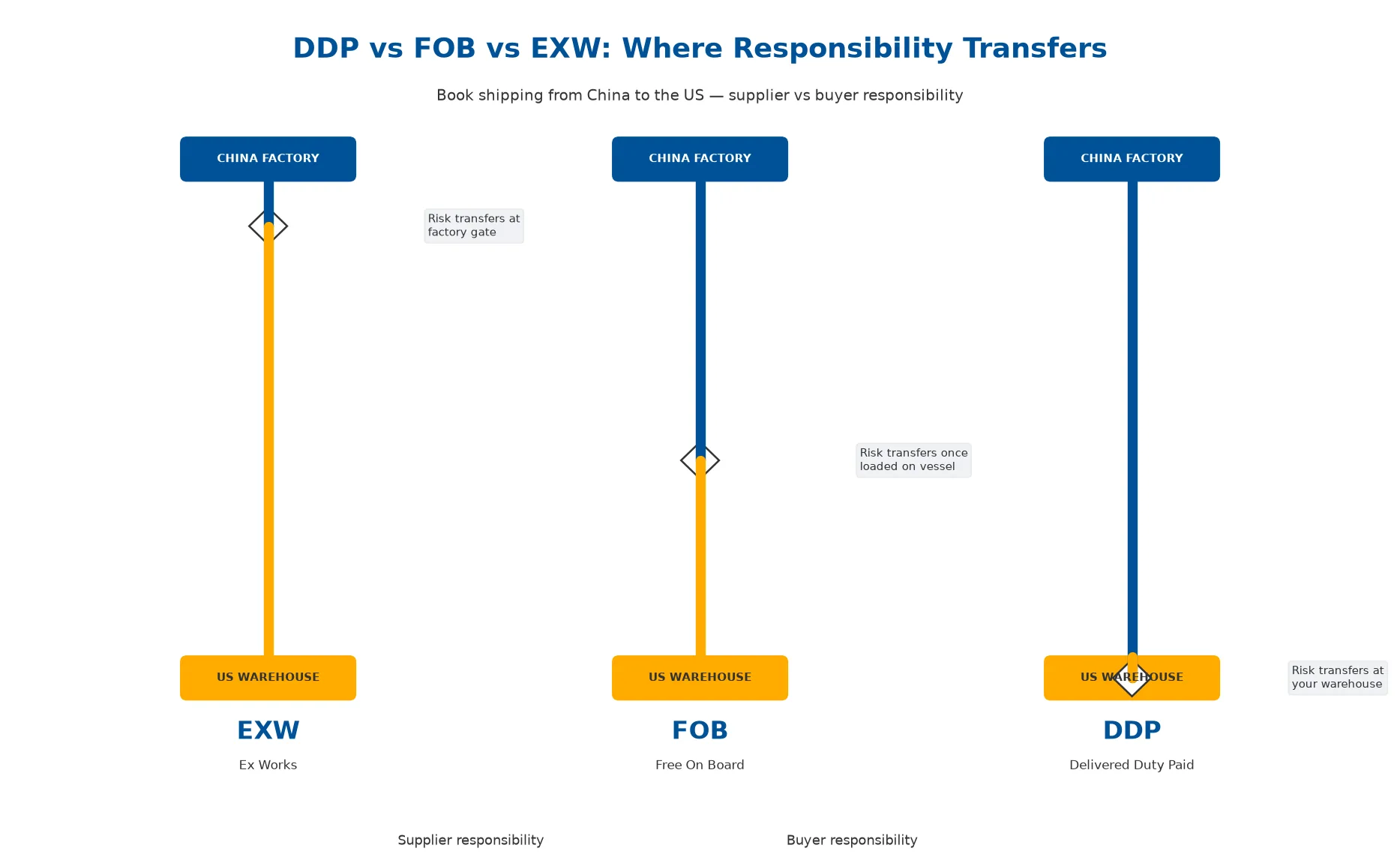
Most book buyers face a choice between three Incoterms: DDP, FOB (Free On Board), and EXW (Ex Works). Each shifts responsibility and cost at a different point.
| Dimension | EXW | FOB | DDP |
|---|---|---|---|
| Risk transfers | At factory gate | Once loaded on vessel | At your warehouse |
| Importer of record | Buyer | Buyer | Supplier or their US entity |
| Customs bond | Buyer sets up | Buyer sets up | Supplier handles |
| Top-line price | Lowest | Middle | Highest |
| True landed cost | Often highest after hidden fees | Varies by your freight contract | Predictable if quote is complete |
| Best for | Buyers with their own forwarder | Buyers with a US broker and freight contract | First-time buyers, Kickstarter creators, small presses |
First-time book buyers often default to DDP because the alternative — setting up a continuous customs bond, signing a freight contract, and finding a US broker — feels intimidating.That is a legitimate reason to choose DDP. The mistake is choosing DDP and then not checking whether the quote actually delivers door-to-door.
If you have already imported books before and have a US broker on retainer, our broader guide to shipping books from China covers the FOB path in more detail. The rest of this article focuses on buyers who want DDP done right.
How to Read a DDP Quote Line by Line
Before you approve any DDP quote, run it through this six-point framework. Each line is a place incomplete quotes stay vague.
- Named place of delivery. The address must match your actual warehouse, not “US Port.” “DDP Los Angeles” is not DDP to your door — it is closer to DAP.
- Incoterm with year. “DDP Incoterms 2020” is the current standard. Older “DDP 2010” wording is still valid but signals an out-of-date contract.
- Freight mode and routing. Ocean LCL, FCL, or air. Origin port (Shanghai, Shenzhen, Ningbo) and destination port (LA, Long Beach, New York, Savannah) should be explicit.
- HTS classification. Most books enter under HTS 4901.91 or 4901.99. The quote should state which 10-digit code will be filed and at what duty rate (often 0% under Column 1).
- Customs bond type. Continuous bond covers multiple shipments; single-entry bond is per shipment and adds up fast if you reorder.
- Last-mile carrier. Trucking from port to your dock is part of DDP. If the quote says “customer pickup at port,” it is not DDP.
The Hidden Cost Signals in Vague DDP Quotes
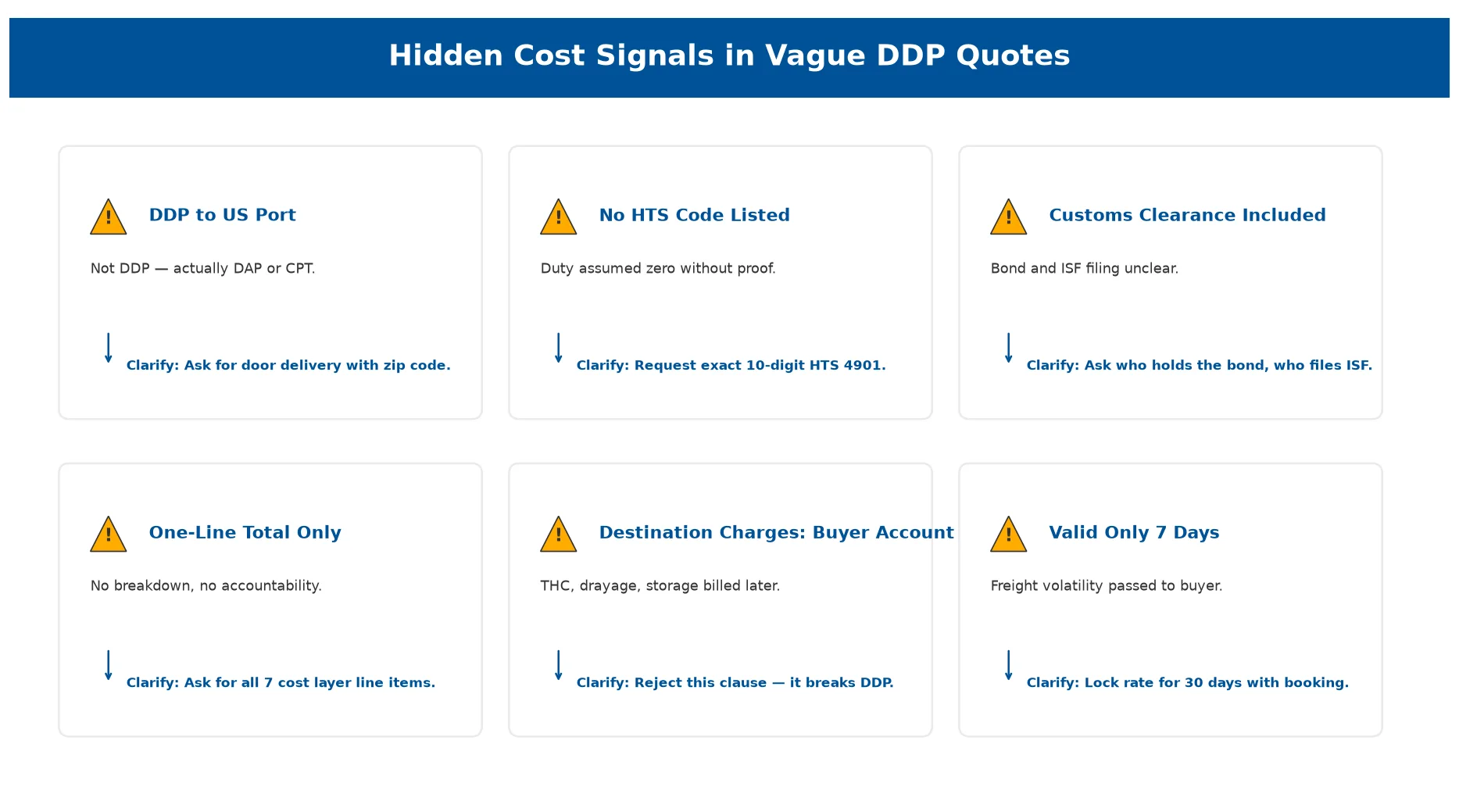
The most dangerous DDP quote is the one that says a single number and nothing else. Here are the signals that “DDP” is actually FOB with a forwarding markup.
| Signal in Quote | What It Usually Means | What to Clarify |
|---|---|---|
| “DDP to US port” | Not DDP — that’s DAP or CPT | Ask for door delivery with zip code |
| No HTS code listed | Duty calculated loosely or assumed zero | Request the exact 10-digit HTS 4901 classification |
| “Customs clearance included” | Broker fee yes, but bond and ISF unclear | Ask who holds the bond and files ISF |
| One-line total only | No breakdown = no accountability | Ask for line items for each of the 7 cost layers |
| “Destination charges at buyer’s account” | THC, drayage, port storage billed later | Reject this clause — it breaks DDP |
| Valid only for 7 days | Freight volatility being passed to buyer | Lock rate for 30 days with booking confirmation |
Each of these signals is a place a supplier can quote low and invoice higher later. The pattern matters: if you see two or more signals in the same quote, treat it as a freight markup, not a true DDP offer.
DDP Shipping Timeline from China to US Ports
DDP door-to-door time depends on origin port, destination port, customs queue, and last-mile distance. The ranges below assume ocean freight, which is the default for full book runs.
| Leg | Typical Time | Where Delays Hide |
|---|---|---|
| Production + carton load | 15 to 35 days | Sample approval, binding queue, finishing |
| China export + ocean transit | 18 to 30 days | Vessel space, transshipment, port congestion |
| US customs clearance | 2 to 7 days | Hold for exam, missing ISF, HTS dispute |
| Last-mile drayage + delivery | 3 to 10 days | Chassis shortage, warehouse appointment |
| Total door-to-door | 25 to 40 days typical | Q4 peak and Chinese New Year extend this |
If a quote promises faster than 25 days door-to-door by ocean, it is probably air freight priced as ocean, or it excludes clearance. Air DDP compresses the full chain to 7 to 12 days but typically multiplies freight cost by four to eight times — viable only for Kickstarter reward tiers where speed beats unit economics.
US Customs, HTS Codes, and ISBN Handling for Books
The good news for book buyers is that most printed books enter the US duty-free under HTS Chapter 49. The catch is that “most” is not “all,” and the wrong subheading can reclassify a children’s picture book as a taxable product.
Printed books, brochures, and leaflets in single sheets or bound form typically classify under HTS 4901.91 (dictionaries, encyclopedias, textbooks) or 4901.99 (other).Children’s picture books usually fall under 4901.99 and enter duty-free under Column 1 rates. Workbooks and interactive learning materials sometimes land under different subheadings, which is why the exact 10-digit code matters.
ISBN registration does not affect customs classification, but it does matter for retail distribution.Make sure each title in your shipment has its ISBN printed on the copyright page and that the manifest matches your catalog. Mismatched ISBNs trigger customs holds even when the duty is zero — the hold itself costs demurrage.
For children’s books specifically, watch the Consumer Product Safety Improvement Act (CPSIA) lead testing rules. A children’s title without a valid Children’s Product Certificate can be held at port even under a clean DDP quote. This is separate from customs duty and is enforced by the CPSC, not CBP.
10-Question RFQ Checklist Before You Approve a DDP Quote
Send these ten questions with your RFQ. A supplier who cannot answer all ten in writing is not selling real DDP.
- Named place of delivery: Can you confirm DDP to my warehouse address at [zip code], not to a US port?
- Incoterm version: Is this quote under DDP Incoterms 2020?
- Freight mode and routing: Ocean LCL, FCL, or air? Origin port, destination port, and carrier?
- HTS classification: Which 10-digit HTS code will you file, and at what duty rate?
- Importer of record: Who is the importer of record — your US entity, your forwarder, or me?
- Customs bond: Is a continuous bond in place, or is this a single-entry bond?
- ISF filing: Who files the Importer Security Filing 24 hours before vessel loading?
- Destination charges: Are THC, drayage, port storage, and last-mile trucking all included?
- Quote validity: How long is the freight rate locked, and what triggers a re-quote?
- Liability for delay: What happens if customs holds the shipment for exam — who pays demurrage?
If you have answered these and still want to compare against a non-DDP path, our analysis of US domestic vs China offshore printing walks through the full landed-cost math on the other side.
Get a Real DDP Book Printing Quote
When DDP Saved the Project — and When It Backfired
The first scenario is a Kickstarter creator who shipped 5,000 hardcover art books under a true DDP contract. The supplier’s forwarder had a US entity, a continuous bond, and a contracted drayage partner.The books cleared customs in three days, delivered to the creator’s 3PL in Pennsylvania on day 32 from vessel departure, and rewards shipped to backers within the promised window. DDP cost roughly 11 percent more than FOB, but the creator had no broker relationship and no capacity to manage customs — DDP absorbed that risk entirely.
The second scenario is a small publisher who accepted a “DDP” quote that turned out to be DDP to Los Angeles port. The supplier’s forwarder had no US broker partner and no last-mile contract.The publisher got a call eight days after arrival from a third-party drayage company demanding payment for chassis rental, port storage, and trucking to their Texas warehouse. The final invoice was 18 percent above the quoted DDP price, and the publisher spent two weeks resolving the customs bond issue.
The difference was not the Incoterm. Both quotes said DDP. The difference was whether the seven cost layers were spelled out, and whether the supplier had the US-side infrastructure to actually deliver door-to-door.For more on the inventory-side consequences of getting this wrong, our DDP inventory strategy for Q4 launches unpacks the timing risk in detail.
Frequently Asked Questions
What does DDP mean when shipping books from China to the US?
DDP means the supplier is responsible for freight, US customs clearance, import duty, and final delivery to your door. The buyer’s risk is low only if the quote spells out every cost layer, including customs bond, port handling, and last-mile delivery.
Is DDP cheaper than FOB for book printing?
DDP is not automatically cheaper or more expensive than FOB. DDP gives you one landed number with less paperwork; FOB gives you a lower ex-works price but you pay freight, duty, and customs broker fees separately. Compare total landed cost, not unit price.
What is the US import duty on printed books from China?
Most printed books classified under HTS 4901.99 enter the US duty-free under Column 1 rates.Children’s picture books, hardcovers, and trade books usually qualify, but you must confirm the exact 10-digit HTS code and country-of-origin rules with your customs broker.
How long does DDP shipping from China to the US take?
Door-to-door DDP shipping typically takes 25 to 40 days by ocean freight from Shanghai or Shenzhen to LA, Long Beach, or New York, plus customs clearance and last-mile delivery. Air freight DDP can compress this to 7 to 12 days, but at a much higher cost.
Who needs a US customs bond for DDP book imports?
Under DDP, the supplier or their freight forwarder is responsible for the US customs bond, importer of record filing, and duty payment. Confirm in writing which party holds the bond and how ISF (Importer Security Filing) is submitted 24 hours before vessel loading.
Choosing DDP for your book run is a trade between price and absorbed risk. The Incoterm itself is sound — the work is in confirming that your specific quote covers all seven cost layers, names a real door delivery address, and assigns a real importer of record.Get those three things in writing, and DDP becomes the cleanest way to bring a finished book from a Chinese press to a US warehouse. Skip them, and you are back to managing the same freight, customs, and drayage chain DDP was supposed to remove.