Shipping board books from China is not a separate project from printing. Carton cube, proof timing, duty classification, and last-mile warehouse delivery all change the unit economics before you approve mass production.
For most US-bound board book runs, DDP works when your quote lists printing, inland China haul, ocean or air freight, US customs clearance, applicable duty, insurance, and delivery to a named US warehouse or address—after you verify HTS 4903 eligibility, carton dim weight, and a written timeline from final sample approval to dock receipt.
Below you will find a stage timeline, HTS duty checklist, carton math for thick board books, a DDP versus FOB responsibility matrix, and a quote review list you can use before deposit.
What DDP delivery means when you print board books in China
Delivered Duty Paid (DDP) means the seller arranges transport and bears cost and risk until goods arrive at the place named in the contract, with import clearance and applicable duties paid unless you agree otherwise in writing.For board books, that usually means the printer or their freight partner quotes one landed figure that should cover production plus logistics to your US warehouse, fulfillment center, or distributor dock.
That sounds simple, but board books are heavy, thick, and carton-sensitive. A quote that only shows a unit print price plus a flat “DDP shipping fee” can hide carton inefficiency, dim-weight charges, or duty assumptions you cannot verify.When you compare board book printing routes, ask for the delivery term, consignee address, and every cost bucket—not only the headline total.
Official Incoterms definitions are maintained by the International Chamber of Commerce and remain the reference point when a supplier says “DDP included.” Use that framework when you read whether customs formalities, duty, and inland US delivery sit with the exporter or with you.
Timeline from proof approval to US warehouse delivery
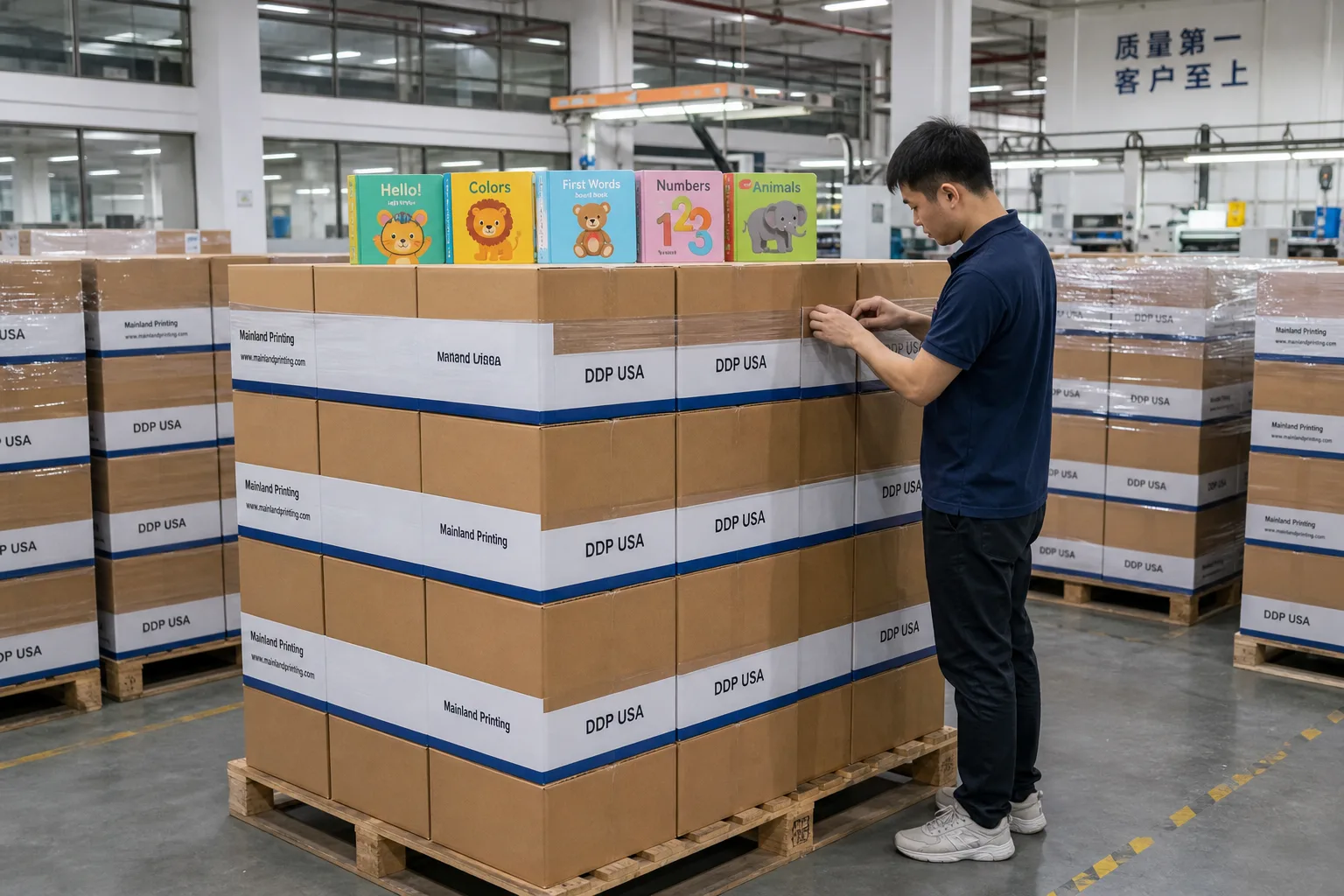
Board book projects rarely fail on ocean transit alone. They slip when sample approval, reprint windows, and carton packing are treated as open-ended. Build your schedule backward from the warehouse receipt date you need for launch or retailer routing.
A practical DDP timeline has six checkpoints: RFQ with trim size and carton target, prepress and digital proof, physical sample or wet proof, mass production slot, export packing and customs prep, then vessel or air departure and US inland delivery.If your title includes rounded corners, special lamination, or a heavy cover board, add buffer after physical sample approval because re-plating or re-cutting can cost one to two production weeks.
| Stage | Typical range | What delays the next step | DDP quote must specify |
|---|---|---|---|
| Digital proof approval | 2–5 business days | Artwork bleed, spine board layout, color revision rounds | Included proof rounds and response SLA in hours |
| Physical sample approval | 7–14 days after digital sign-off | Lamination rub, corner radius, opening resistance | Courier mode for sample only vs production freight mode |
| Mass production | 15–25 days after sample approval | MOQ slot, handwork, drying time for coating | Production days counted from approved sample, not deposit |
| Export packing and customs prep | 3–7 days | Carton relabel, fumigation if required, ISF/data filing | Who files ISF and commercial invoice fields |
| Ocean transit to US port | 18–32 days door-to-port typical | Peak season, routing, port congestion | Named POL/POD and service string |
| US clearance and warehouse delivery | 5–12 days after vessel arrival | Exam hold, appointment windows, lift-gate needs | Final consignee, lift-gate, pallet count, delivery appointment rules |
Air freight compresses ocean legs but rarely removes proof or production time. If you are planning a holiday launch, confirm carton-ready dates before you lock cover specs—thick board and shrink wrap can push packing later than the print line shows on a Gantt chart.
Duties, HTS 4903, and what your quote must include
Many children’s picture and board books fall under HTS heading 4903 when they meet the tariff text for certain printed books. That matters because duty can be zero for qualifying titles, yet your DDP quote should still show a duty line—even if the amount is $0—so you can audit classification before cargo departs.
Do not assume “children’s book” marketing language equals HTS 4903 eligibility. Sets that mix books with toys, non-print inserts, or non-qualifying formats can land in a different heading. Mixed-SKU cartons create the highest audit risk because one misclassified line can hold clearance.
| HTS 4903 self-check | Pass | Fail / escalate |
|---|---|---|
| Product is a printed book, not a toy-dominant set | Board book block with reading function as primary purpose | Plush, electronics, or play kit drives value and classification |
| Commercial invoice description matches physical SKU | Title, format, page count, binding type listed per line | Generic “books assorted” with mixed formats inside cartons |
| Country of origin marked and traceable | Made in China label matches manufacturer on invoice | Repack or commingled inventory without origin support |
| DDP duty line on quote | Shows HTS code used, rate, and $0 or calculated duty | “Duty included” with no code, no broker name, no liability note |
Cross-check heading text on the official USITC HTS database before you approve the commercial invoice template. If your broker or supplier chooses a different code, get the rationale in writing and reconcile it against the physical sample and carton contents.
Red flags that should pause shipment: duty shown as a flat percentage with no HTS code, invoice value that excludes print cost components you already paid, or a DDP quote that assumes you will act as importer of record without signing explicit authorization.
Buyer takeaway
Treat HTS 4903 as a quote line item, not a marketing claim. If duty is “included” but no code, broker, or $0 calculation appears on the proforma, your DDP price is not yet auditable.
Need board book printing with a clear US delivery plan?
Share trim size, quantity tiers, carton target, and warehouse address. Mainland Printing can quote production and DDP routing together so freight math is visible before you approve the sample.
Carton density, dim weight, and freight math for thick board books
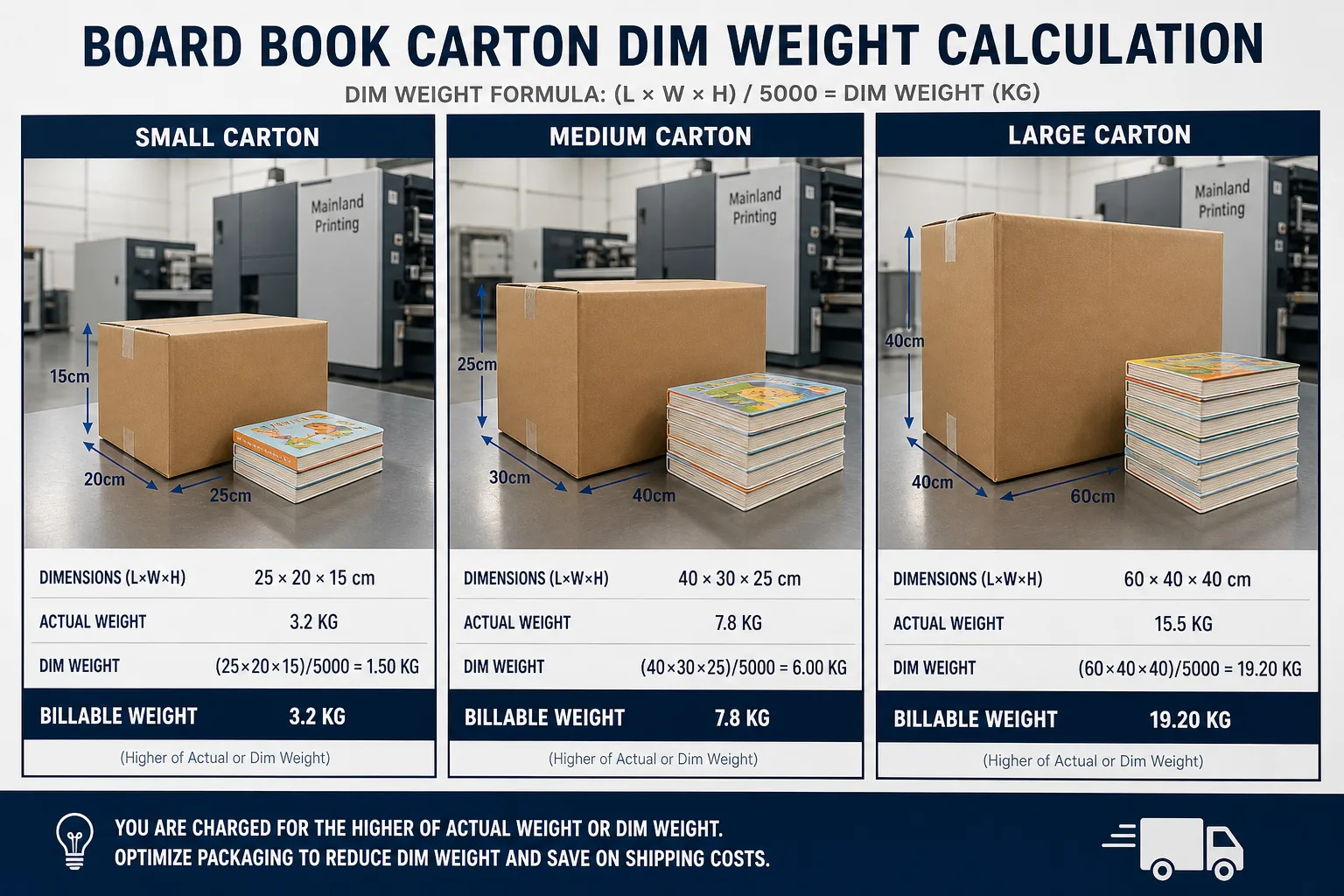
Board books consume carton volume faster than paperback titles. Freight carriers bill on actual weight or volumetric weight, whichever is higher. If your cartons cube out before they weigh out, your DDP cost per book rises even when the print unit price looks competitive.
Start with the factory’s proposed master carton: length × width × height in centimeters, books per carton, and gross weight with corner protectors and dividers.Calculate volumetric weight in kilograms as L × W × H ÷ 5000 for many air and express formulas, and ÷ 6000 for some ocean LCL conversions—confirm which divisor your forwarder uses in the quote.
| Example trim | Books / master carton | Carton size (cm) | Gross weight (kg) | Dim weight @ ÷5000 (kg) | Billable basis |
|---|---|---|---|---|---|
| 6 × 6 in board book, 12 spreads | 40 | 32 × 32 × 28 | 14.2 | 5.7 | Actual weight |
| 8 × 8 in board book, 16 spreads | 24 | 42 × 34 × 30 | 15.8 | 8.6 | Actual weight |
| 8 × 8 in hardcover board book | 18 | 44 × 36 × 34 | 13.1 | 10.8 | Actual weight, borderline on air |
| Oversize 10 × 10 in title | 12 | 52 × 40 × 36 | 11.4 | 15.0 | Dim weight on air/express |
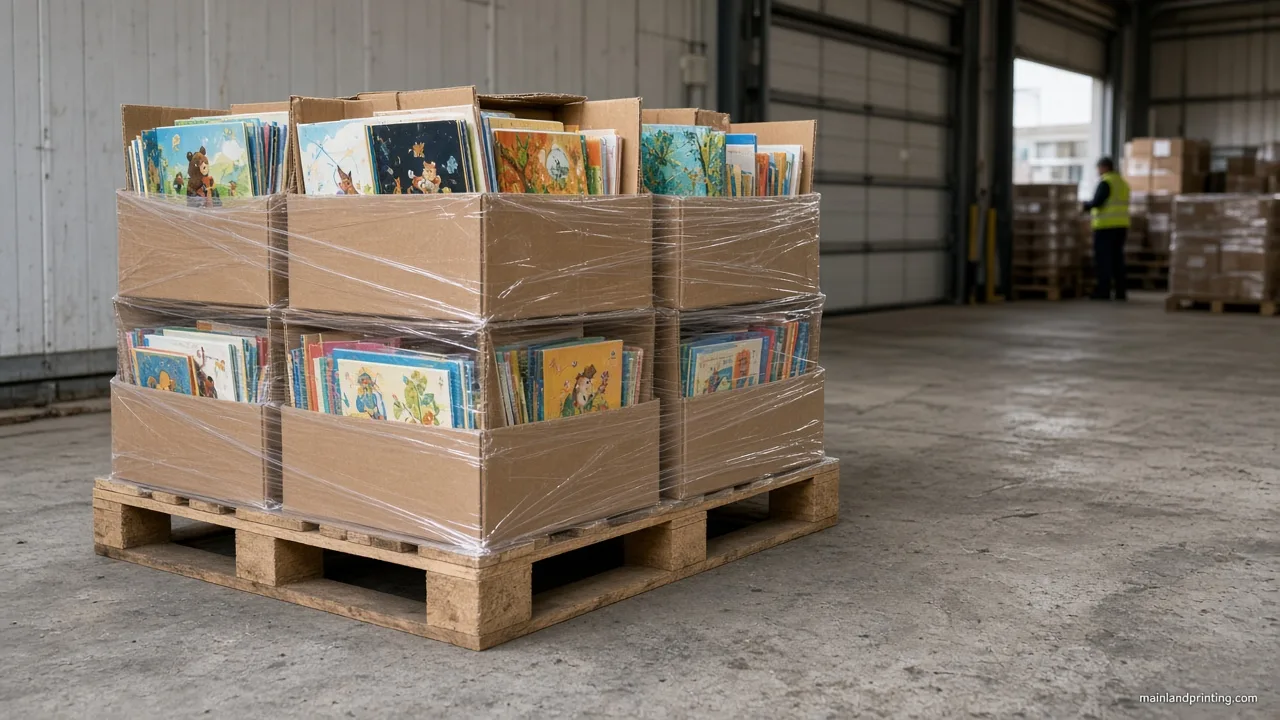
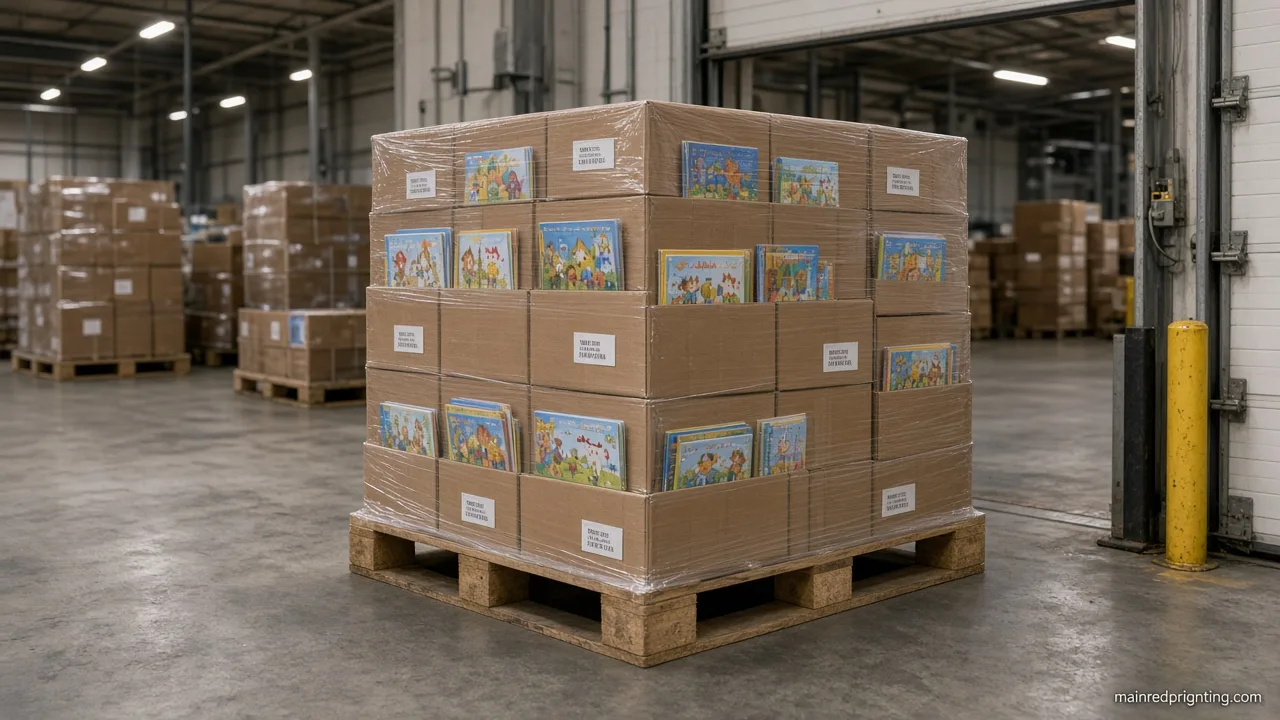
On the production floor, carton plans should be frozen at sample approval. Changing books-per-carton after printing starts can invalidate the freight tier you priced.Ask the project manager to confirm corner protectors, double-wall carton grade, and whether shrink wrap adds measurable height before you accept a DDP per-carton rate.
Pair this math with your print quote review habits in the book printing quote guide so packaging, inspection, and freight stay in one spreadsheet instead of three email threads.
who owns each cost and risk
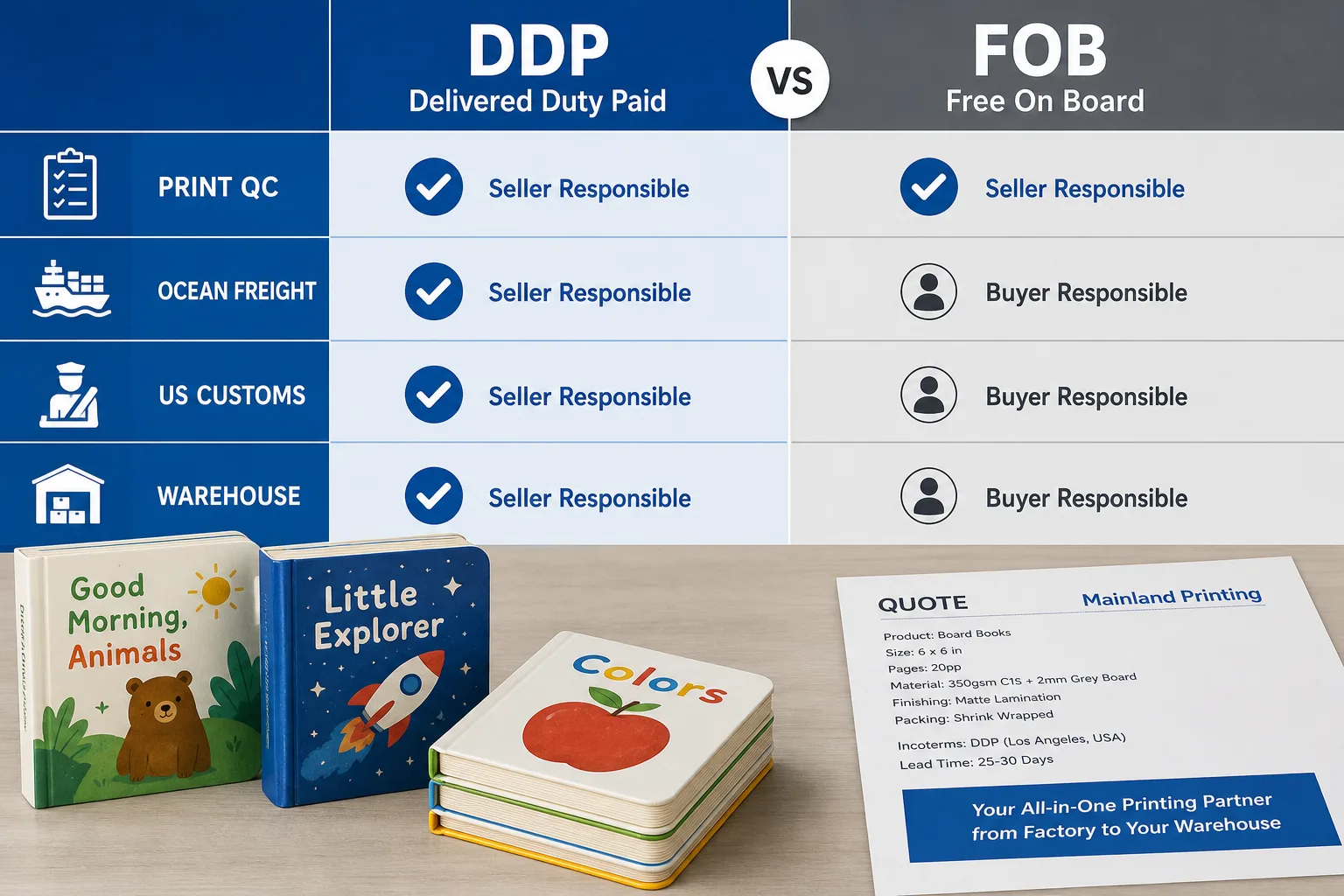
FOB (Free On Board) stops seller responsibility when goods are loaded on the vessel at the named port in China.You—or your broker—take over ocean freight, insurance, clearance, duty, and US delivery. DDP pushes those downstream costs back to the seller side of the quote, which is convenient when you want one invoice from the printer.
Convenience is not the same as transparency. A DDP quote should still mirror the same line items an FOB buyer would budget, so you can compare apples to apples across suppliers.
| Cost / risk bucket | DDP (seller-led) | FOB (buyer-led) |
|---|---|---|
| Printing and QC | Seller | Seller |
| Inland China to port | Seller | Seller to port only |
| Ocean or air main leg | Seller arranges, buyer should still see rate basis | Buyer broker |
| US customs clearance | Seller’s broker, buyer verifies HTS | Buyer broker |
| Duty and MPF/HMF | Seller unless contract carves out | Buyer |
| Warehouse delivery appointment | Seller to named address | Buyer after pickup |
For Incoterms wording and transfer-of-risk language, refer to the ICC Incoterms rules when your contract or proforma invoice cites DDP or FOB.If you only need domestic fulfillment after import, DDP to a 3PL warehouse is usually simpler; if you already hold a US customs broker relationship, FOB can expose freight savings—provided you model carton data yourself.
Cover construction changes cube, so compare packaging notes in the board book cost guide before you treat two DDP totals as comparable.
Quote review checklist before you sign
Use this Pass/Fail list on every DDP board book quote, regardless of supplier. If more than two line items are missing, treat the headline price as incomplete—not cheap.
| Line item | Pass | Fail signal |
|---|---|---|
| Unit print price by quantity tier | Shows MOQ and next break points | Single quantity only, no reprint tier |
| Sample and proof fees | Lists digital, physical, and revision limits | “Free sample” with no courier or tooling note |
| Carton specification | Dimensions, books per carton, gross weight | Freight priced without carton plan |
| Freight mode and transit window | Ocean vs air named with port pair | “DDP by sea” only, no days range |
| Duty and HTS code | Code, rate, broker responsibility stated | Duty omitted or “TBD at port” |
| Insurance | Coverage basis on cargo value | No mention of damage or shortage claims |
| US delivery details | Full address, lift-gate, pallet count | “Delivered USA” without zip or warehouse rules |
| Inspection and replacement terms | Defect threshold and claim window in days | No QC reference photos or acceptance standard |
Before you lock materials, align color and safety planning with board book safety requirements so production, testing, and carton marks stay consistent on the commercial invoice.
Frequently asked questions about DDP board book shipping
What MOQ is realistic for a first DDP board book run?
Many board book lines start near 500–1,000 copies for offset production, with digital routes available below that for trial titles. MOQ should be stated beside the DDP freight tier because a low unit price at an MOQ you cannot sell through is not a workable landed cost.
How do I compare two DDP quotes that look identical?
Normalize carton data first: books per master carton, gross weight, and warehouse zip. Then compare proof rounds, HTS treatment, insurance, and whether reprints share the same freight assumptions. A lower print cent per unit can lose once dim weight or duty handling differs.
Should I air freight board books for a launch deadline?
Air helps when ocean transit misses a fixed on-sale date, but dim weight bites oversize board books harder than small trim titles. Request both modes with the same carton plan so you see whether production time—not freight— is the real bottleneck.
Who is the importer of record under DDP?
Under a standard DDP arrangement, the seller’s customs broker typically files entry, but liability should be explicit in your contract. If you need to own the HTS decision, require the broker name, entry type, and classification worksheet before cargo sails.
DDP shipping for board books works when printing specs, carton math, duty classification, and warehouse delivery are quoted as one auditable package—not a footnote under unit price. Use the timeline, HTS checks, and line-item checklist here to approve the sample and the freight plan in the same review cycle.