You are not really stuck on “80 or 100 gsm.” You are stuck locking paper to the pens your users will actually write with—before a rushed RFQ freezes the wrong stock and the cover everyone loved cannot save the writing feel.
Choose custom notebook paper by the pens users will write with, then lock GSM with opacity and sizing—not GSM alone. Ballpoint kits often clear at 70–80 gsm; gel and dual-side notes usually need 80–100 gsm; fountain pens and markers typically need 90–100 gsm plus a dual-side writing sample.
Keep reading and you will walk out with a pen-to-paper match, a way to separate ghosting from true bleed, a writing-sample gate you can run tonight, and the RFQ fields that keep page count and freight from fighting your paper upgrade.
Start With Writing Tools, Not GSM Alone

When you open with “what gsm?”, you skip the question that predicts complaints: which pens will sit on these pages for the next 30–90 days?
GSM (grams per square meter) is the industry weight number for paper—see paper grammage explained—but it does not, by itself, guarantee the opacity, ink holdout, or hand-feel your brand needs.
Write the tool mix on the RFQ before you debate a number: ballpoint-only giveaways, gel for daily desk notes, fountain pens for a journal line, or markers for workshops.
| Your writing job | Keep this path | Switch when |
|---|---|---|
| Ballpoint / pencil giveaways | 70–80 gsm bright white, cost-first | Marketing still promises “fountain-pen ready” |
| Gel / fineliner daily notes | 80–100 gsm; plan dual-side use | You only tested one side with a dry ballpoint |
| Fountain pen journal line | 90–100 gsm + sizing confirmed on sample | You freeze “100 gsm” with no wet-ink test |
| Marker / brush workshop kit | 100 gsm+; expect fewer pages or higher freight | Budget still assumes 192 thin pages at giveaway cost |
When you once quoted “100 gsm fountain stock” because a retail review loved that number, then approved a ballpoint-only sample, the wet-ink SKU failed on the first influencer unboxing. Name the tool mix first; the gsm band second.
If your design team already fell in love with a cream 120 gsm swatch while the program is a one-day booth handout, Hold the upgrade until the job column matches. Paper fights that start with pretty chips usually end in a remake you pay for twice.
Match GSM Ranges to Common Writing Jobs
When you need a starting band—not a religion—use ranges as hypotheses you still prove on paper, not as marketing claims.
| GSM band | Usually fits | Watch this trade-off |
|---|---|---|
| 70–80 gsm | Short-cycle giveaways; ballpoint notes | Ghosting rises on dual-side gel; do not sell as pen-luxury |
| 80–100 gsm | Most brand desk notebooks; gel + light fountain | Confirm opacity and sizing—weight alone can still show through |
| 100–120 gsm | Fountain / marker leaning lines; VIP journals | Fewer pages or thicker spine; freight climbs |
| 120 gsm+ | Heavy ink / light mixed media | Wrong for mass handouts unless you cut page count on purpose |
When you upgraded every SKU to 120 gsm “to be safe,” then kept a 192-page target, the carton weight broke the gift-kit freight model. Prefer a 100 gsm dual-SKU plan: one fountain-ready VIP book, one 80 gsm event book—same cover art family, different paper lines on the PO.
Before you approve the higher band, ask packing for one estimated carton weight at your target quantity. A paper upgrade that looks free on the unit line often shows up as dimensional weight 10–14 days into production.
If you need the lbs/pt conversion for mixed US–China quotes, use the paper weight conversion guide so buyers and plants argue from the same number system.
Red flags before you “just bump gsm”:
- Page count stays fixed while gsm jumps two bands with no freight check.
- Marketing copy says fountain-ready; sample kit only includes ballpoints.
- Cream vs bright white is undecided, but full-color inner prints are already approved.
- You compare a coated retail sheet to an uncoated factory stock by gsm only.
Separate Opacity Ghosting From True Bleed
When you say “it shows through,” you may be mixing two failures—and they need different fixes.
- Bleed-through: ink soaks to the reverse and can smear or stain; fix with denser stock, better sizing, or a wetter-ink ban.
- Ghosting (show-through): you see the other side’s writing as a shadow without wet penetration; fix with opacity, color (cream often hides less glare but is not magic), or accept single-side writing.
- Feathering: lines go fuzzy along fibers; fix with surface sizing/coating and ink choice—not only heavier gsm.
When you rejected a 90 gsm sheet for “bleed” after seeing shadows under phone light, you may have killed a workable opacity grade. Hold the reject until you mark bleed vs ghost on the sample sheet in two columns.
For coating and opacity pairing beyond this writing focus, keep opacity and coating matching open beside your swatches so print-side and write-side teams do not invent two specs.
Test under the same light you will use for approval photos. A sheet that “looks fine” in warm office light can fail under cool LED product shots your brand posts later—so your sample light and your launch light must match.
If your brief allows single-side writing only, say so in writing. Quiet dual-side expectations are how mid-gsm sheets get labeled “bad paper” after users flip every page.
Pair Ruling Choices With Your Paper Spec
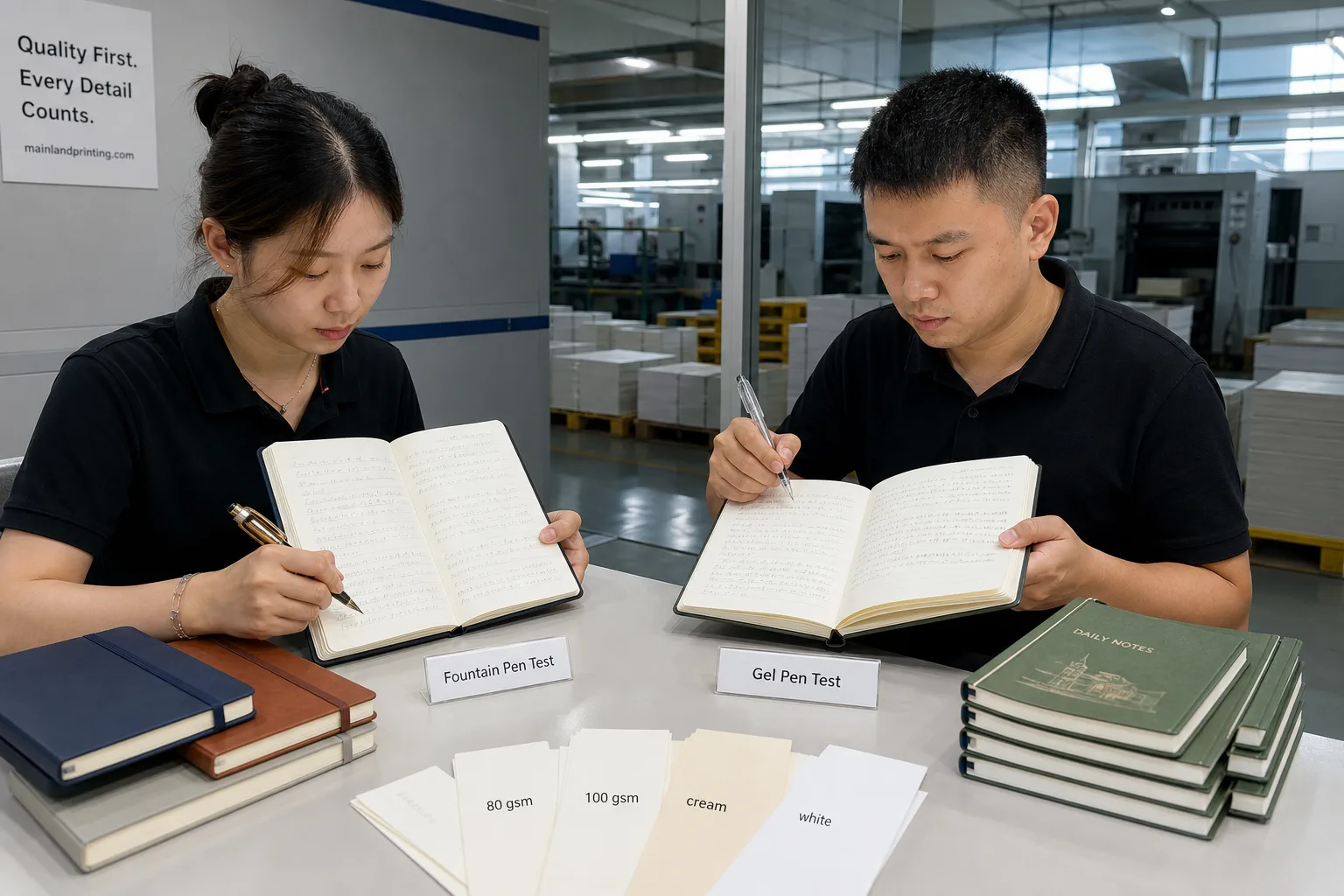
When you pick lined, dot, grid, or blank after the paper is frozen, you often discover that light gray rules disappear—or fight show-through—on the stock you just locked.
| Ruling | Works best when | Paper note |
|---|---|---|
| College / wide lined | Meeting notes, training cohorts | On thinner stock, dark ink + dark rules can feel busy; soften rule color |
| Dot grid | Planners, sketch-plus-notes | Dots hide ghosting better than heavy lines on mid gsm |
| Solid grid | Tech / STEM brand kits | Needs cleaner opacity so charts stay readable both sides |
| Blank | Sketch / workshop books | Marker users push gsm and sizing harder—sample early |
When you approved pale 20% gray dots on an already translucent 70 gsm sheet, users said the page looked “dirty” once gel ink ghosted underneath. Pair ruling tint with opacity on the same sample spread.
If you still need layout hybrids, watermarks, or planner sections, use the deeper inner page layout guide—this article stays on writing performance and the paper lock.
Need a paper and writing sample plan for your notebook run?
Share your pen mix, page-count target, size, and quantity tiers. Mainland Printing can map GSM, opacity, and ruling before you freeze the RFQ.
Run a Writing Sample Before You Lock Specs
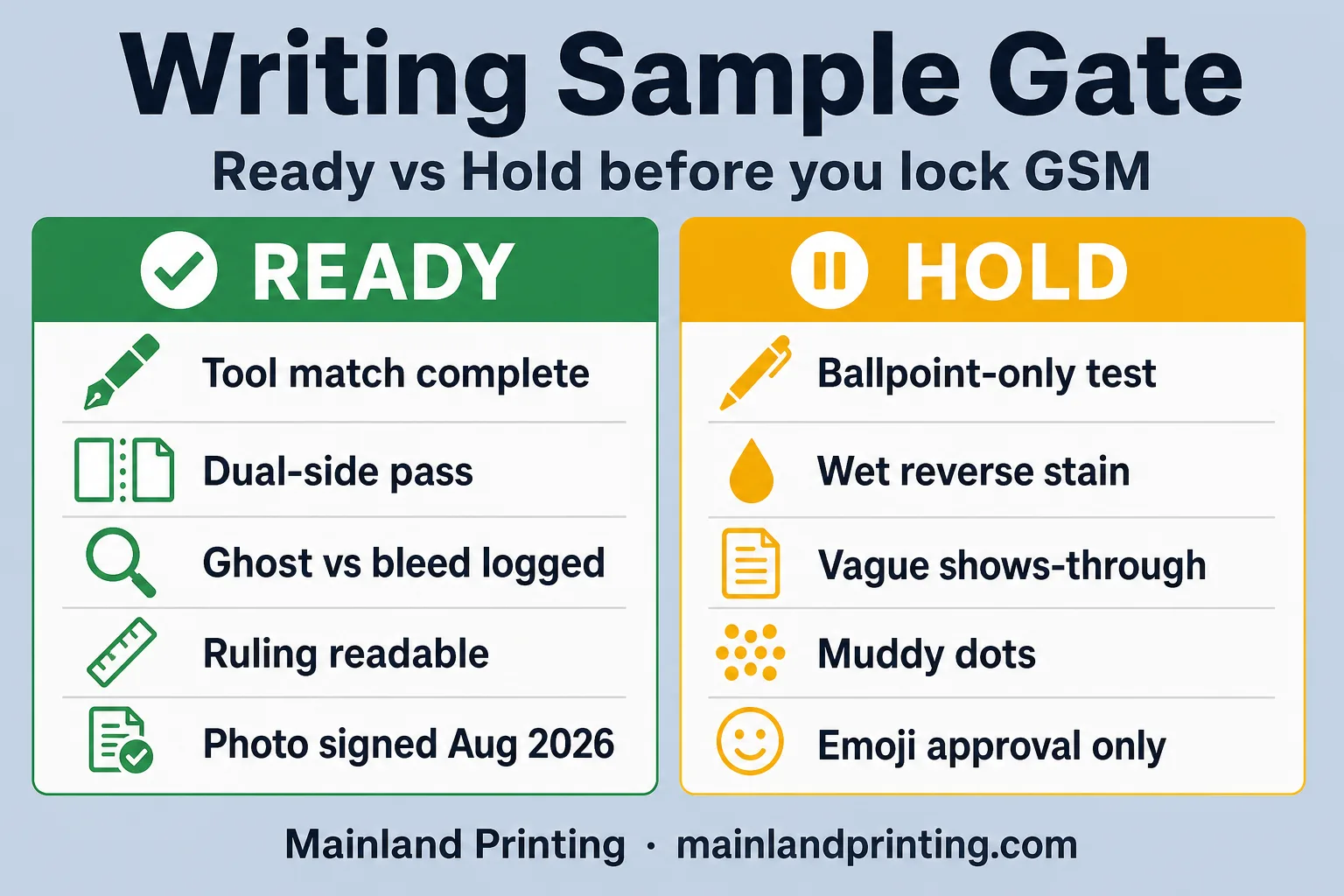
When you lock paper from a swatch book photo, you skip the only test users will run: real ink, both sides, your ruling, your light.
| Check | Ready if | Hold if |
|---|---|---|
| Tool match | You wrote with every pen named on the brief | Only ballpoint was tested for a fountain claim |
| Dual-side pass | Back side usable after 5–10 min dry time | Wet transfer or heavy stain on reverse |
| Ghost vs bleed log | Each failure labeled ghost or bleed in writing | Team only says “shows through” |
| Ruling + paper pair | Rules/dots still guide without looking muddy | Rules vanish or clash with ghosting |
| Sign-off photo | Both sides shot under agreed light, dated | Approval is a Slack emoji on a crop |
When you once shipped bulk after a cover proof only, then support tickets blamed “cheap paper,” the plant had never seen your fountain pen on that lot. Run the five Ready/Hold lines on one bound dummy—or at least a printed signature—before you release plating money.
Ask the factory to write the mill name, gsm, color, and sizing note on the sample packet. A vague “notebook paper, 100 gsm” line is how two lots diverge between pilot and mass—and how your writing feel drifts without anyone changing the PO number.
Keep that packet ID when you run the brand notebook sample gate so writing paper sits beside cover, binding, and version checks before bulk.
If stakeholders disagree on “good enough,” force one signed photo of both sides under the agreed light. Without that artifact, every later complaint becomes a taste argument instead of a spec miss.
Freeze Paper Fields on Your Notebook RFQ
When your RFQ only says “custom notebook, good paper,” every supplier fills the blank differently—and your quotes are not comparable.
| RFQ field | Write this | Why it saves you |
|---|---|---|
| Writing tools | Ballpoint / gel / fountain / marker (name all) | Stops silent under-spec |
| GSM + color | e.g. 100 gsm cream uncoated | Aligns hand-feel and print look |
| Opacity / dual-side | Dual-side required: yes/no + ghosting tolerance | Prevents “looks fine one side” quotes |
| Ruling | Lined spacing / dot pitch / blank + tint % | Keeps rules readable on chosen stock |
| Page count vs freight | Target pages + max packed weight if known | Surfaces gsm upgrades early |
| Sample gate | Writing sample Required before mass | Puts Ready/Hold on the calendar |
When you left page count and gsm as “TBD,” the low bidder won on thin stock and you discovered the gap only after covers were printed. Freeze the six fields above on one line item—then talk MOQ and unit price.
If quantity bands will move with paper cost, peek at notebook MOQ and pricing after the paper line is clear, not before. Start production talk from custom notebook printing with the paper row attached—not a bare “please quote notebooks.”
Lock Your Paper Spec Before the Quote Ships
You choose custom notebook paper by matching pens and dual-side use first, then locking GSM with opacity and sizing—and you prove it on a writing sample before the quote freezes the wrong stock.
Tonight: write your pen mix on one line, mark bleed vs ghost on one sample spread, and paste the six RFQ paper fields into the quote thread.
When those three are done, send the packet with your size and quantity tiers so the plant can answer with comparable paper—not three different guesses dressed as the same gsm.