Are you risking thousands of dollars in demurrage fees and missed release dates by treating heavy offset-printed books like lightweight e-commerce goods? The following analysis provides the engineering truth required to de-risk your logistics investment and guarantee your physical inventory arrives on time.
A 10/90 split-shipping strategy mitigates launch risks by sending 10% of your minimum viable quantity via expedited air freight for immediate fulfillment, while the remaining 90% travels via cost-effective LCL or FCL ocean freight to maximize profit margins.
In this technical guide, we provide a definitive comparison table for your procurement team to evaluate air versus sea freight cost differentials. Furthermore, we outline the hard ROI benchmarks of calculating true cubic meter weight and explain the factory-floor realities of parallel bindery processing to prevent production failure.
Why Standard Freight Advice Fails Publishers

In my 18 years on the factory floor, I have watched countless independent creators panic during the final weeks of their campaign. They build a flawless 120-day marketing strategy, spending up to $5,000 on promotions, only to realize their physical inventory is stuck on a cargo ship. Standard logistics advice treats books like lightweight consumer goods, which is a catastrophic error.
If you want to protect your campaign, you must integrate your manufacturing schedule with your shipping strategy early on. Relying on generic e-commerce shipping timelines will inevitably lead to missed release dates and angry backers. I highly recommend reviewing our guide on how an accurate Offset Print Timeline can help you avoid book launch delays.
The Marketing Timeline Disconnect
Creators often start their 90-day pre-launch platform building without a finalized physical proof in their hands. By the time they hit the 30-day pre-launch countdown, the actual paper signatures are barely coming off our folding machines. This disconnect happens because marketing agencies simply do not understand offset printing physics.
You cannot rush the drying process of dense CMYK ink coverage on coated paper stocks. If we force the timeline and bind the pages before the ink solvents fully off-gas, the pages will permanently stick together. A successful launch requires aligning your promotional countdown strictly with the factory’s curing and binding realities.
Ignoring Physical Supply Chain Realities
Many authors assume they can just switch to air freight at the last minute if production runs late. They fail to account for the fact that air carriers classify anything over 68kg as heavy freight, triggering entirely different and highly expensive chargeable weight pricing tiers. Furthermore, standard sea freight advice completely ignores the realities of port congestion.
When your pallets sit at a sea port depot longer than the agreed free period, you are hit with daily Demurrage fees. If the empty container is not returned to the shipping company on time, Detention fees quickly consume your profit margins. You must plan for these physical supply chain bottlenecks from day one.
The Heavy Reality of Book Density

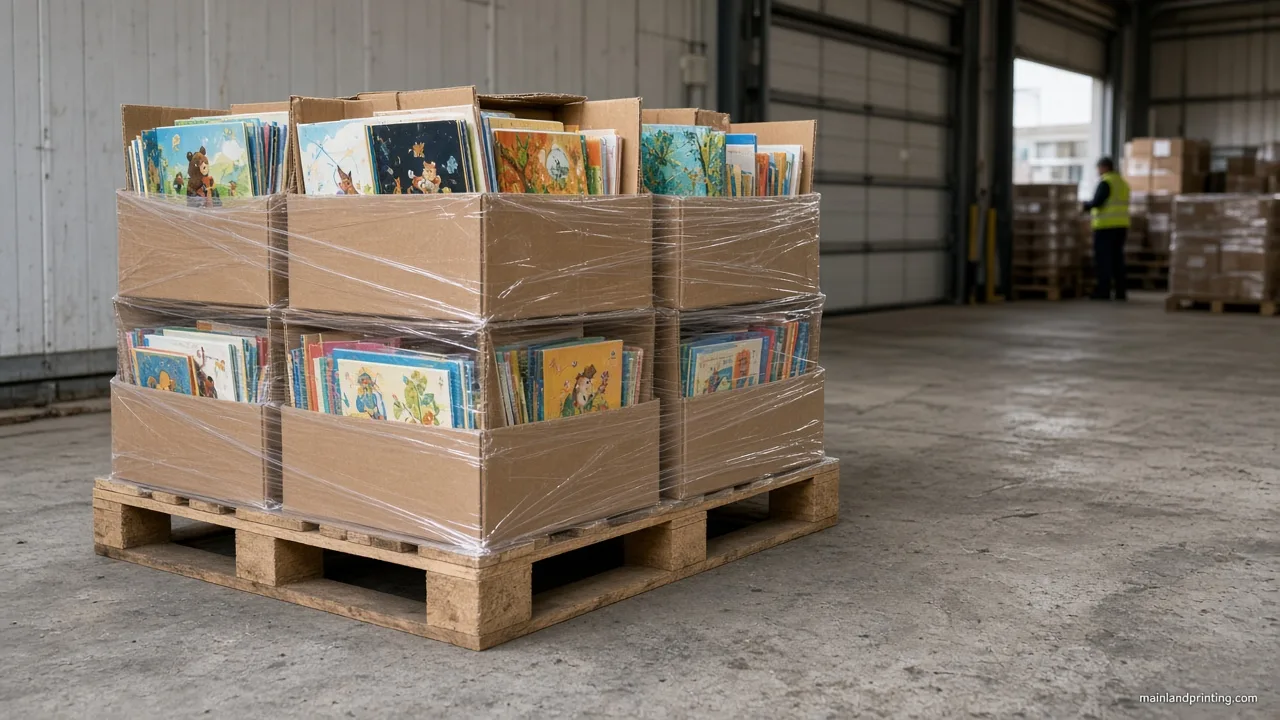
Books are essentially compressed wood, making them one of the most densely packed commodities in global shipping. A standard pallet of hardcover art books can easily weigh over 1,000 kilograms, drastically altering how logistics companies calculate your rates. Understanding this physical reality is critical for budgeting your campaign accurately.
We see clients miscalculate their shipping costs by thousands of dollars because they use standard volumetric formulas meant for plastic toys. This is why we break down these exact weight metrics in The True Cost of China Book Printing.
Calculating True Cubic Meter Weight
Freight forwarders charge based on whichever is greater: the actual physical weight or the volumetric weight. Because bound paper is exceptionally dense, you will almost always pay for the actual physical weight. You must calculate your CBM precisely before requesting a freight quote.
- Paper GSM impact: Upgrading your interior pages from a standard 105gsm to a premium 157gsm art paper increases your total pallet weight by roughly 30 percent. You can learn more about this in our guide to Book Paper Weight Conversion.
- Binding materials: Hardcover boards, typically utilizing 2.5mm or 3mm high-density greyboard, add massive dead weight compared to standard perfect-bound softcovers.
- Carton limits: We engineer our export cartons to never exceed 15kg to prevent warehouse workers from dropping them due to lifting fatigue.
Air Versus Sea Freight Cost Differentials
| Feature | Air Freight (Express) | Sea Freight (LCL/FCL) |
|---|---|---|
| Transit Time | 3–7 Days | 30–45 Days |
| Relative Cost | Very High (5x–8x) | Low (Baseline) |
| Best Use Case | Launch MVQ & PR copies | Bulk replenishment |
Ocean freight is highly cost-effective for bulk replenishment, especially when utilizing Full Container Loads (FCL) where your goods are sealed at the factory. However, when you face a strict launch deadline, the 30 to 40-day transit time of sea freight becomes a massive liability. Air freight cuts transit times to mere days, but the cost multiplier is severe due to the extreme density of the cargo.
“While some businesses consider sea freight as the go-to option for bulk shipping, many SMEs are now discovering that air freight can be surprisingly cost-effective, especially for time-sensitive, high-value goods.” — FedEx, Business Insights
The Launch Critical Inventory Threshold
You do not need your entire print run to execute a successful launch week. You only need enough physical units to fulfill early backers, send out PR copies, and satisfy initial retail orders.
This strategic division of inventory requires robust carton protection, as smaller air shipments endure significantly more manual handling than undisturbed sea pallets. You can learn more about our specific carton bursting strength standards in our case study on Engineering Bulletproof Packaging.
CASE STUDY: Engineering Bulletproof Logistics for 5,000 Art Books
See how we utilized specialized packaging engineering and a strategic DDP logistics plan to ensure a high-stakes Kickstarter project arrived without a single damaged unit.
Defining Your Minimum Viable Quantity
Your minimum viable quantity (MVQ) is the exact number of books required to survive the first 14 days of your post-launch sustained marketing phase. You must calculate your PR list, your guaranteed pre-orders, and a strict 20 percent buffer for immediate replacements.
Shipping this precise MVQ via air freight ensures you meet your launch date flawlessly. Meanwhile, the remaining bulk inventory travels economically by sea, arriving just as your initial stock begins to deplete. This split-shipment approach is a standard best practice in modern e-commerce and publishing.
The Ten Percent Split Ship Formula
In my experience managing global logistics, the most financially sound strategy is the 10/90 split. You send 10 percent of your total print run via express air freight and the remaining 90 percent via Less than Container Load (LCL) or FCL ocean freight. This balances speed with long-term profitability.
Before you open that Softcover air MVQ, confirm dock week and carton facts with softcover dock week plan so split bookings do not outrun warehouse receiving.
- Immediate Cash Flow: The air-freighted units allow you to start fulfilling orders and generating revenue immediately upon launch.
- Risk Mitigation: If a customs delay or port congestion impacts the sea vessel, your launch is already safely underway with the air stock.
- Warehouse Optimization: You avoid paying high storage fees for thousands of books sitting in a domestic fulfillment center before they are actually needed.
Defeating Post Production Repacking Penalties
The biggest mistake publishers make with split shipping is deciding to do it after the books are already packed on pallets. Tearing down stretch-wrapped, export-ready pallets to extract 200 books for an air shipment introduces severe repacking penalties and unnecessary labor costs.
This reactive approach also damages the structural integrity of the remaining palletized cartons. To understand how our facility prevents this through proactive management, you can read the Mainland Printing About Page.
Engineering Splits During Pre Press
The split shipping strategy must be finalized before we even output the printing plates. When my project managers know your air freight quantity in advance, we code the factory job ticket to separate those specific units at the very beginning of the bindery line.
This proactive engineering entirely eliminates double-handling on the factory floor. It ensures your urgent air cartons are packed with the exact weight specifications and labeling required by aviation carriers, bypassing standard sea-freight packaging protocols.
Parallel Processing for Bindery and Packing
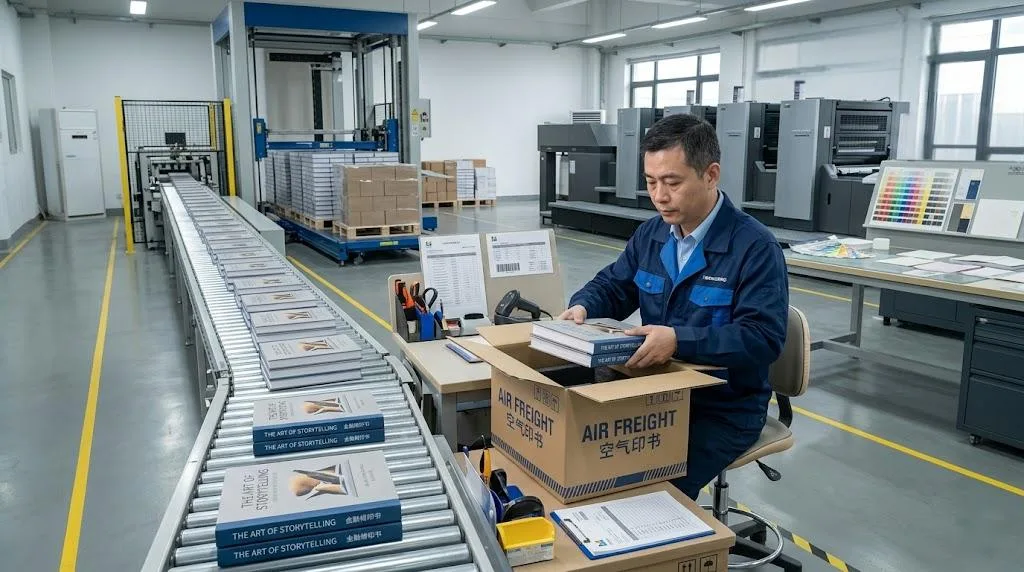
Once the ink is cured and the pages are folded, we utilize parallel processing to expedite your launch inventory. The designated air freight units are prioritized through the sewing and casing-in machines first, moving ahead of the bulk run.
- Priority Curing: The first batch of bound books is moved to a specialized climate-controlled area to accelerate the PUR glue setting process.
- Dedicated Air Cartons: These units are packed in specialized double-walled corrugated boxes designed to withstand the high-frequency micro-vibrations of cargo aircraft.
- Simultaneous Dispatch: While your air shipment is being loaded onto a truck bound for the airport, the rest of your run continues through the standard bindery and sea-palletization workflow.
Conclusion: Strategic Splits Save Book Launches
Executing book launch logistics requires treating your physical inventory with the exact same precision as your marketing timeline. By calculating your minimum viable quantity and engineering a proactive split-shipment during pre-press, you eliminate costly delays and protect your profit margins.
When your files pass final review, our B2B book printing services can carry the project from approved proof to pallet-ready books.
Over my 20 years managing the factory floor, Director Leo and our team have built quality control and logistics systems to prevent the exact supply chain failures that ruin independent publishing campaigns. We engineer every single step to ensure your books arrive flawlessly.
Stop letting unpredictable ocean freight timelines dictate your marketing success and put your campaign at risk. Reach out to our team today to request a custom quote for your next printing project so we can build a bulletproof manufacturing schedule together.