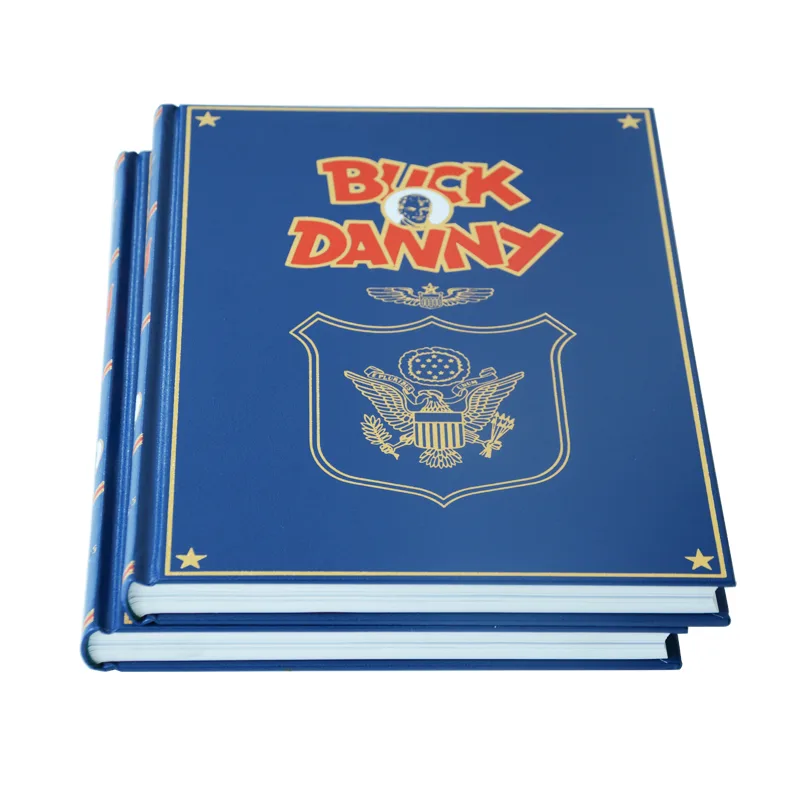
Publishing a thick, high-end hardcover book? You are going to need round spine case binding to prevent catastrophic structural failure. In this guide, I will show you exactly how to navigate the complex physical manufacturing hurdles so your massive overseas print run ships flawlessly.
Round spine case binding is a premium hardcover manufacturing technique where the book’s spine is mechanically hammered into a convex arc. This curved structure absorbs the physical thickness of sewing threads, evenly distributes opening stress, and prevents thick books from breaking or losing pages.
But here is the truth: most print shops completely botch the 3D physics of a curved spine. Keep reading to discover the three critical engineering traps that ruin expensive print runs, and the exact industrial benchmarks you need to demand from your supplier.
Why and When to Use the Round Spine Architecture

Before dissecting the engineering hurdles, it is critical to establish the exact physical threshold where flat spines fail and round spines become mandatory, and whether your project belongs in a simpler binding format baseline workflow before it truly needs case binding.
Before you lock a round case route, use this round vs square spine guide to confirm square vs round from book-block thickness and project type.
Based on global offset printing standards, the decision is dictated strictly by the caliper (thickness) of the text block.
When a book exceeds roughly 15mm in thickness (approximately 150 to 200 pages of standard 157g coated paper), the sheer weight of the pages exerts immense gravity on the spine when the book is held upright.
Physical Parameters: Flat Spine vs. Round Spine
| Engineering Variable | Flat Spine Case Binding | Round Spine Case Binding |
|---|---|---|
| Maximum Safe Thickness | ≤ 15mm | 15mm to 80mm+ |
| Stress Distribution | Concentrated heavily on front and back hinge joints. | Dispersed evenly across the entire convex spine arc. |
| Swell Management | Cannot absorb heavy thread swell. | Absorbs thread swell perfectly through mechanical hammering. |
| Lay-Flat Capability | Tends to snap shut on thicker volumes. | Superior. Drapes naturally and accommodates 180-degree opening. |
| Production Cost Index | Baseline standard cost. | Moderate premium due to automated rounding/backing machinery. |
Quick Guide: If your priority is keeping costs low for books under 15mm, choose flat spine; if you face structural integrity risks on heavy art books, invest in round spine binding.
If your project crosses that 15mm threshold, you must transition to a round spine.
However, that transition introduces our first major industrial trap.
Calculating Cover Art Distortion Over the Spine Arc & Joints
Many independent designers and pre-press novices mistakenly treat a hardcover layout as a flat, 2D rectangle.
They add a standard 3mm bleed, meticulously center their foil-stamped title exactly in the middle of the digital spine, and send the files directly to the factory.
The industrial truth is that a round spine is not a flat surface. It is a highly complex, three-dimensional cylinder forming a roughly 130-degree arc.
Furthermore, it is flanked immediately by deep joint grooves (the hinges) that plunge approximately 8mm into the dense board structure.
When the cover material—whether it is coated paper, cloth, or faux leather—is forcefully wrapped and compressed by rounding and backing techniques, it undergoes severe physical stretching.
If your files are plated and printed exactly as they appear on your computer screen, the physical book will suffer from severe arc distortion.
- Your typography will stretch horizontally, destroying the careful kerning and altering the visual font weight.
- The visual center shifts significantly, making the central logo appear completely lopsided when the book is placed on a table.
- The outer edges of your artwork or text may be swallowed entirely into the deep hinge crevices, rendering them illegible.
Visual centering on a curved plane requires reverse-engineered mathematical compensation. To prevent arc distortion, print engineers must compress the spine artwork laterally before the printing plates are ever exposed to the laser.
Core Decision Points for Procurement & Design
- Force the Shrinkage: Did the factory pre-press team actively shrink your spine elements by the necessary 10% to 15% before approving the files?
- Establish the Safe Zone: Ensure all critical graphics and text are isolated at least 3mm away from the joint impact zones to survive the mechanical compression.
- Demand the Grid Proof: Never approve a flat PDF for a round spine. Demand a 3D mock-up or a grid-lined physical proof to verify the visual centering over the arc.
Real-World Application: The 500K Kickstarter RPG Rulebook
In our collaborative experience with independent publishers, we consistently intercept files that look beautiful digitally but are mathematically doomed.
Recently, a client brought us a massive tabletop RPG rulebook project featuring 350 pages on dense 157g matte coated paper.
Their previous supplier had simply approved the flat file without any warnings.
During our proofing approval stage, the Senior Project Manager calculated that the intricate metallic foil logo on the spine would be dragged directly into the 8mm hinge grooves during the rounding process.
By applying the arc distortion formula, we executed a 12% lateral compression on the foil stamping plates.
When the final books rolled off the automated casing line, the logo expanded perfectly back into optical center, saving the client from a devastating aesthetic failure.
The Battle of Grain Direction vs. Adhesive Integrity
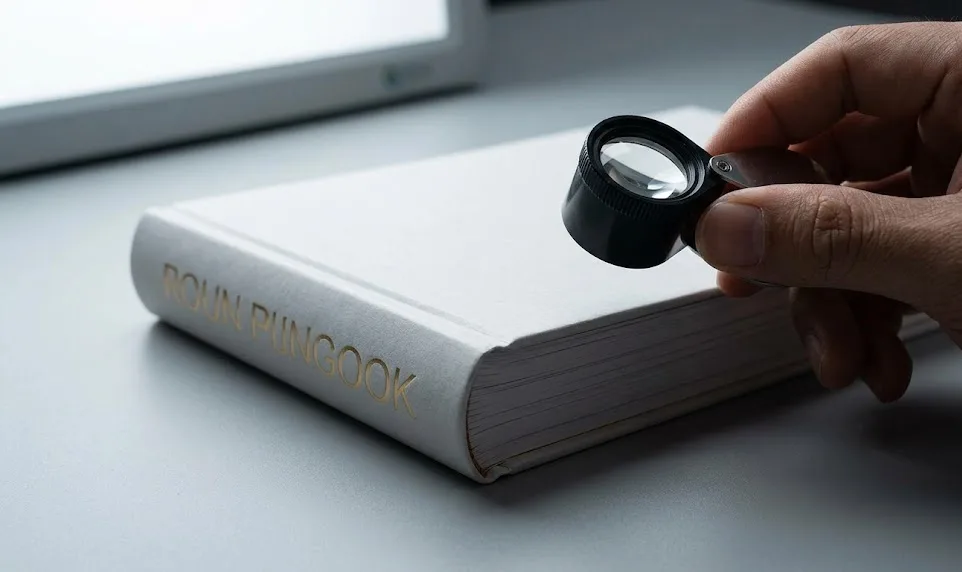
While visual distortion ruins the aesthetics, our second hurdle destroys the actual physical lifespan of the book.
All paper is manufactured on massive wire mesh conveyors, causing the microscopic cellulose fibers to align in a single direction, which creates a natural grain.
To maximize paper yield, minimize waste, and offer you a seemingly competitive cheap quote, many budget factories will silently rotate your layout on the master printing sheet.
This hidden optimization might save 15% on raw materials, but it forces the paper grain to run perpendicular to the spine—a catastrophic manufacturing error known as cross-grain printing.
For a heavy art book or rulebook, cross-grain printing is a structural death sentence.
When a Smyth sewn text block is mechanically hammered into a rounded arc, the perpendicular fibers act like thousands of microscopic springs fighting the curve.
“Ignoring proper grain direction is perhaps the single most common and destructive error in book manufacturing. In case binding, the grain of both the text paper and the endpapers must run parallel to the spine. Cross-grained paper creates a rigid spine that resists opening, stresses the adhesive, and ultimately leads to structural breakdown and page detachment.” — Werner Rebsamen, Professor Emeritus at the School of Print Media, Rochester Institute of Technology (RIT)
When a reader attempts to lay a cross-grained book flat, the rigid pages refuse to drape naturally.
The immense physical recoil of the heavy paper continuously tears at the adhesive lining holding the text block to the cover.
Within a few months of use, the glue fails, the spine collapses, and the pages completely fall out.
Enforcing strict grain-parallel alignment is not an optional premium upgrade; it is the absolute baseline of structural survival for heavy casebound books.
The Industrial Solution: The 100% Grain-Parallel Rule
To completely neutralize this risk, you must eliminate the factory’s ability to compromise on material science.
- Mandate Parallel Fibers: Regardless of the increased paper waste or the slight bump in unit cost, the fiber direction must run absolutely parallel to the binding edge.
- Specify Adhesive Strength: Pair the parallel grain with premium industrial adhesives, such as high-grade PUR or specialized PVA blends, designed specifically for heavy volumes.
- The Pull-Test Benchmark: Demand that the factory executes destructive physical testing, ensuring the adhesive pull-test strength registers strictly at > 1.0 N/cm.
When the 100% Grain-Parallel Rule is enforced alongside premium adhesives, the structural integrity of the book block is mathematically guaranteed.
Your backers can lay the heavy art book perfectly flat at 180 degrees, and the round spine will smoothly flex and distribute the opening strain exactly as it was engineered to do.
CASE STUDY: Engineering “Bulletproof” Packaging & DDP Logistics for 5,000 Heavy Art Books
Are you worried that your massive, round-spine Kickstarter books will be destroyed in transit before reaching your backers? See how we combined custom structural engineering with a flawless DDP logistics strategy to deliver 5,000 premium books with zero damage.
Mastering Tension and Color Consistency Across Curved Surfaces

Many project creators operate under the dangerous assumption that once a flat printed proof matches their digital file, the color is permanently locked in and safe.
They completely overlook the violent mechanical transition the paper must endure—moving from a completely flat cover board to a tightly stretched, curved hinge groove.
When heavy coated paper is forced into a rounded spine and stamped into the deep joint grooves under extreme heat and pressure, the surface tension spikes dramatically.
If the ink adhesion and the protective lamination film are not specifically engineered for this extreme mechanical stress, dark, solid colors will suffer from “cracking.”
This results in jagged, bright white paper fibers exploding through your beautifully printed dark atmospheric cover art right along the hinges.
Furthermore, the physical stretching of the paper alters the microscopic halftone dot structure of the ink, leading to localized color shifts across the curve.
Core Decision Points for Tension Control
- Mechanical Pre-Scoring: Before the printed cover material ever touches the casing-in machine, does the factory apply precise pre-scoring? This critical step gently pre-creases the paper, releasing the underlying fiber stress before the extreme pressure of the hinge-forming machine is applied.
- Anti-Scuff Lamination: Standard lamination shatters under pressure. You must specify high-tensile, anti-scuff matte or gloss lamination that is chemically designed to stretch seamlessly over 3D curves without breaking.
- Strict Spectrophotometer Monitoring: Do not rely on the human eye. Throughout the entire print run, spectrophotometers must continuously monitor the ink density. The factory must guarantee that the color deviation across the complex joint and spine structures remains strictly at Delta E color accuracy standards of ≤ 2.0.
By demanding these three parameters, you ensure that your dark cover art remains flawless, vibrant, and structurally unbroken, regardless of the physical strain it endures during global shipping and years of heavy reading.
The Quality Control Audit Framework
Before you wire tens of thousands of dollars to an overseas supplier for a mass production run, you must establish an uncompromising physical defense.
Theory and emails are not enough; you need tangible proof of engineering competence.
The ultimate tool for this is the Blank Dummy Strategy.
Long before the printing plates are made, demand a complete, unprinted physical prototype constructed with your exact specified paper weights, exact grain direction, requested adhesive, and precise board thickness.
Once this blank dummy arrives at your office, subject it to severe physical abuse by executing a drop test and a 180-degree lay-flat stress test.
Observe the joint behavior closely: the pages should drape naturally without violent spring-back, and the spine should hold its convex arc without snapping, flattening out, or separating from the interior lining.
This quality control audit forces the factory to demonstrate their structural competence before a single drop of ink is consumed.
How to Audit Your Printing Partner
Stop asking suppliers generic questions like “Can you print this book?” and “How much will it cost?”
Instead, interview them aggressively on their engineering parameters when evaluating a printing partner.
The Reverse-Interview Audit Guide
| The Hardcore Engineering Question | The “Red Flag” Generic Answer | The Industrial Expert Answer |
|---|---|---|
| “How do you guarantee and test for 100% grain-parallel alignment before plating?” | “Don’t worry, our paper is very high quality.” | “We calculate sheet yields strictly prioritizing grain direction. We will provide a blank dummy to verify the drape before mass production.” |
| “Are you routing a 7mm or a 9mm hinge gap for this specific 3mm cover board?” | “We use standard sizing for all books.” | “Based on a 3mm board and a 157g text block, a 7mm gap will cause tearing. We will precisely route an 8.5mm hinge for optimal clearance.” |
| “What is your exact ΔE limit for solid ink coverage across the physical stretch of the hinge?” | “We will match your digital proof as closely as possible.” | “We use spectrophotometers to maintain ΔE ≤ 2.0 across the flat boards, and utilize pre-scoring to prevent any cracking over the hinges.” |
Quick Guide: If your priority is absolute risk mitigation, choose the supplier providing concrete metrics; if you face vague “yes-men” responses, immediately switch to a specialized industrial printing partner.
In the high-stakes world of independent publishing and B2B procurement, a factory that simply replies “no problem” to your initial quote request is a profound financial liability.
A capable manufacturing partner answers your requests with physical constants, pre-press formulas, and clearly defined tension thresholds.
Mastering these specific physical variables and demanding absolute technical accountability from your supplier is exactly what elevates a vulnerable digital file into a flawless, physically enduring masterpiece of round spine case binding.
Round-spine blocks are routine in our hardcover book printing line once the board grade and spine radius are confirmed early.