Struggling to justify a $25+ retail price for your latest indie publishing project? You are exactly in the right place. In this guide, I am going to show you how to leverage premium offset printing techniques to skyrocket your perceived value and protect your profit margins.
The most profitable finishes for children’s board books include anti-scuff soft-touch lamination, foil stamping, raised spot UV, deep embossing, and custom die-cut edges. These tactile upgrades increase perceived value, allowing publishers to easily justify a premium retail price.
But here is the kicker: applying these premium upgrades to thick 400gsm greyboard can easily cause warping or spine cracking if you ignore the mechanical limits. Keep reading to discover the exact pre-press troubleshooting steps that will save you from a costly manufacturing disaster.
The Economics of Premium Board Book Manufacturing
Before diving into the mechanical limitations of the printing press, you must understand the financial leverage of premium finishes. The goal is to utilize high-end offset printing to maximize your perceived value while strictly controlling your FOB price.
Table 1: The ROI Multiplier of Premium Finishes
| Finish Type | Est. Added Cost (FOB) | Retail Premium Potential | Mechanical Risk Level |
|---|---|---|---|
| Anti-Scuff Soft-Touch Film | + $0.15 – $0.20 | + $4.00 – $5.00 | Low (Watch ink density) |
| Foil Stamping (Cover) | + $0.15 – $0.25 | + $5.00 – $7.00 | High (Warping / Cracking) |
| Raised Spot UV (3D) | + $0.12 – $0.20 | + $3.00 – $5.00 | Medium (Adhesion issues) |
| Deep Embossing | + $0.20 – $0.35 | + $5.00 – $8.00 | High (Registration limits) |
| Custom Die-Cut Edges | + $0.25 – $0.40 | + $6.00 – $10.00 | Medium (Safety radii) |
Quick Guide: If your priority is instant tactile luxury, choose Anti-Scuff Soft-Touch Film; if you face a highly competitive crowdfunding market, invest in Foil Stamping or Custom Die-Cut Edges to maximize shelf appeal.
For the broader production path, review this board book printing before you finalize specifications, supplier selection, and budget expectations.
As the table illustrates, an upfront investment of just thirty cents in physical hardware can yield a retail bump of ten dollars. But extracting that ROI requires flawless execution on the press floor.
The $25 Retail Standard
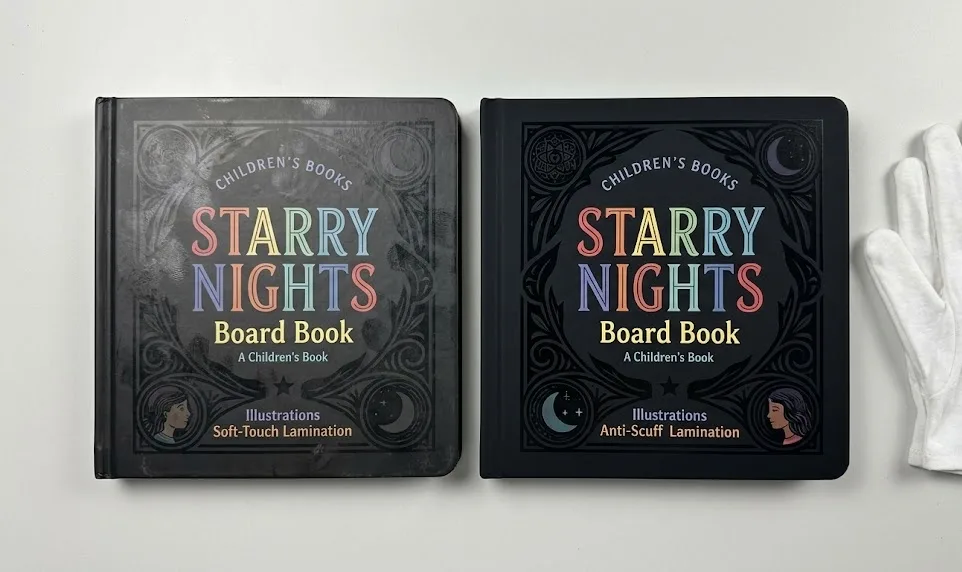
Adding soft-touch lamination is the most cost-effective lever in children’s publishing. It instantly elevates the tactile feel of the cover, transforming standard paperboard into a luxury item with a velvet-like texture.This level of structural refinement is exactly how you justify a higher book pricing strategy to your target audience without losing conversions.
However, inexperienced designers frequently fall into a predictable visual trap: applying standard soft-touch film over heavy ink coverage (specifically where CMYK black values exceed 60%).The physical light refraction of standard soft-touch material immediately deadens deep colors, leaving the printed surface looking muddy. Worse, standard soft-touch is a magnet for oily fingerprints, which destroys the premium visual appeal before the book even reaches the retail shelf.
The Procurement Manager’s Action Plan:
- Mandate Anti-Scuff: For high-end board books, explicitly specify anti-scuff soft-touch lamination in your RFQ (Request for Quote).
- Verify Water-Based Chemistry: Ensure the factory uses a water-based lamination process rather than solvent-based glues. This preserves the color saturation of your print-ready files and guarantees the material easily passes environmental standards.
- Check Color Density: Before finalizing files, audit your CMYK levels. If your total ink limit exceeds 240%, require your prepress team to apply undercolor removal (UCR) to prevent the lamination from lifting off the heavy ink bed.
The Warping and Cracking Trap
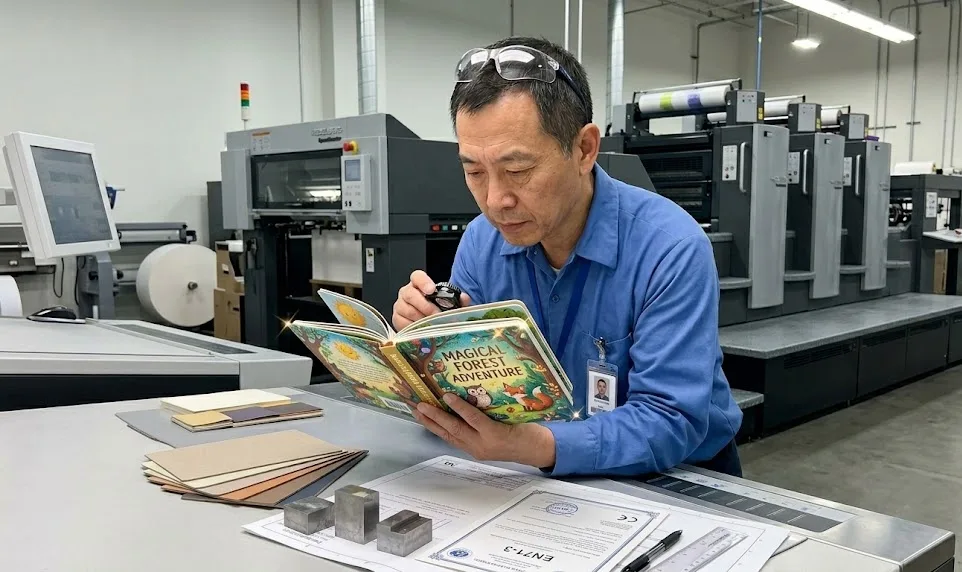
Foil stamping provides immense visual appeal. The interplay of light on golden, holographic, or silver foil communicates immediate luxury. But applying heat and pressure to thick 400gsm greyboard introduces extreme mechanical stress on the rigid materials.When choosing your factory, make sure you know critical questions to ask regarding their experience with automated heavy-gauge foil stamping to prevent catastrophic structural delamination.
Last year, an indie publisher running a highly successful dark-fantasy Kickstarter campaign requested a massive holographic silver foil spanning directly across the spine of their 1.2mm thick board book.
If we had blindly executed that PDF file, the mechanical pressure during the final die-cutting and folding phase would have caused the board to aggressively crack at the spine crease. Furthermore, applying large-area foil requires intense heat (often exceeding 120°C).This rapid heat application destroys the internal moisture balance of the paper stock. Without intervention, these books would suffer severe “moisture shock” inside the humid ocean freight container, arriving at the US fulfillment center completely warped.
Drawing on 18 years of technical expertise, our pre-press team and Master Press Operator immediately halted production to safeguard client capital according to TAPPI T 502 relative humidity standards. We enforced a strict modification: shrinking the foil die-line to pull all foil application zones at least 3mm away from the spine crease. Furthermore, we utilized a climate-controlled press floor to hold the paper’s moisture content strictly at 5% to 7% during the stamping process.
Zero cracked spines, perfectly flat boards upon arrival in Los Angeles, and a completely satisfied base of Kickstarter backers.
The Procurement Manager’s Action Plan:
- The 3mm Rule for Finishes: Never allow foil designs to overlap die-cut lines or spine creases. Always maintain a 3mm safety margin.
- Warping Tolerance Guarantees: When your design requires foil coverage exceeding 30% of the cover’s surface area, you must demand a warping tolerance guarantee (typically $\le 2mm$ deviation) in your production contract.
- Grain Direction Audits: Ensure your printer is aligning the paper grain parallel to the spine of the board book. Cross-grain mounting combined with heavy foil stamping is a guaranteed recipe for warped books.
The Adhesion and Safety Hazard
Raised spot UV adds a premium, 3D tactile dimension to illustrations—perfect for highlighting raindrops, magical glowing effects, or character outlines.But it introduces a severe chemical compatibility issue when applied over lamination. These physical limitations are why your children’s book special finishes require tight execution parameters rather than standard off-the-shelf automation.
In a modernized printing environment, applying thick UV polymer directly over an incompatible lamination film causes chemical rejection. The surface tensions fight each other. Over time, or under the friction of shipping, the UV layer flakes off.
Uncured or chemically rejected polymers that flake off printed pages present a serious quality breakdown and a direct violation of international child safety regulations.
For children’s publishing, peeling plastics are not just a quality control failure; they constitute a direct choking hazard and an immediate ASTM safety violation. Managing this risk requires an industrial cross-hatch adhesion tape test framework during the initial setup phases.
The Procurement Manager’s Action Plan:
- The Adhesion Tape Test: Before mass production begins, your supplier must perform a standard cross-hatch adhesion tape test. If the UV coating pulls away with the tape, the chemical bond has failed.
- Curing Time Verification: Ensure the factory utilizes advanced UV curing lamps that instantly harden the polymer. Undercured Spot UV will stick to the adjacent pages when the board book is closed, ruining the spreads when the child opens the book.
Ready to Elevate Your Book’s Perceived Value Safely?
Don’t let complex coatings and foils turn into a manufacturing nightmare. Work with our expert technical team to implement a flawless, retail-ready finish that protects your margins and passes every safety compliance test.
Pushing Mechanical Registration Limits
Embossing and debossing transform a flat cover into a high-end sculptural piece. The physical relief adds undeniable gravitas to your title. However, forcing thick paperboard into a deep relief mold requires immense, concentrated mechanical pressure.If your project demands strict alignment across multiple volumes, establishing long-term quality control in book printing is mandatory to avoid registration drift between production batches.
If the board is too dense, the internal paper fibers rupture, tearing the printed image. If the board is too thin, the 3D effect is entirely lost. More importantly, aligning the physical embossing die perfectly with the CMYK printed artwork requires world-class machinery.Executing flawless embossing on thick stock demands the precision of advanced Heidelberg or Komori presses, which can hold a mechanical registration error down to a microscopic 0.01mm to 0.05mm range. Low-end machinery will result in a “halo” effect where the physical bump completely misses the printed ink.
The Procurement Manager’s Action Plan:
- Specify Maximum Depth: Work with your Master Press Operator to determine the exact micron depth achievable on your specific 400gsm board without risking fiber tear.
- Vector Registration: Always supply your embossing die-lines as separate, mathematically precise vector layers in your print-ready files. Never use rasterized images for die-line creation.
Engineering for Compliance
Custom die-cut edges or internal peek-a-boo windows immediately separate your board book from standard rectangular retail offerings.They turn a reading experience into an interactive toy. Reviewing a complete children’s book pre-press guide can help your design team set up structural layers properly prior to physical steel-rule tooling fabrication.
Yet, intricate die-lines often result in sharp board corners. Under strict US toy safety guidelines, acute angles on heavy board books are flagged as severe puncture hazards.
The Procurement Manager’s Action Plan:
- The Corner Radius Rule: Always engineer your die-cut files with a minimum corner radius of 3mm to 5mm. This satisfies both aesthetic goals and rigorous safety compliance.
- Die-Cut Bleed Allowances: Standard bleed is 3mm. For complex internal window die-cuts, extend your bleed to 5mm to account for minor paper shifting during the heavy mounting and cutting phases.
The Color Calibration Defense

A critical pain point for indie publishers and purchasing managers is the visual disconnect between a backlit Apple monitor and physical offset printing.You cannot rely on a PDF file to verify how an anti-scuff film will interact with your specific CMYK color matching. The anxiety of overseas production stems directly from this gap.
To eliminate this uncertainty, a Senior Project Manager must enforce a standardized proof-to-press workflow. This replaces subjective visual arguments (“Make it pop more!”) with hard, irrefutable data.
Relying on digital screen mockups to predict ink behaviors under complex physical laminates is the primary cause of industrial print failures.
The Standardized Proofing Sequence:
- Digital Soft Proofing: Checking purely for pagination, bleed margins, and typo corrections.
- Uncoated Hard Copy (Epson Proof): Verifying the baseline CMYK color calibration before any lamination alters the visual output.
- The Press Sheet (Wet Proof): The ultimate truth. This is a physical sheet run through the Heidelberg press with your exact lamination applied.
By insisting on a physical press proof for high-stakes projects, you lock your supplier into an objective standard.You must demand that the color variance between the approved proof and the final mass-produced sheet remains tightly within a $\Delta E < 2.5$ threshold. In color science, a Delta E under 1 is imperceptible to the human eye, and keeping it under 2.5 guarantees absolute brand consistency across a 10,000-unit print run.
Turning CPSIA Compliance into Marketing Leverage
When budgeting for premium upgrades, safety compliance is not a hidden tax—it is your strongest marketing asset.
The Consumer Product Safety Commission (CPSC) heavily regulates lead content and phthalates in children’s products. Board books are legally classified as products intended for children 12 and under, making them subject to mandatory third-party safety testing (such as ASTM F963).Sourcing cheap foil or low-grade UV coatings from unverified factories invites the catastrophic risk of your shipment being seized at the port due to heavy metals exceeding the 90 ppm limit. To protect your investment, ensure your supplier provides full documentation under a transparent board book printing safety guide before raw components are purchased.
“Partnering with an overseas offset printer is not just a cost-saving measure, but a structural necessity for any indie publisher looking to maintain healthy margins—provided the supply chain is legally bulletproof.”
— Darcy Pattison, Indie Publisher & Founder of Mims House Books
The Strategy: Flip the script. Leverage your modernized Chinese printing facility’s compliance as a core selling feature.
- Ensure 100% of your materials use water-based lamination and soy-based inks.
- Display your ASTM F963 and CPSIA compliance certifications directly on your Kickstarter campaign page.
- Print a dedicated “Child-Safe & Eco-Friendly” badge on the back cover of your book.
In today’s highly conscious market, transparently proving your manufacturing supply chain is free of heavy metals and toxic chemicals perfectly justifies a $25 premium retail price to health-conscious parents. It transforms a backend manufacturing detail into a frontline conversion tool.
Your Next Step in High-Margin Board Book Printing
Achieving a profitable, $25-tier board book requires far more than selecting finish options from a drop-down pricing grid; it demands upfront, hardcore engineering.For creators transitioning from light desktop publishing environments, checking a thorough case study on professional offset scaling provides a reliable roadmap for volume execution.
Stop sending flawed print-ready files out for generic quoting. If you are preparing for a major Kickstarter launch or expanding your indie publishing catalog, submit your design for a technical pre-press audit.Addressing physical limitations—like paper grain direction, chemical coating adhesion, and mechanical bleed allowances—is the only way to guarantee your high-profit finishes actually perform on the press floor and succeed in the retail market.
Protect your margins, demand mechanical precision, and build a supply chain that turns physical printing into your absolute competitive advantage.