Most people think paper weight is everything. They’re wrong. If you want pro-level results, you need to understand the technical harmony between your paper’s density and its surface finish. Here is exactly how to master this balance for professional-grade results.
Matching paper opacity and coatings involves balancing the substrate’s light-blocking capacity with ink holdout. High opacity prevents show-through, while coatings regulate ink absorption. Successful matching requires auditing Total Area Coverage (TAC) against the paper’s GSM and bulk ratings.
But there is more to the story than just technical specs. Read on to see the “Ink-Paper Conflict Matrix” and the exact pre-press audit used to prevent 99% of production disasters.
Why Static Specs Fail

Most buyers select paper based on a catalog’s GSM (Grams per Square Meter) and a static opacity percentage. This is a fundamental error. Opacity is not a fixed attribute; it is a dynamic variable that changes the moment it encounters high-speed offset rollers.
“The physical properties of the paper surface, especially its coating and porosity, fundamentally govern dot gain and ink absorption. Uncoated and heavily textured substrates require precise compensations in pre-press to prevent structural weakening of the print.” — Helmut Kipphan, Author of the Handbook of Print Media.
The Physics of Show-Through
The TAPPI T425 standard measures opacity by comparing the light reflected from a single sheet placed over a black surface against the maximum light reflected from a thick stack of the same paper.
In simple terms, this represents the percentage of light a single sheet can block; the higher the percentage, the less “show-through” you will experience.
While a sheet might boast 96% opacity in controlled lab tests, a high-density “Rich Black” design can saturate the fibers and reduce its effective opacity to less than 90% in real-world production environments.
Physical Parameters of Common Paper Stocks
| Paper Category | Typical GSM | Opacity Goal | Best Use Case | Risk Factor |
|---|---|---|---|---|
| Premium Uncoated | 100–120 | 94% – 97% | Minimalist art books, journals | High ink absorption; show-through risk |
| Matte Coated | 128–157 | 96% – 98% | Photography books, catalogs | Scuffing; requires protective varnish |
| High-Bulk Book | 80–100 | 92% – 95% | Trade novels, thick manuals | Rough texture; lower image sharpness |
| Gloss Coated | 128–200 | 97% – 99% | High-end fashion magazines | Visual glare; high fingerprint sensitivity |
Quick Guide: If your priority is tactile feel, choose Premium Uncoated; if you face high-contrast image requirements, invest in Matte Coated stock.
Ink Holdout vs. Absorption
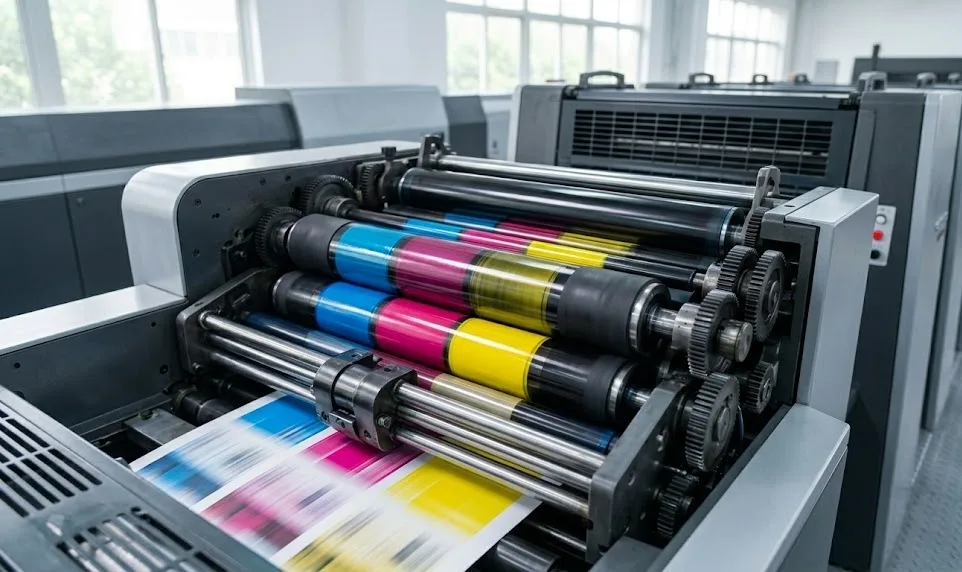
Coating is the “gatekeeper” of your ink. It determines Ink Holdout—the ability of the ink to sit on top of the paper surface rather than soaking into the fibers.
- Uncoated Paper (The Sponge): Fibers are exposed. Ink travels deep into the paper, causing the dots to expand. This is known as Dot Gain.
- Coated Paper (The Shield): A layer of kaolin clay or calcium carbonate seals the fibers. Ink stays on the surface, resulting in higher color saturation and sharper detail.
Decision Points for Art Directors:
- Choose Uncoated if: You want a tactile, organic feel and your design has plenty of “white space.”
- Choose Coated if: Your project relies on high-contrast imagery, deep shadows, and precise color matching ($\Delta E \le 2.0$).
In our facility, we don’t just look at the coating; we look at the pH balance of the coating. If a coating is too acidic, it can interfere with the drying catalysts in the ink, leading to “Set-off” (ink transferring to the facing page) even weeks after the book is bound.
Total Area Coverage (TAC)
In the press room, the greatest enemy of paper opacity is Total Area Coverage (TAC), also known as Total Ink Coverage (TIC).
When an Art Director creates a “Rich Black,” they often layer Cyan, Magenta, Yellow, and Black. If the design specifies C70, M60, Y60, K100, the TAC is 290%.
On a 100gsm uncoated sheet, this volume of liquid ink acts as a solvent, breaking down the paper’s internal opacity.
The “Ink-Paper Conflict” Matrix
| Design Profile | Recommended Substrate | Engineering Intervention Required |
|---|---|---|
| Deep Shadows / Dark Gradients | Coated Matte (157gsm+) | Implement GCR (Gray Component Replacement) to cap TAC at 300% |
| Fine Line Art / Typography | Premium Uncoated (120gsm) | Adjust Tonal Value Increase (TVI) curves to prevent line thickening |
| Vibrant Solid Colors | Gloss Coated (128gsm+) | Use Sealer Coating to prevent ink cracking at the spine |
Quick Guide: If you face heavy ink designs, choose Coated Matte with GCR; if your priority is fine lines, invest in Premium Uncoated with TVI adjustments.
The Kickstarter Disaster
A client once insisted on using 100gsm high-bulk uncoated paper for a photography book with 300% TAC backgrounds. The result? The ink saturated the fibers so heavily that the pages became translucent and wavy.
We intervened at the pre-press stage, using GCR to reduce the physical ink volume by 40% while maintaining the visual “depth” of the black. We saved the project by switching to a “Descendant Engineering” approach—adjusting the machine rather than forcing the paper.
Ready to Perfect Your Art Book Printing?
Don’t let ink bleed ruin your creative vision. Partner with us for expert pre-press auditing and premium manufacturing that guarantees flawless reproduction.
The Human Element

No matter how advanced the machine—be it a Heidelberg XL-106 or a Komori Lithrone—the final result depends on the Master Press Operator.
In our modernized Chinese facility, the operator monitors the Delta E ($\Delta E$) in real-time. $\Delta E$ is the mathematical distance between two colors in the $L^*a^*b^*$ color space:
$$\Delta E = \sqrt{(L_2 – L_1)^2 + (a_2 – a_1)^2 + (b_2 – b_1)^2}$$
For premium book printing, we maintain a $\Delta E$ of less than 2.0. This requires a constant adjustment of Ink Tack and Press Speed.
If the press runs too fast, the friction creates heat that thins the ink, leading to “ghosting” on the reverse side of the page—a direct failure of matched opacity.
The Sourcing Manager’s Proofing Protocol
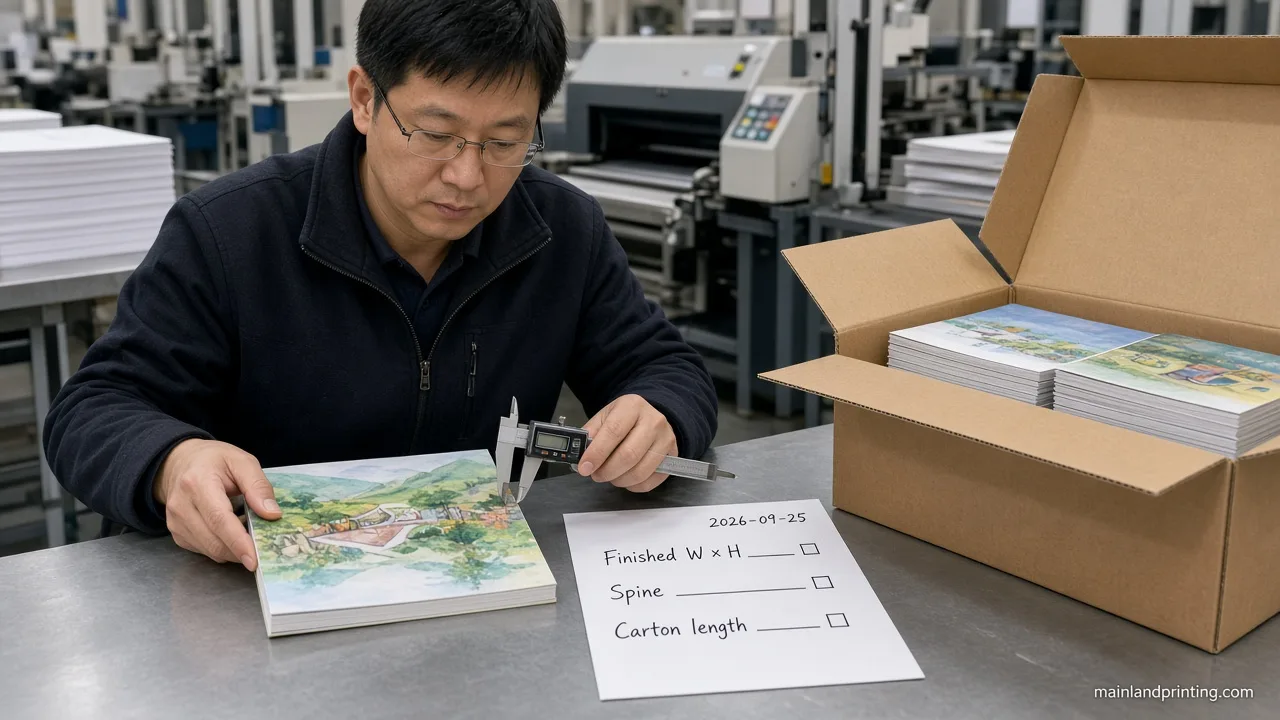
Digital PDFs are for proofreading text; they are useless for auditing paper opacity and coatings. To eliminate the “Blind Run” risk in cross-border manufacturing, we implement a three-tier physical validation protocol.
The Mainland Printing 3-Tier Audit
- The Blank Dummy (The Feel Test): We provide a 1:1 physical sample using the exact paper and binding. This allows you to test the “Show-Through” in natural light before a single drop of ink is spent.
- The Ink Draw-down (The Chemistry Test): For custom brand colors or high-density blacks, we perform an ink draw-down on your specific paper stock. This reveals how the coating reacts to the ink’s pigment.
- The Press Proof (The Gold Standard): A high-fidelity sample produced on the actual offset press. This is the only way to verify how the coating and opacity will hold up under industrial pressure.
“You cannot separate the color from the substrate. The paper’s optical properties—specifically its shade, brightness, and opacity—are the absolute foundation of any predictable color management strategy.” — Don Hutcheson, Inventor of the G7 Methodology.
The £40,000 “Screen-Only” Mistake
A British stationery brand once ordered 10,000 premium journals with a soft-touch matte lamination. They confirmed the color via a calibrated monitor. They didn’t account for the fact that a soft-touch coating acts as an optical filter; it absorbs light and shifts the color toward the yellow spectrum.
When the container arrived in London, the brand’s signature “Arctic Blue” looked like a “Murky Teal.” Because they skipped the physical ink draw-down, the entire run was off-brand.
The Lesson: Never authorize a mass production run based on a digital signal. Physicality is the only truth in printing. We now mandate a physical coating-match sample for every project involving soft-touch or spot-UV finishes.
The 2026 Strategy
As global supply chains face increasing volatility, the role of the “factory owner” is evolving into that of a “technical consultant.” Success in 2026 requires moving beyond the transactional.
Strategic Procurement Checklist
- Audit the TAC: Ask your supplier, “What is the TAC limit for this uncoated stock?” If they don’t have an answer, they aren’t auditing your files.
- Verify the Bulk: Don’t just pay for GSM. Ask for the Caliper (thickness). A high-bulk 100gsm paper provides the opacity of 120gsm at 80% of the shipping weight.
- Demand a Troubleshooting Partner: You don’t need a “Yes Man.” You need a Senior Project Manager who will tell you, “This design will bleed on this paper; we need to adjust the coating.”
The Bottom Line
Matching paper opacity and coatings is a balance of Industrial Physics and Artistic Intent. By shifting your focus from the “cheapest price per book” to the “lowest risk per run,” you secure the only thing that matters in B2B sourcing: Predictability.
At Mainland Printing, we don’t just put ink on paper. We manage the complex physical interactions of advanced Heidelberg technology with global paper standards to ensure that when you open that shipping container, the only surprise is how well the project matches your vision.