Publishing a heavyweight art book carries massive financial and reputational stakes. When backers pay premium prices for a 400-page Kickstarter exclusive, expecting a generational heirloom, structural failure is not an option.
Yet, a ruthless physical force threatens these high-value projects: gravity.
Round spines prevent spine slumping by utilizing symmetrical tension engineering. The bindery process creates a mechanical shoulder that physically interlocks with the hardcover boards. This transfers the heavy textblock’s weight entirely away from the adhesive and directly onto the rigid greyboard.
But a curved shape alone will not save a massive hardcover from collapsing over time. Discover the exact joint depth formulas, PUR adhesive requirements, and critical pre-press grain alignments that eliminate structural failure for good.
The Physics of Spine Slumping
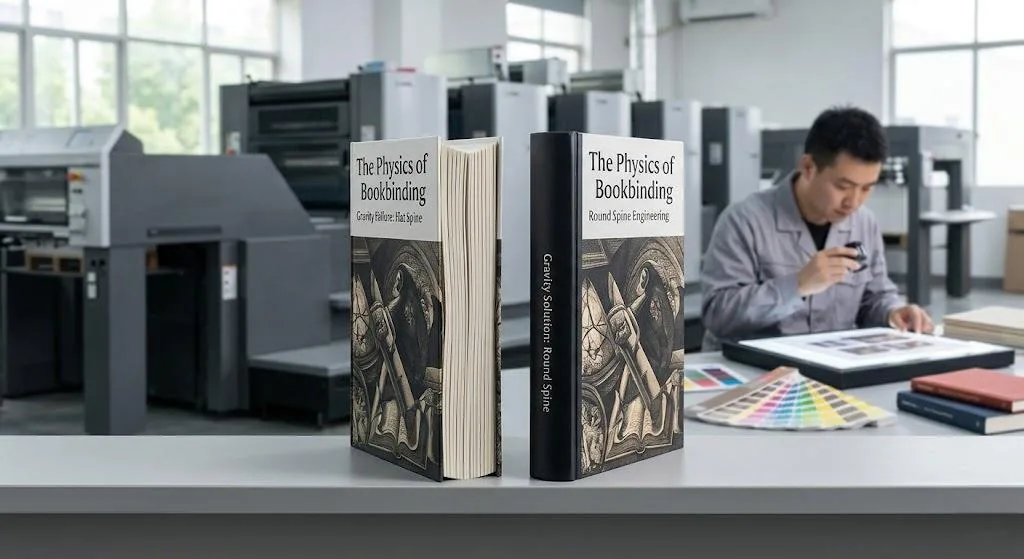
To effectively engineer round spines and prevent “spine slumping” in heavyweight volumes, standard bindery methods are entirely insufficient. The Northeast Document Conservation Center (NEDCC) formally identifies this physical degradation as “text block sag.”
Their official storage and handling practices state that when a heavy volume stands upright without proper engineered support, gravity relentlessly pulls the textblock downward until it physically tears itself out of its cover. This phenomenon is a primary cause of key printing mistakes found in high-mass art books.
Consider the raw physics. A 400-page volume printed on 157gsm coated art paper carries a textblock weighing nearly 2 kilograms. Relying on basic flat spine construction or standard PVA adhesives to hold that mass upright guarantees structural collapse and a devastating wave of chargebacks within months of delivery.
If you are still deciding whether flat or round belongs on the job, compare options with this square or round spine choice before you engineer anti-slump details.
Combating this gravitational pull requires strict post-press engineering. Symmetrical tension and millimeter-precise structural calculations dictate the survival of heavy hardcovers. Inside a modernized Chinese printing facility equipped with advanced Heidelberg/Komori presses, mitigating this risk begins long before the ink cures.
Backed by 18 years of technical expertise, preventing spine collapse demands a rigid, mathematical approach to both pre-press layout and bindery mechanics.
Symmetrical Tension Engineering

The physical construction of a durable hardcover relies on precise millimeter calculations. Forming a round spine on an advanced Kolbus or Muller Martini binding line requires engineering the shoulder bite—or joint depth—to exact tolerances.
For a heavyweight art book utilizing a rigid 3mm high-density greyboard cover, the optimal joint depth must be set precisely between 3.5mm and 4.0mm. This specific dimensional allowance creates a mechanical lever. When the volume stands vertically on a shelf, that 3.5mm lip transfers the 2kg textblock weight entirely away from the vulnerable spine curve and distributes the load directly onto the dense cover boards.
A processing deficit of even 0.5mm leaves the heavy pages suspended in the air, guaranteeing physical failure. This level of precision is why many publishers choose to print hardcover books with specialized facilities rather than generalist printers.
PUR Adhesive and Structural Integrity
Chemical adhesion dictates the secondary line of defense against gravitational pull. Many standard factories substitute high-grade adhesives with basic EVA hot-melt glues to extract marginal profits per unit. During ocean transit, freight container temperatures routinely exceed 60°C. Standard EVA softens under this thermal load, causing the spine structure to shift and warp before the shipment even clears customs.
True industrial standards mandate moisture-curing Polyurethane Reactive (PUR) adhesives for 400+ page volumes. A deep technical comparison of traditional EVA vs. PUR adhesive confirms that once PUR undergoes its 48-hour molecular cross-linking phase, the chemical bonds become virtually indestructible.
Industrial Adhesive Tolerances for Heavy Textblocks
| Quality Factor | Standard EVA | Moisture-Curing PUR |
|---|---|---|
| Pull Strength | 3-5 N/cm | 8-12 N/cm |
| Thermal Resistance | Softens at 60°C | -40°C to +100°C |
| Structural Risk | High (Spine shift) | Zero (Permanent cross-linking) |
Quick Guide: If your priority is long-term structural integrity in varied climates, always mandate PUR adhesive.
The 25mm Rule: Multi-Layer Crash
The reinforcement matrix must physically lock these components together. The high thread-count industrial crash (or mull) applied over the glued spine cannot merely cover the binding edge. Factory engineering protocols demand that this crash material extends outward by an absolute minimum of 25mm to 30mm on both sides. This 25mm extension bonds permanently with the 140gsm endpapers and the 3mm greyboard, forming an invisible, load-bearing suspension system that physically halts downward gravity.
Ready to Engineer Your Art Book?
Stop worrying about spine slumping and textblock sag. Get expert guidance on industrial-grade binding for your 400+ page project.
The Pre-Press Mandate: Aligning Grain Direction
The foundation of a durable round spine is dictated by pre-press engineering. A prevalent industry trap involves maximizing paper yield at the expense of structural integrity, specifically by ignoring grain direction on heavyweight stocks. This is a critical factor when attempting to ensure book printing quality.
A documented manufacturing failure involving a 450-page Kickstarter art book illustrates this blind spot. To compress material costs by 15%, the previous supplier imposed the 157gsm art paper with a cross-grain orientation. The physics of high-GSM paper dictates that transverse rebound tension is incredibly strong. Every time a reader opened the volume, the perpendicular grain acted like a coiled spring, exerting continuous outward force against the adhesive layer. Within two weeks, the internal tension sheared the glue entirely, causing catastrophic spine slumping.
Global offset printing standards demand precise grain alignment before a single plate is exposed. A fundamental engineering principle is that one must make sure that all materials have the grain direction parallel to the binding edge to prevent internal warping and ensure a tight, lasting fit.
Professional pre-press troubleshooting dictates a strict, non-negotiable rule: all 157gsm and heavier paper stocks must feature grain direction 100% parallel to the gutter. While this increases paper waste, it completely neutralizes the internal rebound forces that threaten to tear the textblock apart.
ROI Analysis: The True Cost of Failure
Procurement decisions often default to the lowest unit price, yet evaluating manufacturing risk requires a broader financial model. Saving a marginal $1.50 per volume by accepting subpar EVA adhesives and incorrect cross-grain layouts triggers catastrophic back-end expenses.
When spine slumping causes a 15% chargeback rate six months post-delivery, the true financial damage compounds. The costs of international replacement shipping and a decimated brand reputation dwarf any initial production savings.
Risk vs. Value: 2,000 Unit Art Book Project
| Metric | Low-Cost Factory | Engineered Printing Partner |
|---|---|---|
| Unit Price | $12.00 | $13.50 |
| Failure Rate | 15% (300 Units) | < 0.1% |
| Total Realized Cost | $69,000 + Brand Damage | $27,000 + Top Reputation |
Quick Guide: Investing in engineered quality upfront eliminates the $40,000+ hidden cost of structural failure.
Supplier Audit Protocol

Securing a reliable printing partner demands moving past superficial sales guarantees. Auditing a modern bindery facility requires enforcing strict, quantifiable engineering metrics before authorizing a proforma invoice. This is how you choose the right book printing factory.
When evaluating potential manufacturing partners, demand exact specifications on three critical parameters:
- The Joint Depth Formula Constraint: Challenge the facility to provide their exact shoulder bite calculation for a 3mm high-density board. A failure to supply a precise 3.5mm to 4.0mm parameter indicates a lack of post-press calibration.
- The Grain Direction Mandate: Require written confirmation that the pre-press department mandates 100% parallel grain direction for all 157gsm coated stocks, regardless of paper yield impacts.
- The 25mm Crash Overlap Baseline: Verify the exact dimensional extension of the industrial crash material. Any specification falling short of a 25mm extension guarantees the suspension system will eventually collapse.
Mastering the physics of bookbinding transforms a risky manufacturing venture into a predictable, engineered success. Expert pre-press troubleshooting and strict quality control standards are mandatory for any high-value art book.
Partnering with seasoned manufacturing professionals guarantees seamless bilingual communication, meticulous proofing approval, and flawless final delivery. Ensure your next 400+ page project completely defies gravity with expertly engineered round spines.