Have you ever approved a flawless hardcover sample, shipped a full production run, and then spent the next six weeks managing warped covers, furious clients, and inventory you can no longer fulfill — all because a single material specification was never properly controlled?
The financial exposure from that one oversight compounds far beyond the reprint cost itself, and understanding the engineering truth behind moisture imbalance is the only reliable way to protect your project before it reaches the bindery floor.
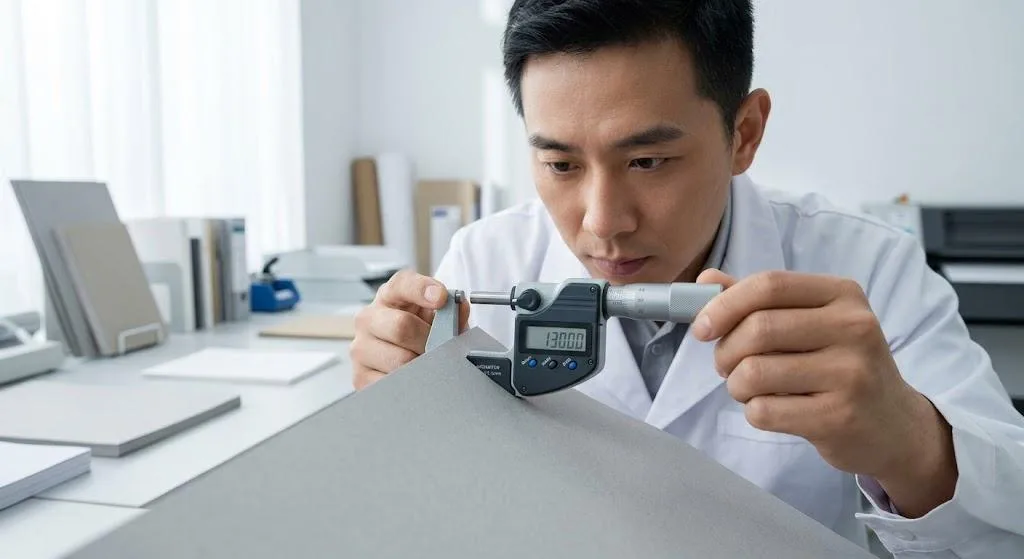
Premium greyboard (≥750 gsm, ±0.1mm caliper tolerance, vacuum-sealed at 50% RH) maintains moisture equilibrium across climates; cheap greyboard (±0.3mm or worse, unprotected shipping) arrives pre-stressed, creating an irreversible warp memory no binding process can correct.
Below, we outline a definitive seven-point Decision Matrix and the exact material and environmental benchmarks your printer must document before you approve a single specification, giving you a concrete, pressure-tested framework to evaluate any hardcover proposal and ensure your production run arrives flat, on schedule, and fully shippable regardless of the destination climate.
The Hidden Cost of “Good Enough” Printing
Here’s a scenario that plays out more often than most printers will admit: a hardcover book looks flawless when it leaves the bindery, passes quality inspection, and ships across the ocean without a single complaint. Then, six weeks later, you’re fielding emails about covers that have visibly warped, boards that have bowed, and a print run that’s become a liability instead of an asset.
The frustrating part is that “good enough” printing didn’t fail at the press. It failed silently, in the materials specification stage, long before ink touched paper.
Where the Real Losses Accumulate
The direct cost of a reprint is painful, but it’s actually the smallest part of the damage. Consider what a single warped run actually costs your project:
- Warehousing and logistics for returned stock
- Delayed fulfillment to backers, retailers, or distributors
- Reputational damage that no reprint can fully recover
- The time cost of managing a crisis instead of your next project
Industry benchmarks, including data compiled by KOPA, rate thin book blocks under 3mm and dry winter environments as the highest-risk combination for warping — scoring a full 5 out of 5 on their impact scale. That risk doesn’t disappear by choosing a printer with a good portfolio; it disappears by choosing one with a documented materials and climate-control process.
The sections below break down exactly what that process looks like, and what specific, measurable standards you should be asking for before you approve a single specification.
The Engineering Truth Behind Board Warping
Before we talk solutions, you need to understand what’s actually happening inside that cover, because once you see the physics, you’ll never approve a print spec the same way again—especially when dealing with the complex mechanics of curved spine manufacturing.
Warping isn’t a defect that appears randomly — it’s a predictable outcome of a moisture imbalance between materials that are fighting each other.
Think of greyboard as a sponge with a memory. It constantly exchanges moisture with its surrounding environment, expanding slightly when it absorbs humidity and contracting when it releases it.
When one side of the board is sealed by a cover material — say, a laminated printed sheet — and the other side faces the book block and adhesive, the two surfaces respond to moisture at completely different rates, and that differential stress is what physically bends the board.
The Five-Component System That Must Work as One
This is where most print buyers get blindsided. Warping is never caused by a single material in isolation — it’s a failure of the entire binding system to reach equilibrium. Every component carries its own moisture level into the bind:
- Greyboard density and caliper uniformity (tolerance must be ±0.1mm)
- Cover material — laminated vs. uncoated surfaces seal moisture at different rates
- Endpapers — grain direction and paper weight directly affect pull force on the board
- Case-making adhesive — humectant concentration controls the moisture buffer
- digitally printed interiors carry near-zero residual moisture
When these five components aren’t engineered to complement each other, the board warps — not because the greyboard is “bad,” but because the system was never balanced. That distinction matters enormously for your project, because it shifts the conversation from blaming materials to controlling the entire production environment from day one.
Cheap Greyboard Failures
Here’s a scenario that plays out more often than it should: you approve a flat, b
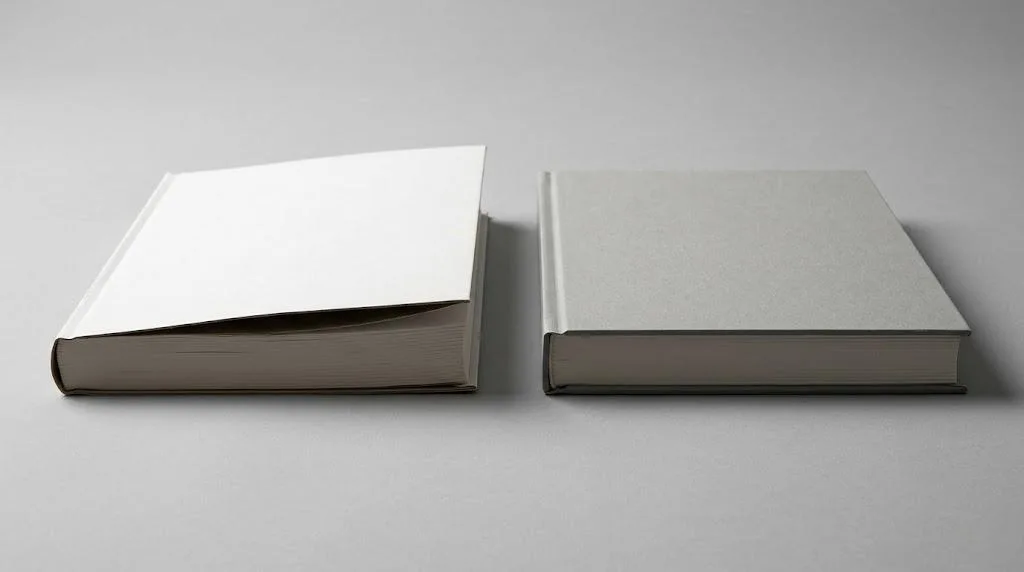
eautiful sample in the summer, place a large order, and then receive a shipment of warped covers three months later — right before your launch date. The printer points to “storage conditions.” You’re left holding unusable inventory with no clear path to a refund.
The root cause almost always traces back to one compromised material: the greyboard. Cheap greyboard fails not because it’s thin, but because of two structural defects that no amount of careful binding can overcome.
The Two Hidden Defects in Low-Grade Board
- Inconsistent density: Budget boards often carry a caliper tolerance of ±0.3mm or worse, meaning one sheet absorbs moisture at a different rate than the next, creating unpredictable stress across a print run.
- No mill-level moisture preconditioning: Premium board is vacuum-sealed at 50% RH before shipping; cheap board ships unprotected, arriving at the bindery already stressed and carrying an irreversible “memory” for warping.
Once that memory is baked in, it doesn’t matter how carefully the binding team works — the board will move when humidity changes, and it will always move in the same direction. This is why a book that looks perfect in a humid Chinese bindery can warp severely after shipping to a dry climate like Colorado or the UK in winter.
The fix isn’t simply “buy better board.” It requires specifying a density threshold of ≥750 gsm with a documented mill certificate, which is a procurement step most buyers never think to request until after the first failed shipment.
Your Warp-Free Hardcover Decision Matrix
At this point, you have the technical knowledge — now you need a tool that converts it into a fast, confident procurement decision. Because the real cost of warping isn’t just reprinting; it’s the delay, the client complaint, and the inventory you can’t ship.
Use this matrix before you approve any hardcover specification. Each row represents a control point where a wrong call creates irreversible downstream risk.
Seven Critical Control Points for Warp-Free Hardcover Production
| Control Point | Minimum Safe Specification | Red Flag to Reject |
|---|---|---|
| Greyboard Density | ≥ 750 gsm, caliper tolerance ±0.1mm | No mill certificate provided |
| Grain Direction | Parallel to spine — confirmed in writing | Verbal confirmation only |
| Bindery RH Environment | 45–55% RH, maintained continuously | No climate control on binding floor |
| Acclimatization Period | 72 hours minimum for all components | Same-day casing-in after delivery |
| Digital Block Rest Period | 48 hours post-trimming before binding | Immediate binding after digital print |
| Adhesive Specification | Humectant content at 5–8% | No adhesive tech sheet available |
| Pre-Production Dummy Test | 7-day warp test, <5mm deflection acceptable | Printer skips dummy stage entirely |
Any printer who cannot answer these seven points with documented evidence is transferring the financial risk directly onto your project, and that’s a conversation worth having before you sign off on a production run.
From Specification to Verification
Knowing the root causes of warping is only half the battle, because the real risk is in the gap between what you specify and what actually gets produced on the floor. A clear, enforceable specification document is the single most effective tool you have to close that gap before a single sheet of greyboard is cut.
What Your Specification Must Lock Down
Your print spec should not be a general description of the finished book, but a technical checklist that leaves no room for interpretation. At minimum, it needs to address the following points explicitly:
- Greyboard density: ≥ 750 gsm, with a caliper tolerance of ±0.1mm
- Grain direction: parallel to the spine, confirmed in writing by the production manager
- Acclimatization protocol: all materials held at 45–55% RH for a minimum of 72 hours before casing-in
- Adhesive formulation: humectant content at 5–8% for multi-climate stability
- Digital interior rest period: 48 hours post-trimming before binding begins
The Verification Step That Most Projects Skip
Once your spec is agreed upon, require a physical dummy book built from the exact production materials, then store it in your local environment for 7 days and measure for warp, with an acceptable threshold of less than 5mm per industry standard. This single step transforms a verbal commitment into measurable proof, and any printer confident in their process will not hesitate to provide it.
Our hardcover printing service is built on the exact moisture-engineering principles outlined above. We provide documented mill certificates, climate-controlled binding floors, and mandatory dummy testing to ensure your books arrive flat, on time, and ready to ship.
Partnering with a Process-Driven Printer
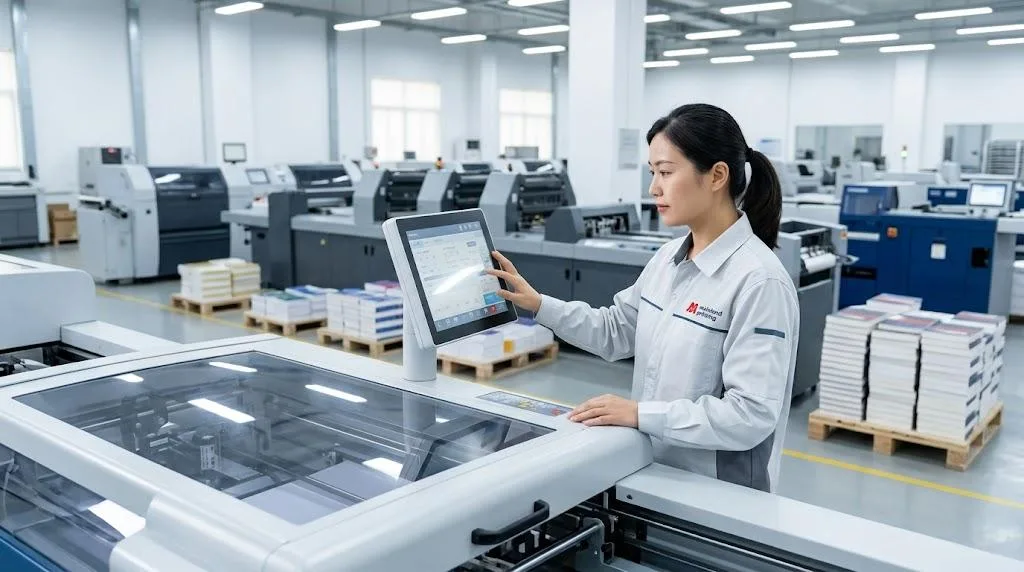
Here’s the uncomfortable truth: even a perfectly specified greyboard can warp if the printer’s bindery floor lacks humidity controls. The material science only works when the production environment supports it, which is why the printer you choose is as much a technical decision as a creative one.
When you’re evaluating a print partner for hardcover work, the right questions aren’t about price per unit—they’re about process documentation. A process-driven printer will have clear, verifiable answers to the following:
- Does their bindery maintain a 45–55% RH environment, and can they show you the monitoring logs?
- Do they enforce a 72-hour acclimatization protocol for all incoming greyboard before it enters production?
- Can they confirm, in writing, that grain direction runs parallel to the spine on every hardcover run?
- Do they offer a physical dummy book for climate-stress testing before your full run is approved?
If a printer hesitates on any of these points, that hesitation is your answer. A shop that cannot articulate its moisture-control process is one that has never systematically solved the warping problem—meaning your project absorbs that risk.
At Mainland Printing, these aren’t policies we invented for marketing copy; they’re the operational baseline our binding team works from on every hardcover project, because we’ve seen firsthand what a single uncontrolled variable costs a client in reprints, delays, and damaged trust with their own customers.
Conclusion:
Warping is not a mystery; it’s a predictable failure of a five-component system—greyboard, cover, endpapers, adhesive, and book block—to reach moisture equilibrium. The solution lies in engineering that system from the start, with precise specifications for board density (≥750 gsm, ±0.1mm), adhesive humectants (5–8%), and a controlled bindery environment (45–55% RH). This approach transforms a common quality gamble into a repeatable, stable manufacturing outcome.
By using the decision matrix as your procurement checklist, you shift the conversation from reactive problem-solving to proactive risk management. Requiring documented evidence for each control point ensures your printer is a true technical partner, safeguarding your project’s timeline, budget, and the professional presentation of your final product.
When you’re ready to discuss how these moisture-engineering principles apply to your next hardcover project, contact our engineering team for a custom quote. We can also provide a detailed guide on quality control in book printing to complement your specifications.