When a training team, coaching practice, or school program needs write-in workbooks that stay open on the desk, the first budget question is rarely a single sticker price.It is whether 100, 300, or 500 copies still make sense once page count, color, coil choice, tabs, covers, packaging, and ship-to destination are locked.
Spiral bound book printing cost is planned from quantity plus a locked specification—not a fixed unit price—so a 100 / 300 / 500 ladder and a comparable-quote field list let you compare printers before you RFQ.
This guide shows how to brief finance on why the first batch sits at one rung, what moves the number, and which files and destinations every vendor must price the same way.
What Actually Moves Spiral Workbook Printing Cost
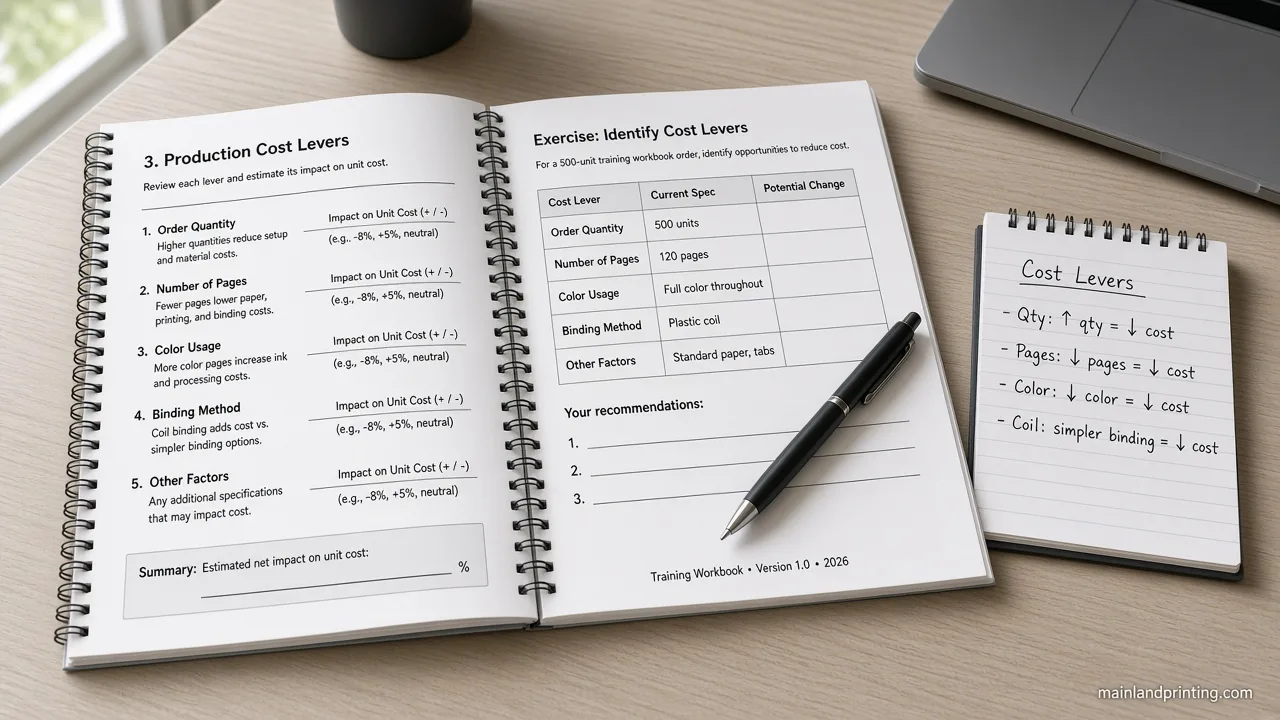
Spiral workbook unit cost moves with run size, page count/thickness, interior color mix, coil or Wire-O choice, cover/lamination, and file setup constraints such as binding-edge margin.
External guides document these levers for US short-run and workbook jobs; destination packaging and tabs still need to be listed on the RFQ even when a calculator omits them. Competitor dollar bands are not Mainland prices; do not publish a single fixed unit price without a locked specification.
The table below locks the levers before anyone asks “how much per book?”
| Cost lever | What to lock for a comparable quote |
|---|---|
| Quantity rung | Plan 100 / 300 / 500 as first-batch options, not three vague guesses |
| Page count and trim | Finished pages, US Letter vs A4 vs custom, portrait or landscape |
| Interior color | B&W, full color, or mixed sections called out by page range |
| Reliure | Plastic coil vs Wire-O, color, bound edge (side or top) |
| Tabs / dividers | Count, stock, print, and position—mechanical binds can mix stocks when specified |
| Cover + write-on stock | Cardstock + lamination or PVC; uncoated interiors for pen work |
| Packaging + destination | Carton marks, office vs warehouse delivery, Incoterm if cross-border |
US workbook guides also stress uncoated interiors for fill-in pages and coil sizing that follows thickness—useful planning logic, not a substitute for your factory quote. See Publishing Xpress’s workbook spiral guide for competitor-side paper and coil framing only.
Build a 100, 300, and 500 Copy Cost Ladder
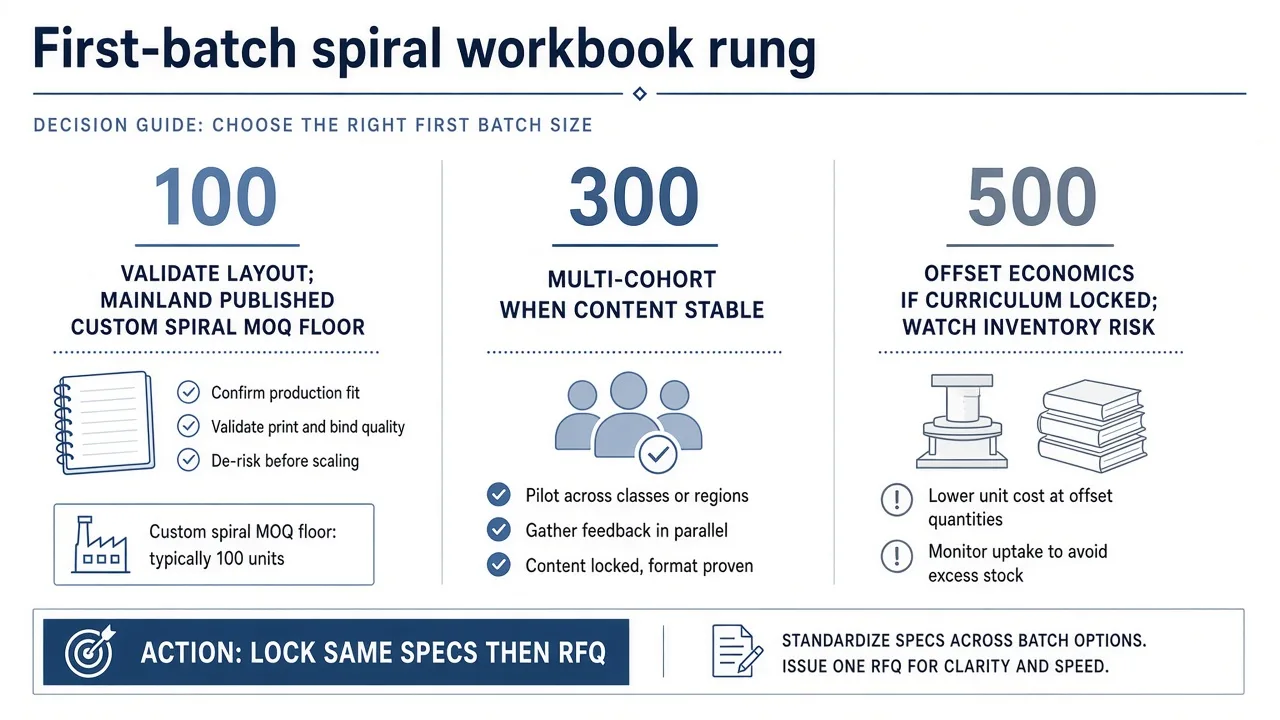
Mainland’s published standard minimum order quantity for custom spiral-bound notebooks is 100 copies.This MOQ is stated on the spiral product FAQ for custom spiral-bound notebooks on the offset path; project exceptions need a live quote confirmation. MOQ 100 is not a fixed unit price and does not prove every workbook configuration starts at the same per-unit cost. Finance still plans from the published 100 MOQ floor, then verifies unit cost only after the same rung and specs are locked.
The ladder works as three planning conversations, not three promises:
- 100 copies — Validates layout, coil color, and write-on stock with the smallest committed inventory. It matches Mainland’s published custom spiral MOQ floor for many branded workbook jobs.
- 300 copies — Fits multi-cohort trainings or a quarter of facilitated programs when content is stable. Unit cost usually improves versus 100, but only if page count and color mix stay identical on the RFQ.
- 500 copies — Often the rung where offset economics and packaging amortization look healthier for stable curricula. It is still an inventory decision: unsold workbooks with dated exercises are expensive “savings.”
If content will change after the first workshop, stay on 100 now + 300 later instead of forcing 500 for a prettier unit number. When you compare printers, force every quote onto the same rung and the same variable table above—otherwise “cheaper” is just a thinner spec.
Plastic Coil vs Wire-O in the Budget
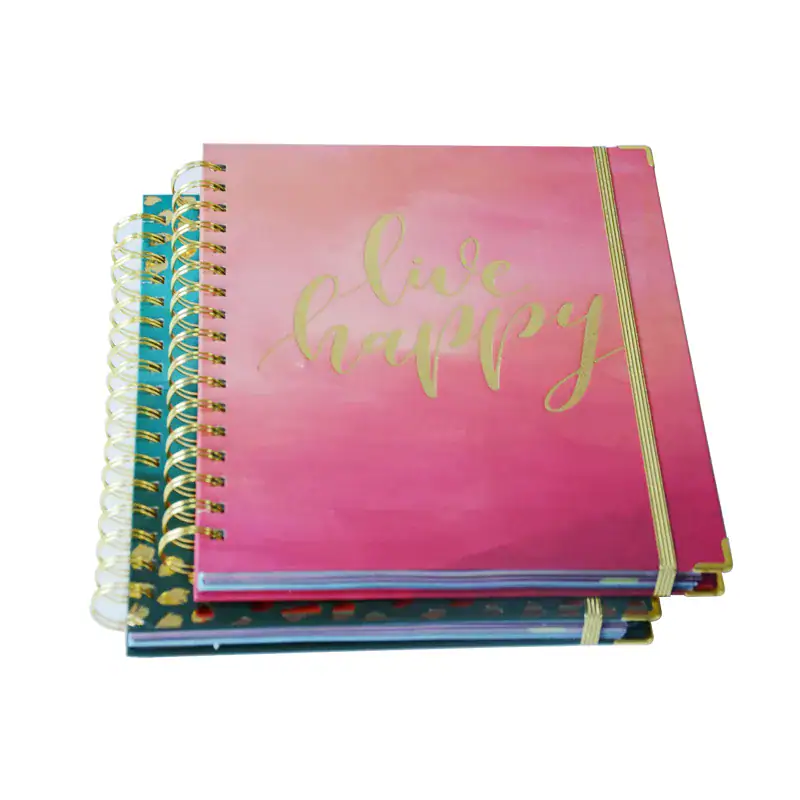
Plastic spiral coil is the durability pick for heavy-use workbooks and training manuals because it springs back if crushed; Wire-O looks more formal but can stay bent if mishandled.Use this as a budget and use tradeoff inside the cost plan; a full material comparison belongs on the Wire-O vs plastic coil sibling article. Do not invent pitch or diameter absolute limits beyond the money page; coil diameter still follows finished thickness on the quote.
US trade explainers make the same crush point from the other direction: a flattened twin-loop wire stays flat in bags and cartons, while plastic coil tends to recover—one reason field manuals lean plastic (4OVER4 Wire-O guide). That is a durability cue for your budget row, not a Mainland price card.
When the workbook doubles as a client-facing leave-behind on a boardroom table, Wire-O can justify a premium line item. When coaches toss copies into backpacks between sessions, plastic coil usually belongs on the cost plan first.
Ready to compare real spiral workbook runs?
Share the field list in the next section and we will price the same rung on Mainland’s spiral line—coil options, write-on stocks, and factory packing included.
Write-On Paper and Covers That Change the Quote
For training manuals, workbooks, and planners, Mainland recommends 80 lb / 120 gsm uncoated interior stock because it is easy to write on. Image-heavy sections may still use coated stocks; mixed stocks are a quote line, not a free default.Competitor 60/70/80 lb guidance is not Mainland’s published default; prefer Mainland’s table when stating company recommendations.
Check three quote lines before you approve stock:
- Uncoated write-on weight for exercise pages (Mainland table: 80 lb / 120 gsm)
- Any coated photo inserts called out by page range
- Cover cardstock + lamination, or frosted PVC for high-touch manuals
Coated gloss interiors look sharp in photos and smear under gel pens on fill-in pages, so keep exercise sheets uncoated even if a photo insert section upgrades. Leave at least 12 mm to 15 mm (about 0.5″) of inner margin so spiral punch holes do not cut into text or graphics.Applies to spiral/Wire-O punched edges on Mainland’s published FAQ; landscape or top-bound jobs still need the clear zone on the bound edge. This is a prepress clearance rule, not a pricing formula. Inspect proofs and measure the 15 mm gutter once on the PDF, because reprints from punched-through type are still a real cost event.
MOQ and What to Send for a Comparable Quote
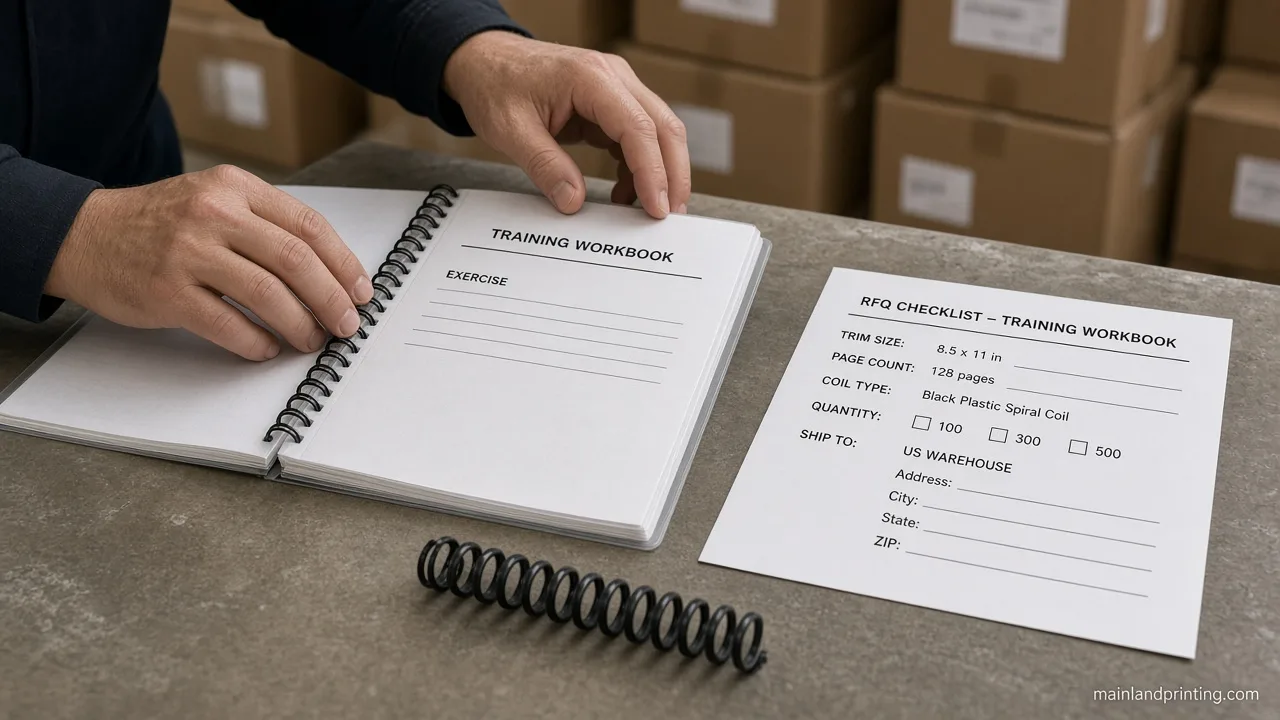
After a few spiral RFQs, the pattern is familiar: buyers ask for 50 / 100 / 200 / 300 copy prices while files are still missing tabs, destination, or binding edge.Mainland’s published custom spiral MOQ of 100 copies is the planning floor for many branded notebook-style jobs, so treat sub-100 asks as a confirmation question on the quote thread rather than a silent assumption.
Red flags on a spiral workbook quote: missing destination packaging, unspecified write-on stock, or three quantity prices with different page counts.
Send one pack so every printer prices the same job:
- Trim size, orientation, and finished page count
- Interior ink plan (B&W / color / mixed page ranges)
- Paper: uncoated write-on weight for exercise pages; note any coated inserts
- Binding: plastic coil or Wire-O, color, side or top
- Tabs/dividers count and stock if used
- Cover construction and lamination or PVC
- Quantities on the 100 / 300 / 500 ladder (or your locked rung)
- Packaging marks and ship-to (office, school, or warehouse) plus Incoterm if cross-border
- Press-ready PDF with ≥0.5″ clear binding edge and bleed notes
General hardcover and softcover publisher tables live on our book printing cost guide; keep that path for case-bound budgets, not spiral workbook ladders. Product options and samples start from the spiral bound book printing page after the rung is locked.
Lock Specs Before You Chase a Unit Price
Spiral workbook budgets hold when the specification and the quantity rung move together. Lock write-on stock, coil choice, tabs, covers, packaging, and destination, then read 100 / 300 / 500 as inventory decisions against Mainland’s published 100-copy custom spiral MOQ—not as three detached stickers from a calculator.
If the curriculum is still shifting, print the smaller rung, mark the RFQ fields once, and reuse them when you step up. That is how spiral bound book printing cost stays comparable across vendors and across reprint seasons.