When a monograph has a fixed gallery receiving date and a separate warehouse on-sale window, the freight plan has to start at the dock appointment—not at the day cartons leave the plant.
Art book shipping to the USA works when you lock the hard delivery date first, then backfill export pack specs, warehouse ASN fields, and whether a preview tranche flies while bulk inventory moves on ocean DDP to a US 3PL.
You leave able to reverse-schedule from the gallery or warehouse date, sign off export pack before freight books, email a warehouse row the receiver can act on, and decide split versus one bulk DDP drop without guessing from ex-factory alone.
Packaging Risk Checklist Before Freight Leaves the Plant
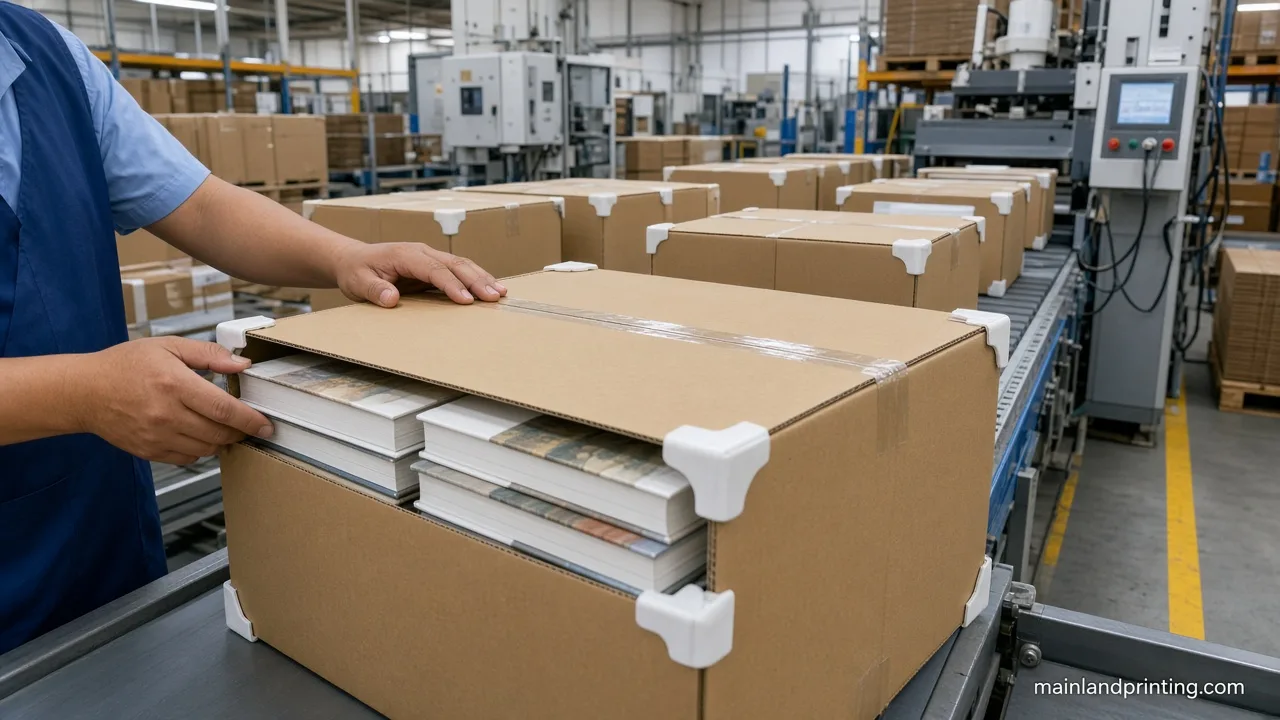
Heavy art books fail in predictable places: cover scuff where volumes rub, corner crush where cartons stack, and jacket tears where flaps catch on tape or a neighbor book.
Swann’s book pack steps state the per-volume rule plainly: Wrap each book individually in clean tissue paper or bubble wrap, secure all sides with tape, and ensure no tape is placed on the surface of the book.
This Swann consignment pack note targets auction inbound cartons; it still applies when export cartons mix multiple art-book SKUs and you need to stop cover scuff from neighbor volumes.
Attribute the no-tape-on-cover rule to Swann’s published steps; it does not replace factory shrink or slipcase specs on the RFQ.
ShipStation book packing guidance states the weight cue this way: Use a double-walled box if total shipment exceeds 10 pounds, and add bubble wrap especially around hardcover corners and the spine.
ShipStation’s retail book guidance assumes parcel post; ocean export cartons still need corner protectors when cartons stack in a container.
The 10-pound double-wall cue is ShipStation’s published threshold, not a Mainland MOQ or carton count rule.
Wrap each volume individually, keep tape off cover surfaces, and fill carton voids so corners cannot telegraph crush in transit.
The table below flags the three damage modes your pack brief should close before freight books. Treat each row as pass/fail at final pack approval.
| Risk signal | Pack response |
|---|---|
| Cover scuff from unwrapped neighbor volumes | Individual wrap; tape only on wrap, not on jacket or case |
| Corner crush under stacked cartons | Double-wall export cartons, void fill, corner protectors on heavy sets |
| Jacket tear at flap or spine fold | Jacket-on shrink or slipcase where flaps move; note fragile on outer carton |
On a documented 5,000-set Kickstarter hardcover run, Mainland used custom double-wall corrugated cartons with reinforced corner protectors before DDP distribution—that engineering story lives on the art book packaging case study, while this page keeps the generic checklist you reuse on the next title.
Warehouse Intake Fields Galleries and 3PLs Actually Use
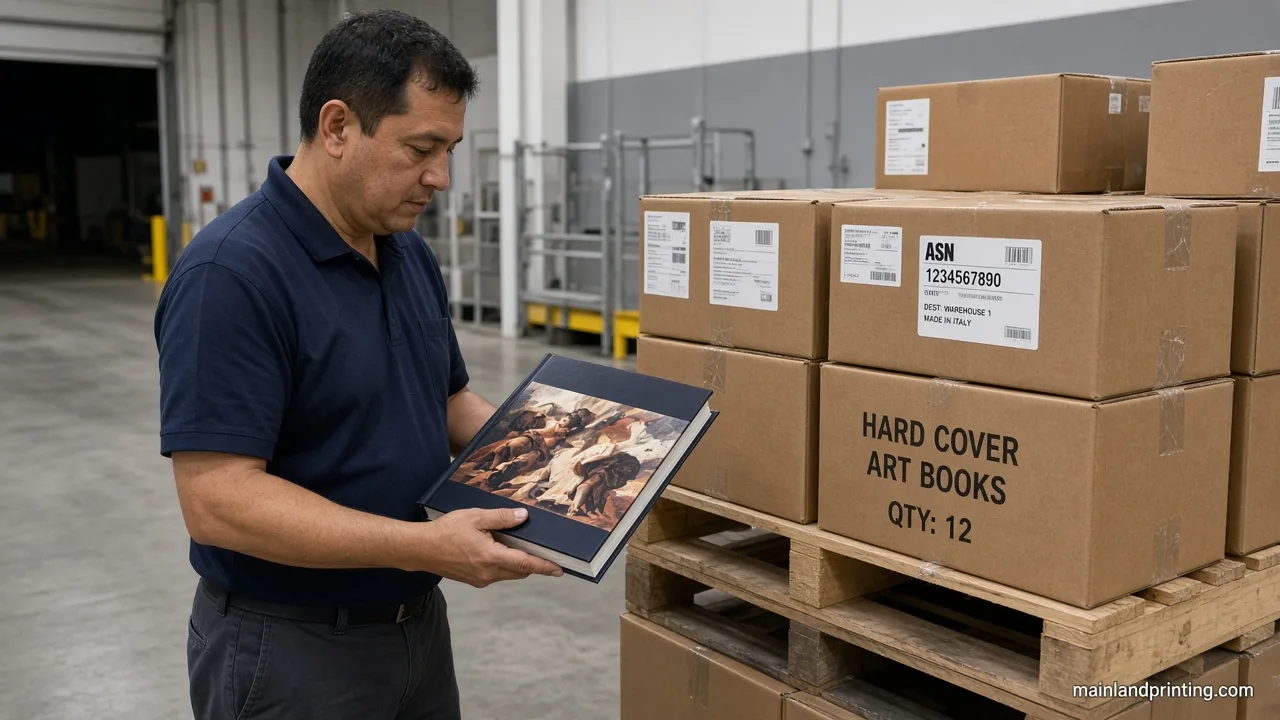
Galleries and book-trade receivers rarely reject freight because the ISBN was wrong; they stall when ASN data, dimensions, or appointment windows do not match the physical pallet.
Measure stacked carton height against the warehouse cube limit when you draft the ASN row so receivers do not reclassify the lot as oversize freight.
Racklify’s art book fulfillment overview describes intake the way US 3PLs expect it: Receiving inspection should check dust-jacket condition at intake, and picking should use rigid backing boards, corner protectors, and appropriately sized boxes to prevent spine damage and edge scuffing.
Racklify describes 3PL art-book fulfillment; your warehouse row still needs live ASN, appointment, and lift-gate fields from the receiving 3PL.
Fulfillment encyclopedia text does not prove Mainland runs US warehousing; it only supports the intake checklist buyers must send.
Receiving inspection should flag dust-jacket condition, oversized dimensions, and special-handling SKUs before pallet putaway.
Send this field set with the ASN before you confirm the sailing or air booking. Missing lift-gate or oversize flags is what turns a clean DDP arrival into a reschedule fee, and oversize pallets without a red flag on the ASN are the usual reason receiving moves your slot.
| Warehouse field | Why receivers ask |
|---|---|
| SKU / edition flags (signed, jacketed, oversized) | Routes special handling and pick packaging |
| Carton dimensions and weight per SKU | Drives DIM billing and slot assignment |
| Dust-jacket condition note at intake | Sets damage claims before putaway |
| Delivery appointment / receiving hours | Gallery and trade docks are appointment-driven |
| Lift-gate or inside delivery requirement | Prevents refused LTL at curb |
Reverse Schedule From Exhibition or On-Sale Date
When the gallery confirms a receiving appointment, count backward through customs clearance, ocean or air transit, export pack approval, and binding completion—not from printer ex-factory optimism alone.
Work backward from the gallery delivery appointment through customs clearance, ocean or air lane choice, and export pack approval—not from printer ex-factory alone.
Lock the gallery delivery appointment before you commit cartons to a single ocean DDP lot.
Transit ranges belong in quotes, not guarantees: published US parcel tables often cite roughly two to ten days for economy book post and one to three days for priority domestic parcel, while ocean DDP lanes from China commonly sit in forwarder estimates around several weeks, and your forwarder row replaces any generic range once the lane is booked.
The milestone table is a planning spine. Adjust weeks to your lane confirmation; the order of gates stays the same.
| Milestone (from event date) | Planning gate |
|---|---|
| Event / on-sale date (Day 0) | Gallery delivery or warehouse release aligned to publicity |
| US customs cleared + last-mile booked | DDP proforma named place matches receiver; see DDP buyer guide for Incoterm depth |
| Ocean or air departure | Pack checklist signed; ASN sent |
| Export pack approval | Corner protectors and jacket protection verified on a sample carton before the line seals |
| Binding ex-factory | Tied to print schedule on impression de livres d'art specs |
Ready to align print dates with US delivery?
Send your event date, pack checklist status, warehouse row, and whether you need a split tranche so production can quote print and freight together.
When to Split Shipments Instead of One Bulk DDP Drop
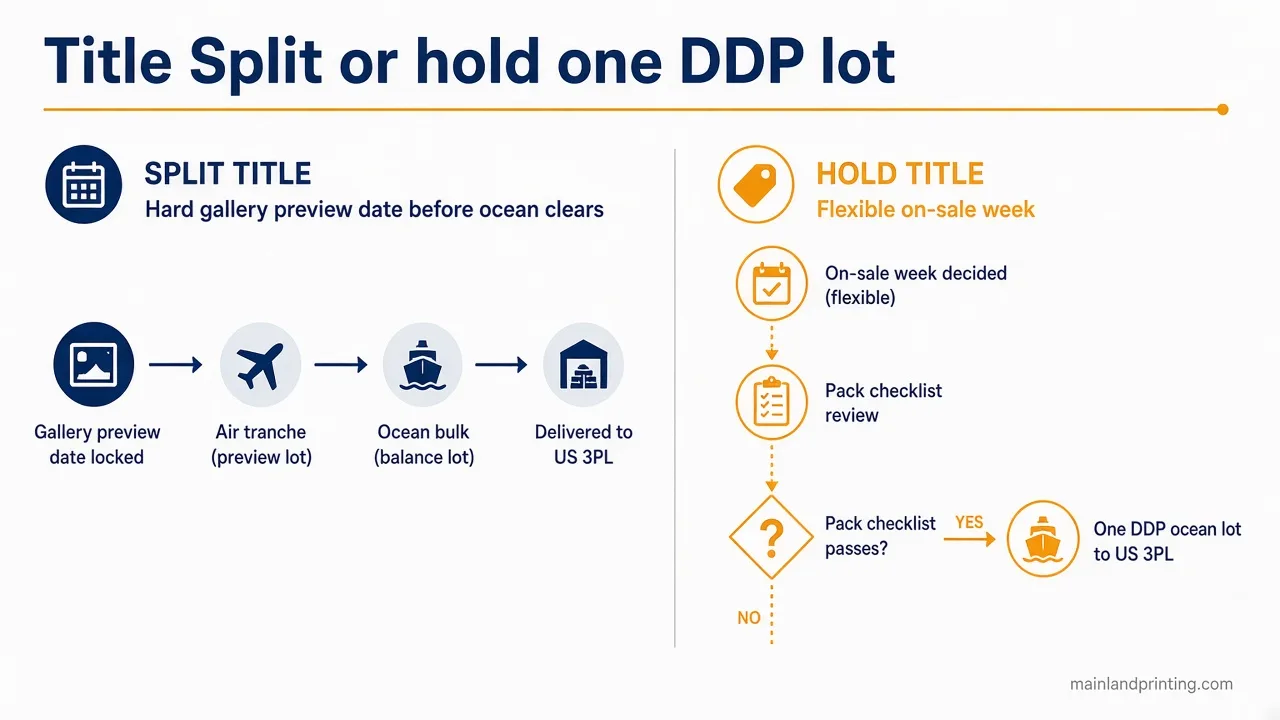
One ocean DDP lot is cheapest on paper until a dated preview, a museum shop opening, or a Kickstarter tier needs cartons early while the rest of the print run still sails.
Split when a dated gallery or preview tranche needs air protection while inventory bulk continues on ocean DDP to a US warehouse without missing the public on-sale window.
Mainland’s published Kickstarter art-book case reported less than 0.1% damage on 5,000 units—cite that page, not as a universal SLA.
That figure is tied to one documented case with custom double-wall cartons and DDP logistics; it is not a universal SLA for every art-book shipment.
Do not extrapolate 0.1% to all mainlandprinting.com quotes; link readers to the case study for context and keep this page on planning frameworks.
Split when the left column matches your launch; hold one bulk DDP drop when the right column matches.
| Launch signal | Ship pattern |
|---|---|
| Hard gallery or preview date before bulk ocean can clear | Air or express tranche for dated copies; ocean DDP bulk to US 3PL for inventory |
| Single warehouse on-sale with flexible publicity week | One DDP ocean lot if pack checklist passes and ASN is accepted |
| Mixed destinations (gallery + shop + 3PL) | Split by receiver after US hub, not only by carton count at origin |
| Collectors’ jackets or slipcases that fail repack at hub | Keep finished pack at origin; avoid break-bulk repack unless the 3PL spec allows it |
Incoterm definitions, duty lines, and proforma checks stay on the DDP buyer guide; this split frame only decides whether one lot or two tranches matches the calendar.
Send Your Gallery Dates With the Print RFQ
When pack, warehouse, schedule, and split rules are written, the useful next step is an impression de livres d'art review that carries the same dates—not a freight quote detached from binding completion.
Approving a beautiful press sheet does not approve export cartons; passing the pack checklist and ASN row is what lets DDP delivery match the gallery appointment without a surprise curbside refusal.
Send event date, receiver list, pack checklist status, and split yes/no with the print RFQ so production and logistics price the same reality.