When a China softcover run already has a print unit price but the US warehouse still has no firm inbound week, debating ocean versus air first rarely fixes the refusal risk. You can still reverse-plan dock week, receiving rules, carton marks, and split or DDP checks before freight becomes a gamble.
Plan paperback book printing from China to a US warehouse by locking the dock receipt week first, then reverse-scheduling sample, press, packing, and freight—and treat DDP or split air as final only after warehouse rules and carton facts are written.
You will leave able to freeze a print-to-dock schedule you can defend, Hold unsafe mode or DDP asks, and send a Softcover RFQ that already carries receiving and carton fields—so the next launch does not depend on a freight-mode guess.
Start With Dock Week, Not Freight Mode
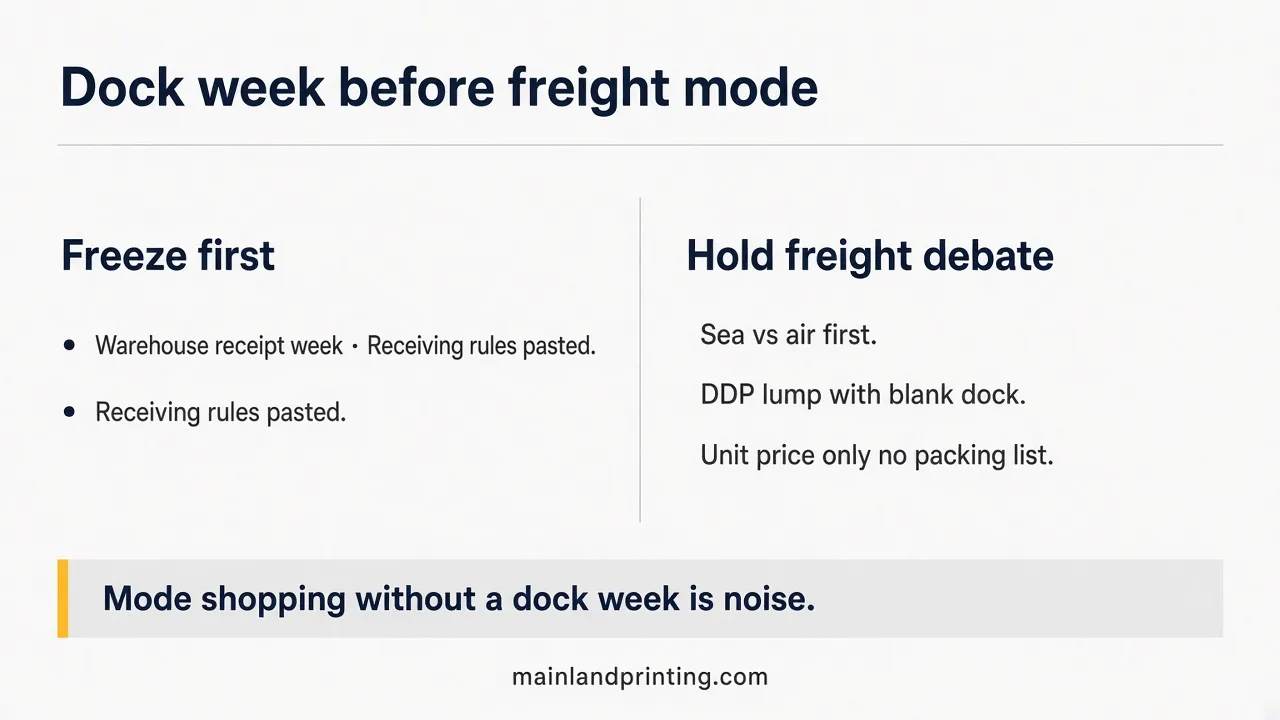
When the first line in the quote thread is “sea or air?”, you are skipping the only date your warehouse will enforce: the week cartons must clear inbound.
Write the required warehouse receipt window on the RFQ before you debate freight mode. Then ask the plant to backfill sample approval, press time, bindery, export packing, and transit so the whole chain lands inside that window.
| If you start here | Better first move |
|---|---|
| Ocean vs air debate | Freeze receipt week + appointment rules first |
| “DDP included” headline | Ask for receipt date + carton plan on the same quote |
| Print unit price only | Lock trim, page stock, cover finish, then freight tier |
If your launch calendar is still moving, Hold the freight mode choice and keep refining the print schedule against a provisional dock week. Mode shopping without a date is noise.
Put the dock week next to quantity on every revision. When marketing shifts the on-sale date, you update the warehouse window in the same email—not three threads later when freight is already booked.
Planning bands for sample (often 7–14 days with courier), press (often 2–4 weeks after sample OK), and transit must be confirmed on the live booking—treat them as planning tools, not a universal Softcover SLA for every ZIP and Incoterm.Inspect the reverse schedule whenever marketing moves the on-sale date by even 5 days.
Lock Warehouse Receiving Facts Before You Quote DDP
Before you ask for a delivered total, send the warehouse facts the forwarder cannot invent. Incomplete address threads are how “door delivery” turns into a refused trailer.
Use when the consignee is a commercial/3PL warehouse with published inbound rules.
| Detail to send | Keep / Hold |
|---|---|
| Full consignee + ZIP | Keep when legal name matches paperwork; Hold on city-only or “TBD 3PL” |
| Address type | Keep when commercial dock / 3PL / residential is labeled; Hold when type is blank |
| Receiving hours + appointment | Keep when hours + ASN/appointment rules are stated; Hold on “anytime” with no contact |
| Unload gear | Keep when dock + forklift or written liftgate need exists; Hold on ground-level door with no liftgate line |
| Pallet / height / label rules | Keep when max height, wrap, and marks are pasted from the warehouse email; Hold when limits are assumed |
Treat United States warehouse receiving as a written checklist: packing list, carton marks (title/ISBN/qty/weight), pallet height limit, and ASN/appointment when the warehouse requires them — unlabeled or loose softcover cartons can be refused even if freight is paid.
Cardinal limits (e.g., 52-inch pallet, 40-lb carton, 15-carton appointment threshold) are one warehouse example — always use the buyer warehouse written rules, not these numbers as universal. Publisher warehouse standards such as carton shipping standards show why marks, ASN, and height show up in inbound emails.
- Warnsignal: commercial invoice ready but carton marks still “TBD.”
- Warnsignal: pallet height measured after wrap exceeds the warehouse email limit by even 2 inches.
- Warnsignal: liftgate required at address type, missing on the booking for 3–5 days.
Verify receiving hours in writing (for example 08:30–15:30) and check whether an ASN is required 24–48 hours before arrival.Measure max pallet height against the warehouse email before you approve dispatch photos.
Copy this line into your RFQ remarks: “US delivery plan: [address type], appointment [yes/no], liftgate [yes/no], max pallet height [in], receiving contact [name/phone].” If any bracket stays blank, Hold the freight line.
Plan a Paperback Print and Delivery Schedule
Share quantity, softcover specs, dock week, address type, and receiving rules. Mainland Printing can align Softcover print with carton and delivery planning before you approve the sample.
Write Paperback Carton and ASN Facts Once

Use when a softcover or paperback RFQ is moving from print unit price to United States warehouse delivery planning. Freight follows the packed shipment—not the cover price alone.
Before you ask for freight on a China paperback run to a United States warehouse, request an estimated packing list — carton count, books per carton, carton dimensions, gross weight, and total volume — because freight follows the packed shipment, not the unit print price alone.
Does not invent Mainland SLA days or guarantee a freight rate; packing estimates can change slightly after production. OEM landed-cost guides put the same packing-list ask ahead of mode shopping—request carton count, books per carton, and gross kg before you compare ocean vs air rates.
| Softcover carton check | Ready / Hold |
|---|---|
| Books per carton + L×W×H + gross kg | Ready when on the packing estimate; Hold on “standard export carton” with no sizes |
| Carton marks (title / ISBN / qty / weight / carton # of #) | Ready when they match the ASN template; Hold on generic “books” marks |
| Cover finish / flaps noted for scuff protection | Ready when laminate/flaps and inner wrap method are written; Hold when finish changed after freight was frozen |
| Pallet height vs warehouse email | Ready when measured height ≤ written max; Hold when wrap photo shows lean or overhang |
Softcover cartons are denser than hardcover board stacks, but laminated covers and flaps still scuff if void fill is lazy.Freeze cover stock, lamination, and flap choice before you lock freight—or reprice when those specs move. Freeze cover stock, lamination, and flap choice before you lock freight—or reprice when those specs move.
Hardcover board, jacket, and corner-guard math stays on the Lieferung aus dem Lager für Hardcover-Bücher twin—do not paste those board rules onto a Softcover ASN.
Open Split Air Only When Launch MVQ Is Real
Use when a paperback launch needs early cartons before ocean arrives. Split can help—only if the early quantity is real.
Open an air-first softcover split only when you can name the launch week and the minimum cartons that must arrive early — otherwise Hold split and keep one ocean plan, because split adds packing lists, marks, and bookings you must manage.
Does not publish a universal 10/90 ratio here; formula depth belongs to the split-shipping article; no invented Mainland air MVQ percentage. Use the geteilte Versandstrategie page when you need the deep air/sea formula after this gate says Open.
| Signal | Open or Hold split |
|---|---|
| Launch week + early carton count named | Open — then price air MVQ + ocean balance as two packing lists |
| “Maybe air some” with no count | Hold — keep one ocean plan until MVQ is written |
| Dock week already fails even with air | Hold freight debate — move dock week or compress sample/press first |
Audit Named-Place DDP Before You Approve Freight
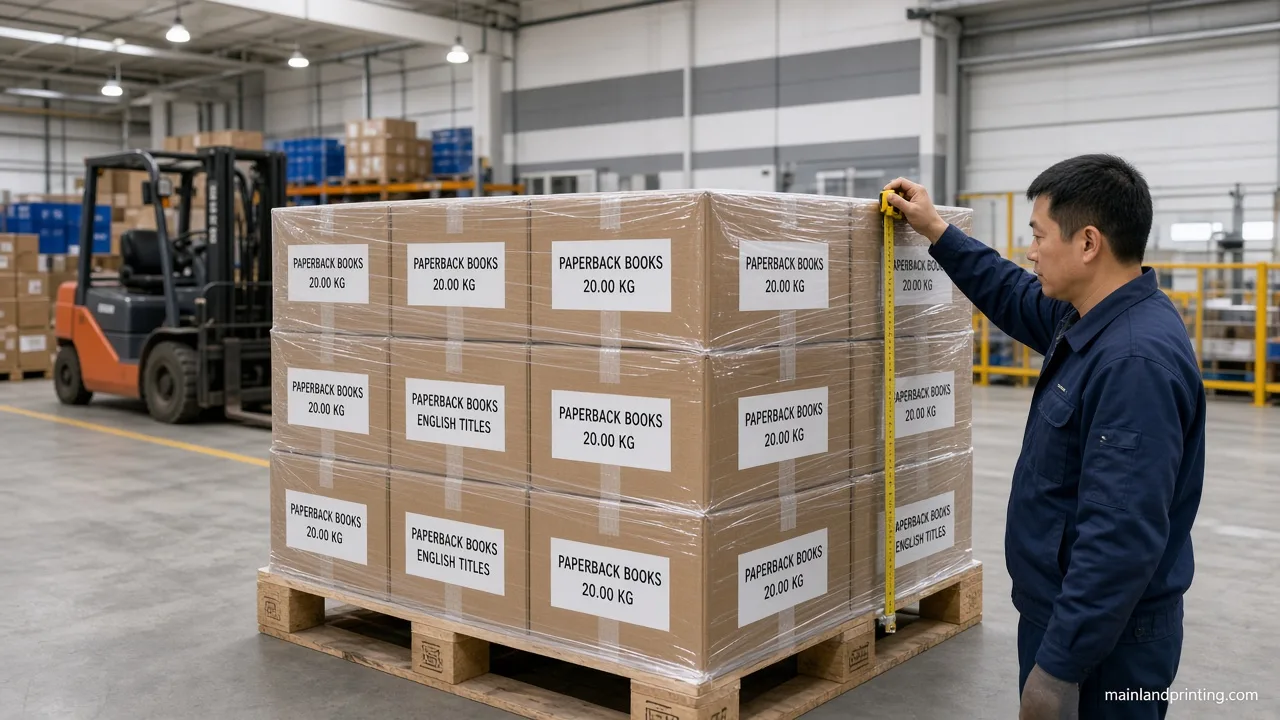
Use when Softcover buyers ask for DDP to a US warehouse or commercial dock.
Audit any Softcover DDP quote against the named place on the contract and the warehouse receiving rules — Incoterms allocate cost and risk to a delivery point; they do not certify that your 3PL will accept the pallet height or carton marks.
Does not restate full ICC article text; deep Incoterm layers stay on the site DDP guide; forbids claiming DDP guarantees inbound acceptance.Read the official framing on the ICC Incoterms® 2020 page, then bring the named place and unloading notes back to your Softcover proforma. For the full buyer-side DDP checklist, use the DDP buyer guide—this article only audits Softcover warehouse fit.
| DDP line to audit | What to write back |
|---|---|
| Named place = port only | Ask for warehouse/3PL ZIP + inland assumption on the same quote |
| One lump “DDP included” | Request freight / clearance / duty / inland as separate lines under the total |
| Receiving rules blank | Hold approval until pallet height, marks, and appointment sit beside the DDP line |
Ask your supplier to list freight, clearance, duty, and inland delivery as separate lines even under one DDP total. If any bucket is a vague lump, you cannot audit the quote when specs or the named place change.
Lock Your Softcover Dock Week Into the RFQ
Lock the receipt week, paste the warehouse checklist, freeze softcover specs that drive cartons, and only then open split air or approve a named-place DDP line. That sequence is how you move paperback books from a China press to a US warehouse without gambling the launch on a mode guess.
When quantity, cover finish, dock week, address type, and ASN fields are ready, start from Softcover-Buchdruck with those fields attached—not a bare unit-price ask. If quantity tiers are still open, Hold the freight booking until the Softcover Planner quote and dock week sit on the same revision.
A complete Softcover RFQ that already names dock week and receiving rules is the signal you are ready to approve print and delivery together—not three email chains later.