Getting a CPC certificate for lead-free children’s book printing shouldn’t be a guessing game. If you are terrified of CPSC holds and hidden heavy metals ruining your shipment, you are in the right place. I am going to show you the exact factory-level protocols we use to guarantee 100% compliance.
Lead-free children’s book printing ensures total heavy metal content stays below 90 ppm for surface coatings and 100 ppm for substrates, meeting CPSIA standards. Factories achieve this by strictly combining soy-based inks, phthalate-free PUR glues, and deep press washing to stop contamination.
But here is the crazy part: your eco-friendly ink means absolutely nothing if your factory uses the wrong binding glue. Let’s dive into the hidden traps that trigger U.S. customs holds—and exactly how to avoid them.
Press-Level Anti-Contamination Protocols
Most procurement managers operate under a dangerous, simplified misconception: they equate child safety strictly with purchasing safe raw materials.You specify soy-based ink and FSC-certified paper, assuming the final laboratory ASTM F963 testing will automatically validate the final product. This mindset completely ignores the physical reality of an active manufacturing floor.
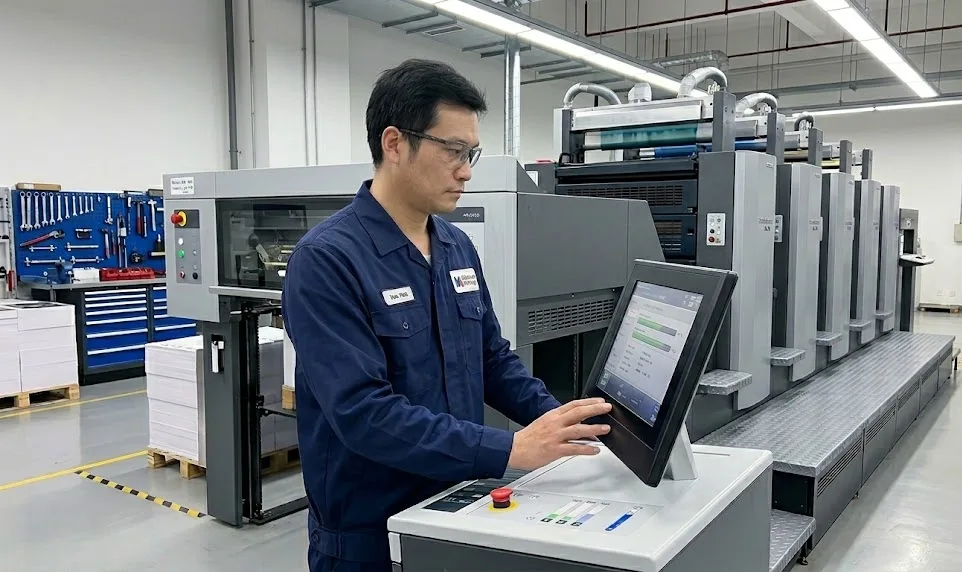
Consider the machinery itself. A modernized Chinese printing facility rarely prints children’s books exclusively. The production run immediately prior to your project is highly likely to be a high-gloss commercial catalog or a heavy industrial brochure.To achieve rapid curing on heavy commercial paper stocks, standard industrial inks utilize aggressive metallic driers containing cobalt, manganese, and trace amounts of lead. If the pressroom only executes a standard, quick wipe-down between shifts, microscopic metallic residues remain trapped deep within the roller pores, the ink fountains, and the dampening system.
When your environmentally pure soy ink is loaded into the press, its high chemical solvency acts as an active stripping agent. It pulls those residual heavy metals directly out of the rollers and deposits them onto your pristine paper stock.Your “safe” materials are chemically compromised before the very first sheet reaches the delivery tray. This mechanical reality aligns with the stance of Gary Jones, Director of Environmental, Health, and Safety (EHS) Affairs at the PRINTING United Alliance, who emphasizes that chemical compliance requires meticulous facility-level chemical management, not just eco-friendly purchasing.
To physically prevent this cross-contamination, your printing partner must execute a strict, verifiable quarantine procedure. A Master Press Operator must execute a strict Deep Roller Wash protocol.Before a lead-free children’s book goes on press, it mandates a 45 to 60-minute dedicated cleaning cycle, circulating compliant, heavy-metal-free wash-up solutions through the rollers a minimum of three times. Without this press-level quarantine, your material specifications are completely invalidated by the machinery printing them.
Factory Cleaning Protocol Comparison
| Operational Parameter | Standard Commercial Wash (High Risk) | Deep Roller Wash Protocol (Child-Safe) |
|---|---|---|
| Execution Time | 10 – 15 minutes | 45 – 60 minutes minimum |
| Chemical Process | Single pass with standard industrial solvents | 3x circulation with compliant, heavy-metal-free wash |
| Production Scheduling | Run immediately after any commercial job | Quarantined scheduling (run after blank or eco-friendly jobs) |
| Color Control Impact | Standard visual checks | CIP3 system validation for ΔE ≤ 2.5 color accuracy |
Quick Guide: If your priority is avoiding cross-contamination penalties, choose the Deep Roller Wash Protocol; standard commercial washes do not extract deep chemical residues from the ink roller micro-pores.
Hidden Lead Traps in Book Binding
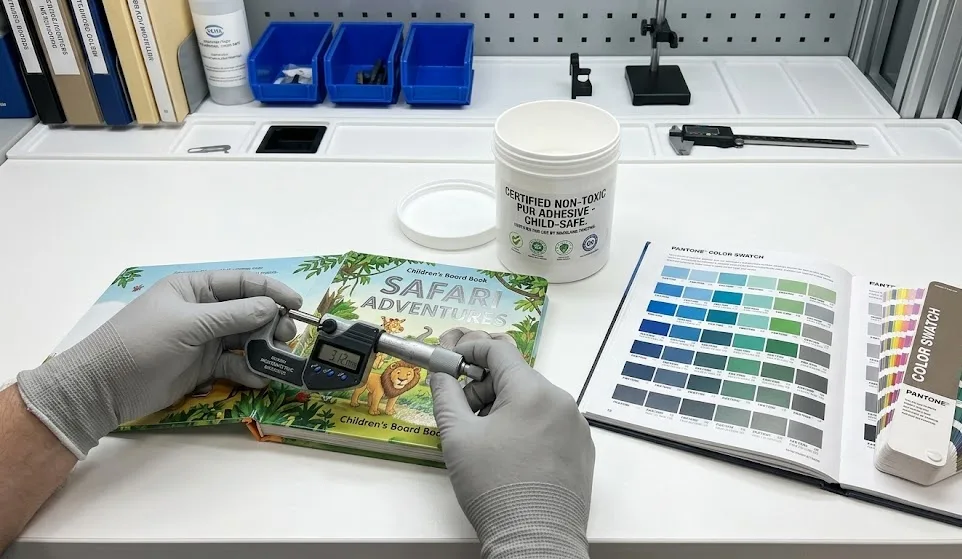
In a standard board book or hardcover volume, the actual printing ink accounts for less than 3% of the total physical weight of the product. Procurement managers routinely fixate all their auditing energy on the paper and the ink, completely missing the most volatile regulatory blind spots in the entire process: the secondary binding materials.We frequently audit troubled projects from independent publishers who previously sourced their printing elsewhere and failed customs inspections. The root cause is rarely the primary materials; it is almost always a failure in post-press supply chain control.
We frequently audit troubled projects from publishers who previously sourced elsewhere. In one specific recovery case, a buyer commissioned a board book using 350gsm C1S art paper with a foil-stamped cover.They aggressively mandated soy ink and demanded FSC certifications up front. Yet, their entire shipment triggered a U.S. Customs hold for heavy metal contamination. The paper and ink were, in fact, perfectly compliant. The failure originated from a hidden, physical supply chain swap.
What actually happened on the factory floor? First, the previous facility failed to maintain the post-press workshop’s relative humidity within the strict 50% to 55% operational window. Second, the raw paper absorbed ambient moisture, creating severe structural tension imbalances and moisture shock (warping) during the board mounting process.Third, to forcefully flatten the warped boards and salvage the delivery timeline, a subcontracted binding workshop silently abandoned the specified safe adhesive. They substituted a low-grade EVA hot melt glue formulated with heavy metal stabilizers to artificially increase tackiness and drying speed. Furthermore, the sizing layer of the cover’s foil stamping later tested at 140 ppm for lead—instantly breaching the 90 ppm surface coating limit under the CPSIA lead limits standard.
The paperwork means absolutely nothing if the physical manufacturing process allows for chemical cross-contamination or hidden material swaps on the factory floor.
To prevent this catastrophic “bait and switch,” you must establish hard boundaries with your printing partner before mass production begins. Review these core decision points for material lock-in:
- Zero Subcontracting Policy: Mandate that all binding, laminating, and foil stamping must occur in-house under the primary factory’s direct quality control.
- Adhesive Verification: Demand independent, third-party testing specifically for the PUR (Polyurethane) or EVA glues being used to eliminate structural failure and heavy metal contamination.
- Phthalate-Free Mandates: Ensure all lamination films are explicitly certified as Phthalate-Free, as these plasticizers are heavily restricted under CPSIA regulations.
Why Mixed Samples Ruin Deliveries
To compound the disaster of hidden material swaps, many factories attempt to minimize laboratory costs for their clients by utilizing a dangerous shortcut known as Composite Testing.Instead of paying for individual lab tests for the paper, the glue, and the foil, the factory instructs the third-party laboratory to physically mix the lamination film, the foil, and the binding glue into a single test batch. While this saves a few hundred dollars upfront, it alters the legal mathematics of your compliance, often resulting in a rejected shipment under the official CPSC testing rules.
Here is the mathematical testing trap that destroys delivery schedules. When $n$ distinct materials are tested together, US Customs enforces a strict fractional margin of safety to prevent the dilution of toxic elements.Because three materials were combined ($n=3$), the standard 90 ppm legal limit was immediately compressed by the laboratory to a maximum threshold of just 30 ppm based on the composite limit formula: $\text{Result} \le \frac{\text{Limit}}{n}$.
The laboratory result returned a value of 38 ppm. While 38 is technically lower than the standard 90 limit, it fails the composite equation because $38 \text{ ppm} > 30 \text{ ppm}$.Customs agents are legally required to assume that any single material in that physical mixture could theoretically hold the entire 38 ppm concentration on its own. Therefore, the shipment is classified as an absolute compliance failure and seized. Never accept composite testing to save minor lab fees.
Testing Strategies and Clearance Risks
| Testing Strategy | Upfront Lab Cost | Custom Clearance Risk | The Financial Impact of Failure |
|---|---|---|---|
| Composite Testing (Mixed) | Low (Highly appealing to budget buyers) | Extreme Risk | Total shipment hold, daily demurrage fees, missed retail launches. |
| Individual Material Testing | Moderate (Requires budget allocation) | Minimal Risk | Zero delays. Seamless customs clearance and immediate distribution. |
Quick Guide: If your priority is complete safety against customs seizures, invest in Individual Material Testing; choosing composite testing exposes your brand to strict fractional penalty thresholds.
Ready to Ensure Flawless Compliance for Your Book?
Our technical experts manage chemical safety at the press level. Protect your publishing investment with our certified production standards.
Translating Lab Data to Defensible Customs Documentation

A raw laboratory report from SGS or Intertek is not a magical shield against U.S. Customs. Many buyers erroneously forward these technical testing sheets directly to their freight forwarders, entirely unaware that border agents require a structured Children’s Product Certificate (CPC) issued by the U.S. importer. The laboratory data merely serves as the evidentiary foundation for that certificate.If the documentation contains logical gaps, the shipment halts. This legal reality mirrors the warning of Neal Cohen, a Product Safety Attorney and former Small Business Ombudsman at the U.S. Consumer Product Safety Commission (CPSC), who notes that a CPC is only as good as the actual testing and supply chain knowledge behind it; relying on raw supplier paperwork without deep verification exposes importers to direct liability.
This is where a dedicated Senior Project Manager bridges the gap between factory-level manufacturing and legal compliance. Before mass production initiates, the project management team must enforce a definitive Bill of Materials (BOM) lock-in during the proofing approval phase.
This operational step freezes the exact brand of paper, the specific batch of soy ink, and the precise formulation of the PUR binding adhesive. Seven days prior to vessel departure, a legally defensible compliance portfolio is assembled.Every batch number, SKU description, and material formulation on the commercial invoice must map identically—a strict 1:1 structural translation—to the corresponding fields on the final CPC document. Discrepancies as minor as an abbreviated product title between the packing list and the safety declaration will trigger a CPSC data-penetration audit.
You are not just buying printed pages; you are securing a legally defensible asset that proves absolute supply chain transparency to your internal stakeholders and federal regulators.
To avoid compliance audits, you should implement our 1:1 structural translation framework, which is detailed in our guide on children’s book printing safety procedures. This protocol ensures that every laboratory record perfectly aligns with your shipping documentation before customs inspection.
The Audit Protocol
Evaluating a potential manufacturing partner requires interrogating their operational blind spots. When auditing an overseas printing company for your next project, abandon generic questions about paper quality or sample turnaround times.Instead, force the supplier to address their physical execution and material tracking procedures. Use this targeted technical audit protocol to evaluate vendor capabilities before signing a production contract:
- Press Quarantines: Ask the factory: “What is your specific Deep Roller Wash protocol timeline before running a CPSIA-compliant project on your Heidelberg presses?” A professional facility will confirm a minimum 45-minute multi-pass wash cycle. Red flag vendors will offer vague assurances about wiping machines down between shifts.
- Sub-Material Safety: Ask the factory: “Will you provide independent, individual (non-composite) test data for the specific PUR adhesive and lamination films?” A compliant partner will provide unmixed testing sheets for every adhesive batch. High-risk suppliers will claim that certifying the paper and ink alone is sufficient.
- Supply Chain Control: Ask the factory: “Will you legally commit to a material BOM lock-in upon proofing approval, explicitly banning any post-press outsourcing?” A reliable manufacturer executes finishing in-house and signs a strict material specification freeze, while sub-par operations will insist on keeping post-press flexible based on floor capacity.
For deeper evaluation metrics, you can utilize our comprehensive 10-point factory audit checklist to vet overseas production lines.For over a decade, navigating the friction between cost-control and strict safety mandates has defined our operational methodology. True compliance is never achieved by accident. It requires a modernized infrastructure designed to anticipate and neutralize both mechanical and chemical failures before the ink hits the paper.
We deliver a legally defensible compliance file that guarantees smooth customs clearances and absolute brand protection.
As you prepare your next title, scrutinize the physical mechanics backing up your paperwork. Do not let your compliance strategy rely on assumptions or unverified sub-contractors.We invite you to submit your most demanding specifications to our team at Mainland Printing. We build partnerships grounded in absolute manufacturing transparency, ensuring your supply chain for lead-free children’s book printing remains an impenetrable, audit-proof fortress.