Worried about customs seizing your Kickstarter shipment at the border? You can actually bypass complex freight logistics and hidden port fees entirely. Here is the exact blueprint to legally bring your printed books into the US without touching a single piece of import paperwork.
To import books from China without a license, strictly use Delivered Duty Paid (DDP) shipping terms. With a DDP agreement, your printing facility and their logistics network act as the legal importer of record. They handle all customs clearance, port tariffs, and final delivery to your door.
But picking the right shipping term is only half the battle. Keep reading to discover how to calculate your true landed cost, avoid catastrophic moisture damage during ocean transit, and guarantee the truck actually unloads at your residential address.
Why Independent Publishers Don’t Need a U.S. Import License

When you ship under Delivered Duty Paid (DDP) terms, the seller assumes all responsibility, risk, and costs associated with transporting your goods until they are delivered to your door. The International Chamber of Commerce (ICC), the governing body that publishes Incoterms, established these rules to provide absolute legal clarity in global trade.For an independent publisher, this means the printing facility and their integrated logistics network handle the commercial invoice, the bill of lading, and the entire US customs clearance process on the backend. You do not need to register as an importer of record or navigate Harmonized Tariff Schedule codes; you are simply the final recipient.
But here is the critical industry truth that generic freight forwarder blogs completely miss: the real threat to your shipment is almost never U.S. import law. The genuine barrier is China’s strict export regulation on cultural materials.In China, printed books are not classified as general commodities like plastic electronics or clothing. They are heavily regulated cultural products. If you hire a third-party logistics broker who attempts to bypass scrutiny by mislabeling your pallet of books as “standard paper products” to secure a cheaper shipping rate, your inventory is walking into a trap.
The Incoterms 2020 rules are the world’s essential terms of trade for the sale of goods. Whether you are filing a purchase order, packaging and labelling a shipment for freight transport, or preparing a certificate of origin at a port, the Incoterms rules are there to guide you.
The standard practice for generic freight brokers often results in severe transit delays. When the container reaches Chinese customs, inspectors identify the discrepancy.Because the books lack the mandatory cultural export clearances, the entire shipment is seized. The creator is subjected to daily demurrage fees while the container sits idle for weeks, ultimately missing the promised delivery window to their backers.
This is exactly why isolating manufacturing from logistics is a fatal procurement error. At a modernized Chinese printing facility equipped with advanced Heidelberg/Komori presses, export compliance is front-loaded.Before ink ever touches paper, a Senior Project Manager ensures your Copyright Authorization and ISBN are fully registered for the official book export channels. By legally binding the production order directly to a cleared DDP export lane, the risk of your books being detained at the port of origin is structurally eliminated.
Calculating True Landed Cost
Many independent publishers fall into a catastrophic financial trap when comparing international printing bids. They evaluate the manufacturing cost in a vacuum. You receive an initial quote for 1,000 hardcover books based on Free On Board (FOB) terms, and the per-unit price appears highly competitive.However, as Prof. Yossi Sheffi of MIT’s Center for Transportation & Logistics emphasizes, supply chain risk management is an absolute necessity for survival. For a Kickstarter creator operating with rigid, crowdsourced funding, treating an FOB quote as your final budget is a fatal financial miscalculation.
Let us break down the physical scale of your order. A standard production run of 1,000 hardcover books yields a total mass of roughly 1,000 to 1,200 kilograms—more than a metric ton of dense material—occupying up to three cubic meters.Under FOB terms, the manufacturer’s liability ends the moment those pallets are loaded onto the vessel in Shenzhen.
When that container reaches the Port of Los Angeles, the blind spots in your budget are aggressively exposed. Because you lack an integrated customs network, you are forced to hire a local broker, instantly triggering a $100 to $150 filing fee.Furthermore, while printed books under HS Code 4901.99.00 legally carry a zero percent import tariff in the US, customs still enforces mandatory Merchandise Processing Fees and Harbor Maintenance Fees. Then the port authority bills you for Destination Terminal Handling Charges (DTHC), document handover fees, and volatile equipment storage penalties if a trucking chassis is not immediately secured. That initially cheap FOB print run suddenly inflates by hundreds of dollars in localized port surcharges.
Drawing from our internal project audits over the last decade, we routinely see independent labels bleed their entire profit margin at the destination port because they failed to establish a total landed cost model. The only viable procurement strategy for rigid budgets is demanding a strict DDP contract.Your commercial invoice must explicitly declare that all destination port charges, customs clearance operations, and inland trucking fees are fully prepaid. True DDP serves as a non-negotiable financial firewall, forcing the supplier to absorb the volatility of port congestion and customs inspections, ensuring your exact landed cost is locked before the printing plates are even exposed.
Landed Cost Comparison (FOB vs. DDP for 1,000 Books)
| Financial Component | FOB (Free On Board) Model | DDP (Delivered Duty Paid) Model |
|---|---|---|
| Initial Manufacturing | Baseline Printing Quote | Baseline Printing Quote |
| Ocean Freight Quote | Appears highly discounted (Port-to-Port only) | Higher upfront (Door-to-Door included) |
| U.S. Customs Broker Fee | You hire an external broker ($100 – $150) | Included completely ($0 extra) |
| Terminal Handling (DTHC) | You pay volatile, unpredictable port fees | Included completely ($0 extra) |
| Mandatory Port Taxes | You are billed directly for MPF & HMF | Included completely ($0 extra) |
| Inland Trucking Dispatch | You must secure a local carrier at premium rates | Included completely ($0 extra) |
| Budget Predictability | Extremely Low (High risk of severe cost overruns) | 100% Guaranteed (Zero hidden fees) |
Quick Guide: If your priority is budget predictability and protecting fixed crowdsourced capital, choose the DDP model to eliminate variable post-press fees.
Protecting Books from Moisture Shock and Crushing
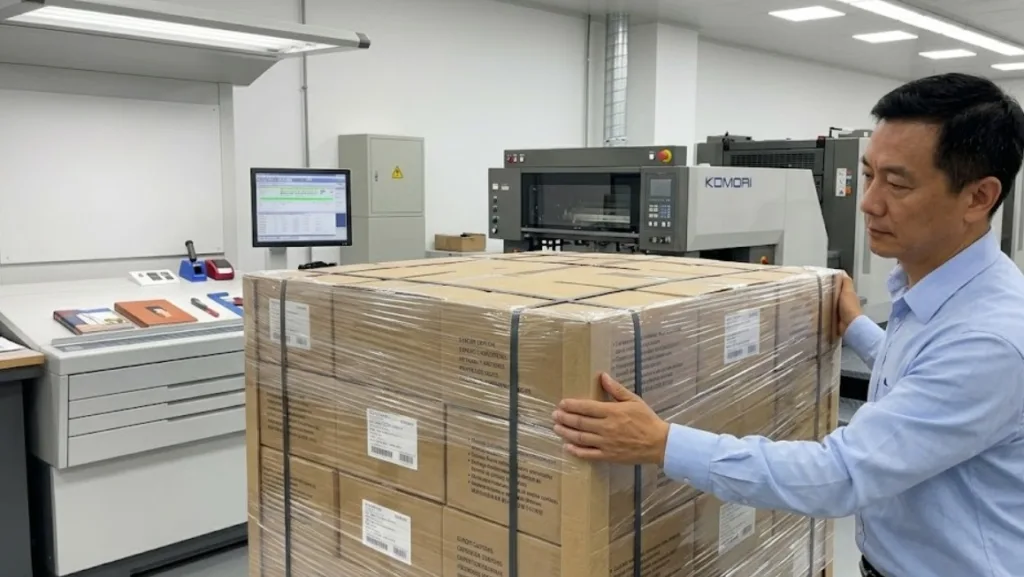
Clearing U.S. customs is entirely meaningless if your inventory arrives warped and physically crushed. Ocean transit introduces extreme environmental and kinetic stresses that generic freight forwarders simply ignore.Printing books requires precise color calibration and dot gain control, but protecting those books requires an understanding of heavy industrial physics.
Consider the environmental reality of a trans-Pacific voyage. Your books will spend 30 to 40 days sealed inside a steel shipping container. As the cargo vessel navigates through different climate zones, it endures massive day-to-night temperature fluctuations.When the steel cools rapidly at night, the air inside the container loses its ability to hold moisture, creating severe condensation known as container rain which drips directly onto the cargo.
If your books are packed naked inside standard corrugated boxes, the highly porous paper fibers will act like a sponge. We once analyzed a disaster where an independent photography label ordered 1,500 premium art books printed on 157-gram matte art paper through a careless broker.Because the books lacked oxygen-barrier sealing, they absorbed the ambient humidity and suffered irreversible wavy distortion, known as moisture shock. Furthermore, to maximize their profit margins, the generic forwarder stacked the wooden pallets to a height of 1.8 meters. The immense static weight from the top boxes exerted hundreds of pounds of downward pressure, fracturing the spines of the bottom 200 copies before they even reached the port.
To ensure your inventory survives the journey, you must demand that absolute moisture isolation, strict pallet height limits, and structural corner reinforcement are written directly into your manufacturing contract as non-negotiable specifications.
- Absolute Moisture Isolation: Standard packing tape is useless against ocean humidity. Demand that every single book, or at minimum every inner carton, undergoes industrial shrink-wrap books protocols to completely seal the paper fibers away from the ambient air.
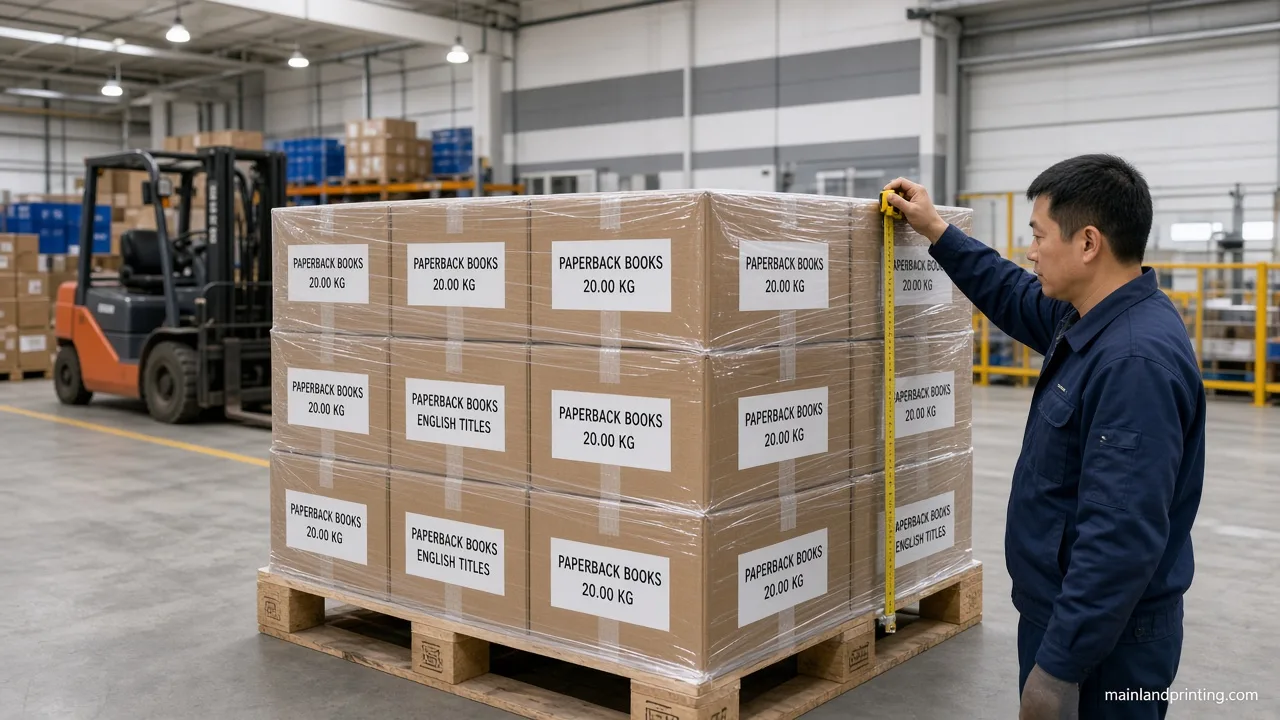
- Strict Pallet Height Limits: A 1.8-meter pallet is a structural hazard for printed material. The absolute red line for book palletizing is 1.5 meters. Anything taller exponentially increases the risk of crushing the bottom layers.
- Structural Corner Reinforcement: The static weight must be distributed away from the center of the cartons. We mandate the use of heavy-duty, rigid corner boards along the vertical edges of every pallet, locked together tightly with heavy-gauge strapping.
Ready to Streamline Your Overseas Book Printing Project?
Stop gambling with unverified freight forwarders and hidden port surcharges. Our integrated manufacturing and DDP logistics logistics protect your budget from factory floor to garage door.
Why “Liftgate Delivery” is Mandatory for Residential Addresses
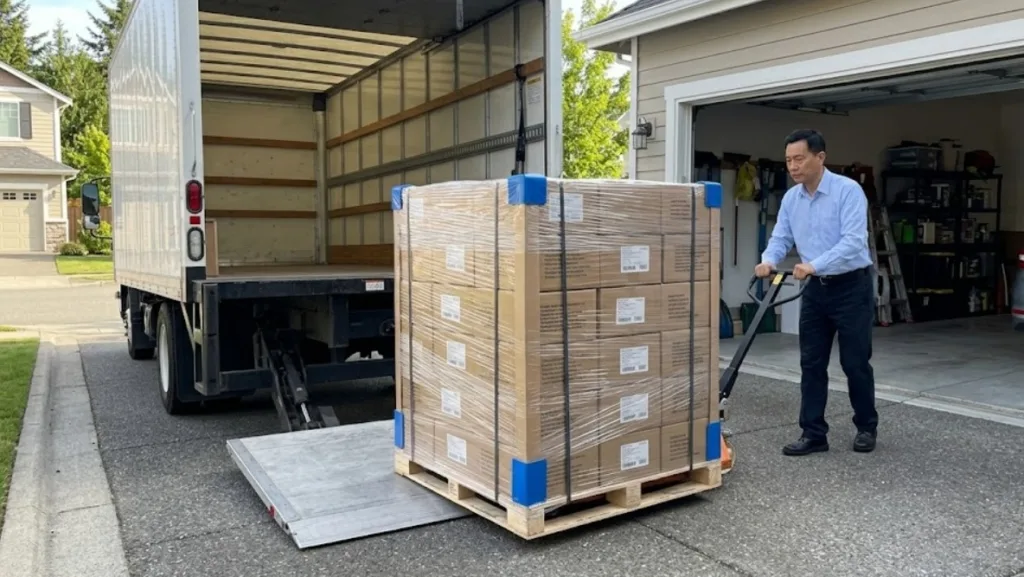
Many creators assume that a “door-to-door” logistics contract guarantees the courier will bring the boxes directly into their studio living room. In the heavy freight network, this assumption leads to the most common, and most infuriating, delivery catastrophe.The U.S. domestic inland trucking network operates on a very specific set of assumptions. When a massive 53-foot dry van is dispatched to deliver your metric ton of books, the carrier assumes your destination is a commercial warehouse equipped with a raised loading dock and a heavy-duty forklift.
If you are operating out of a residential address, a garage, or a storefront without dock access, the delivery truck will simply park on your street. The driver is strictly forbidden from manually unloading thousands of pounds of individual boxes by hand.If you cannot extract the heavy pallets from the trailer bed yourself, the driver will terminate the delivery. Your books will be routed back to a regional distribution hub, and the carrier will levy a redelivery penalty ranging from $75 to $150 before they attempt a second trip.
This is where integrating your manufacturing directly with your ship books from china pipeline protects your final mile. Before the ocean vessel ever departs the port in China, our dispatch protocols intervene.Our logistics team ensures that your final Bill of Lading explicitly mandates Residential Delivery with Liftgate Service. A liftgate is a motorized hydraulic platform attached to the rear of the truck. It safely lowers your heavy pallets directly to street level, allowing the driver to utilize a manual pallet jack to roll the entire load smoothly into your garage or ground-level studio. Never sign a DDP agreement unless the liftgate requirement is confirmed in writing as a line item.
Reverse-Engineering Your Kickstarter Fulfillment Timeline
Logistics is only half of the battle; managing your backers’ expectations is the other. To avoid breaching your promised delivery dates, you must construct a reverse-engineered fulfillment timeline based on harsh physical manufacturing constraints, not optimistic estimates.A standard trans-Pacific project requires a rigid 40 to 50-day total turnaround time to guarantee your project reaches its final destination without disruptions.
Failing to account for the physical curing time of industrial book glues and the custom clearance cycles at regional marine terminals will inevitably break your fulfillment promises to backers.
To avoid delivery friction, creators must deploy strategic Kickstarter shipping strategies that build realistic operational buffers directly into the production schedule.
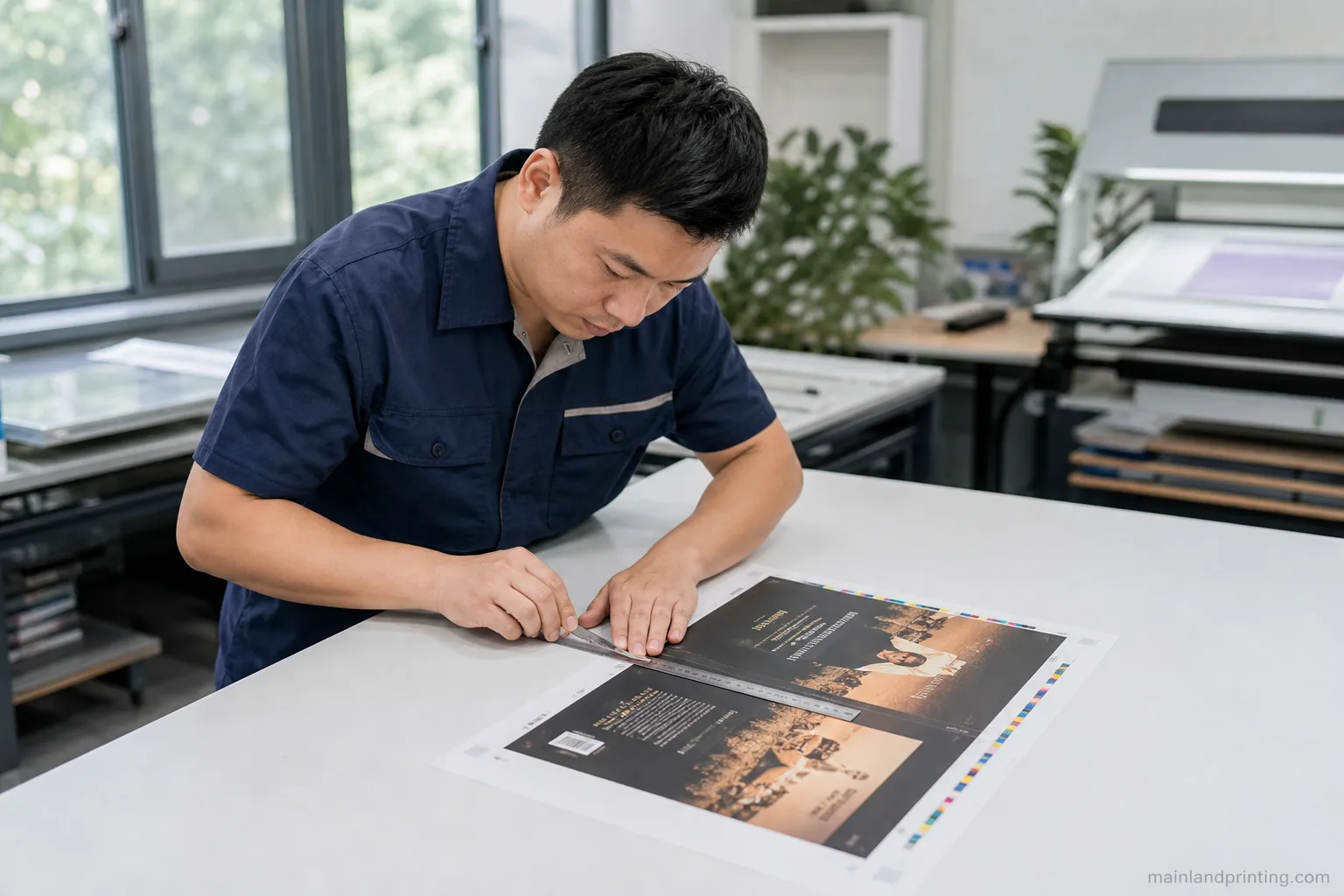
- Days 1 – 5 (Pre-Press Diagnostics & Export Clearance): Before plates are exposed, your files undergo rigorous technical screening. We verify bleed margins to prevent white edges during guillotine trimming and ensure crucial illustrations avoid the spine’s glued binding area. Simultaneously, the factory secures your ISBN export records.
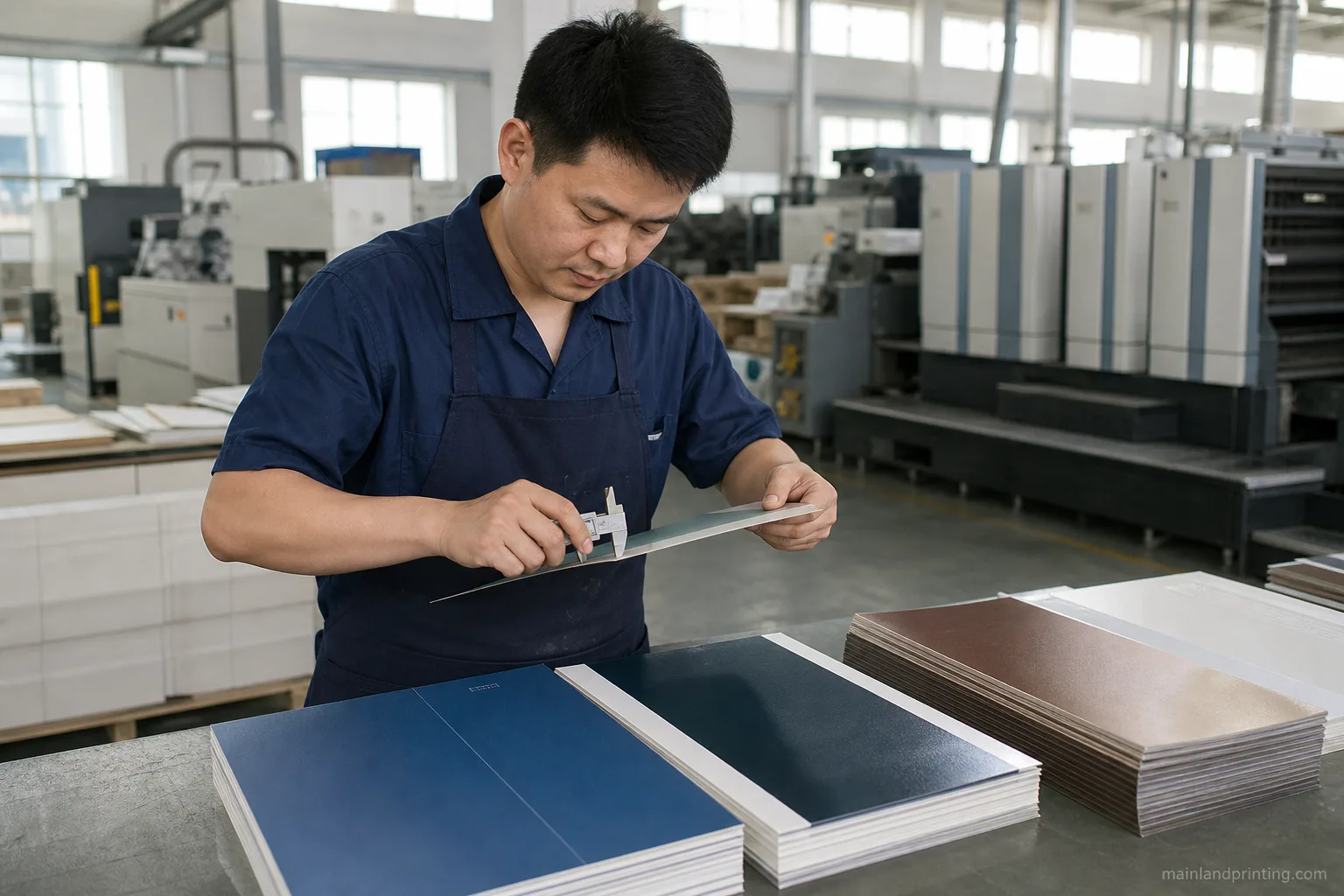
- Days 6 – 20 (Offset Printing & Binding Execution): The actual manufacturing window. This includes exposing the aluminum plates, running the sheets through the Heidelberg presses, allowing critical ink-drying time to prevent smudging, and executing the physical folding, sewing, and gluing of the hardcover bindings.
- Days 21 – 40 (Ocean Freight Transit): The fully palletized and shrink-wrapped books are loaded into containers. The vessel departs Shenzhen, enduring the trans-Pacific voyage. Transit to the U.S. West Coast generally takes 15 to 20 days, while East Coast destinations require closer to 35 days.
- Days 41 – 45 (Port Unloading & Customs Extraction): The container is offloaded at the destination port. Under the DDP firewall, our logistics network automatically processes the commercial invoice, pays the MPF/HMF taxes, and extracts the pallets from the congested terminal to a regional trucking hub.
- Days 46 – 50 (Inland Liftgate Delivery): The final mile. A specialized truck equipped with a hydraulic liftgate navigates to your residential or commercial address, safely lowering the pallets to street level and transferring the physical inventory into your possession.
Summary: Building a Turnkey Production Partnership
Procuring overseas manufacturing is not simply about acquiring printed paper. It is about buying into a highly optimized, heavily defended supply chain that absorbs risk on your behalf.Finding out how to import books from China without a license is easy—you demand true DDP shipping. But ensuring those books arrive in pristine condition requires a partner who understands the physics of ocean freight just as deeply as they understand color calibration.
By enforcing strict moisture isolation, demanding structural pallet limits, and securing residential liftgate delivery, you strip the volatility out of international trade.Do not accept quotes that leave room for hidden broker fees, and do not let generic forwarders handle your life’s work. Approach your procurement process with exact specifications, and lock in a turnkey partnership that protects your budget and your physical product from the factory floor directly to your front door.