Votre devis mentionne déjà du carton de 40 points ou du C1S de 1,0 mm, mais ce soir, vous vous demandez encore s'il ne vaudrait pas mieux passer à 60 points — car une page plus épaisse modifie l'épaisseur du dos, le volume du carton et le prix unitaire avant même l'expédition du premier carton.
Prévoyez une épaisseur de 40 pt pour la plupart des livres pour tout-petits destinés à la vente au détail, sur papier C1S monté (environ 1,0 mm) ; n’optez pour une épaisseur de 60 pt (environ 1,5 mm) que lorsque la tranche d’âge, une manipulation brutale ou des éléments interactifs lourds nécessitent une rigidité supplémentaire — et indiquez clairement « pt », « mm » et le type de fabrication dans chaque ligne de l’appel d’offres.
Avant de valider la prochaine commande, veuillez consulter le tableau de conversion des épaisseurs et des spécifications de fabrication, le guide de détermination des épaisseurs, le tableau des limites pour le dos et le carton, ainsi que les critères de vérification des devis et des échantillons relatifs aux épaisseurs (Vérification sur le devis / Acceptable si / Refusé si).
Convertir 40 pt, 60 pt, 1,0 mm et 1,5 mm en termes utilisés dans les appels d'offres
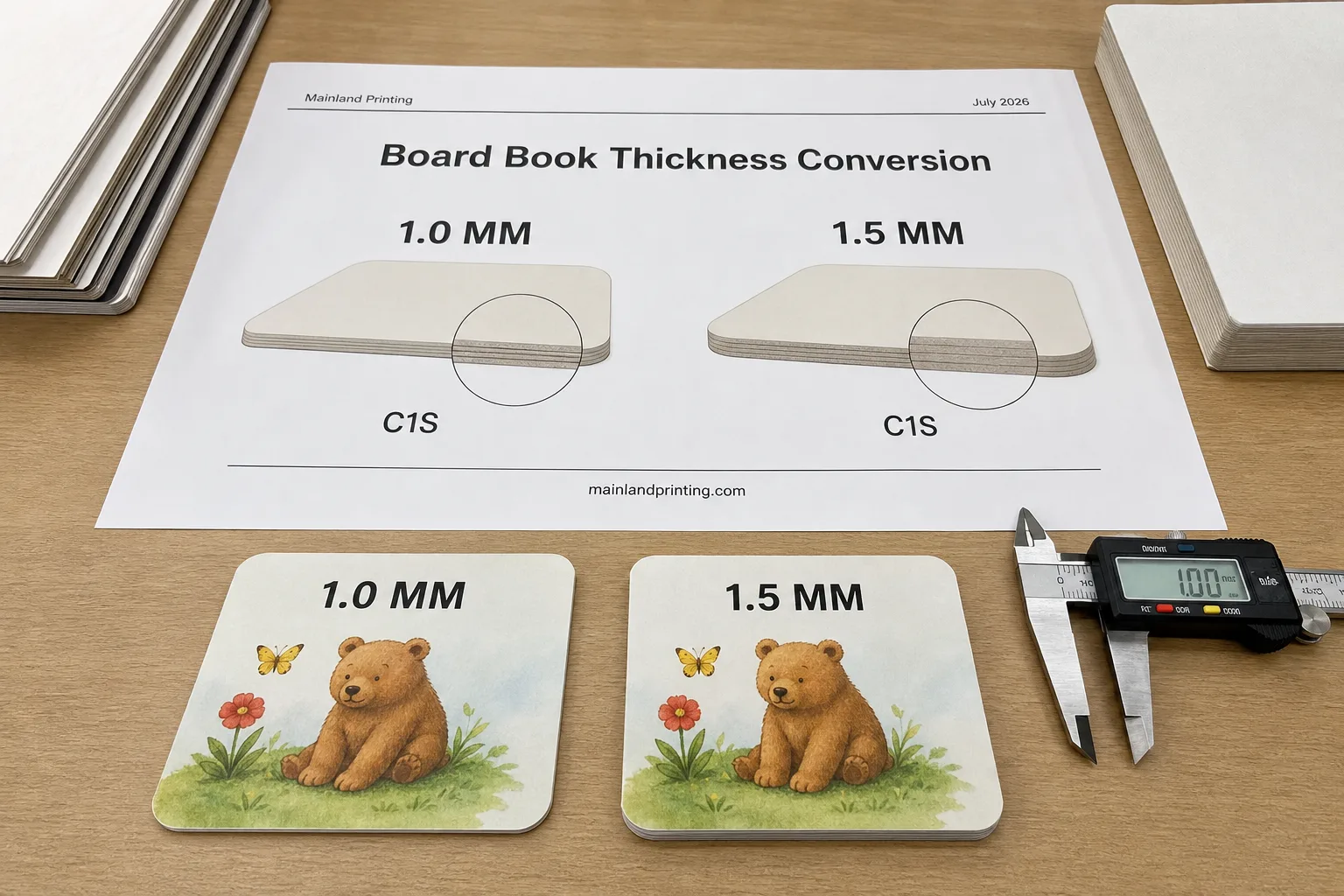
Le point (pt) est une unité de mesure utilisée en typographie : 1 pt équivaut à 0,001 pouce. Les imprimeurs continuent d'exprimer les dimensions des livres cartonnés en pt, car les opérateurs de presse et les fabricants de matrices utilisent ce langage commun sur le plancher d'atelier.
Les millimètres permettent d'harmoniser les appels d'offres entre les États-Unis et la Chine lorsque l'acheteur et l'usine utilisent des unités de mesure différentes. Considérez 40 pt ≈ 0,040″ ≈ 1,0 mm et 60 pt ≈ 0,060″ ≈ 1,5 mm comme des fourchettes de référence, et non comme des valeurs absolues parfaites en laboratoire ; vérifiez-les à l'aide d'un pied à coulisse sur l'échantillon blanc.
“ C1S ” signifie “ enduit sur une face ” : la face imprimable est constituée d’un papier couché laminé sur un support en carton blanc ou gris. C’est cette structure que la plupart des devis désignent par « carton 40 pt », et cela ne correspond pas à l’expression « couverture en papier de 350 g/m² » sur un livre cartonné à couverture détachable programme.
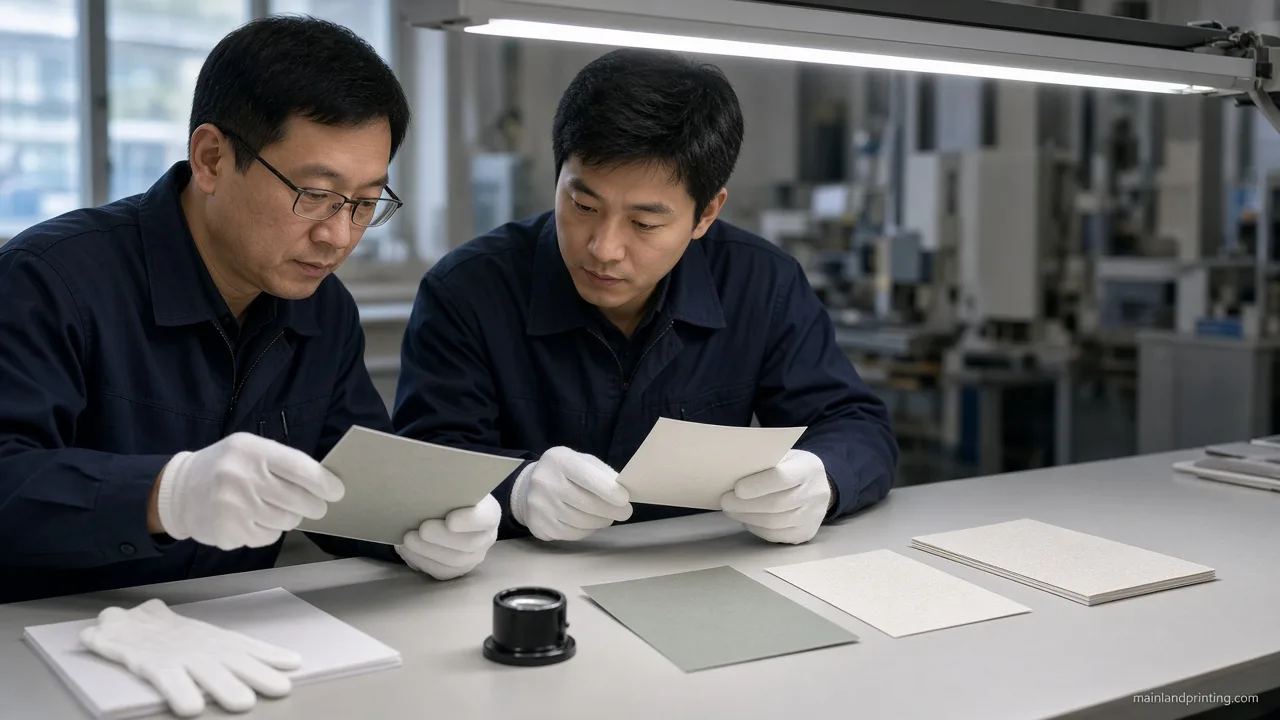
Le papier à âme blanche offre généralement un rendu plus net sur les illustrations aux couleurs pastel claires ; celui à âme grise peut transparaître lorsque la couche d’encre est fine, notamment au niveau des coins arrondis. Précisez le type d’âme dans la demande de devis afin que le service d’estimation ne puisse pas changer d’âme dans le but d’obtenir un prix unitaire plus bas.
Copiez le tableau « Conversion des épaisseurs et spécifications de construction » dans votre appel d'offres afin que tous les fournisseurs établissent leurs devis sur la base du même objet. Les pratiques courantes dans le secteur concernant l'épaisseur du carton suivent des méthodes telles que Contrôle d'épaisseur selon la norme ISO 534; votre appel d'offres doit encore comporter les termes relatifs à la construction commerciale indiqués ci-dessous.
| Note relative à l'appel d'offres | Environ pouces / mm | Construction type | Quand l'utiliser |
|---|---|---|---|
| 40 pt | 0,040″ / ≈1,0 mm | Feuille C1S imprimée, collée sur un carton blanc ou gris ; coins arrondis ; pelliculage à base d'eau | Livres classiques pour tout-petits, livres sur l'alphabet et les chiffres, à partir de 2 ans environ |
| 60 pt | 0,060″ / ≈1,5 mm | Même type de reliure, mais avec un cœur plus épais ; un livre plus lourd et un dos plus large | 0–2 : manipulation brutale, cycles de fréquentation de la crèche/bibliothèque, encombrement important sur les étagères |
| 1,0 mm / 1,5 mm uniquement | Les mêmes groupes que ci-dessus | Ce n'est pas complet tant que vous n'avez pas ajouté « pt + montage C1S contre auto-couverture ». | Jamais seul sur RFQ : associez-le à « pt » et « construction » |
| Couverture rigide de 350 g/m² | Ce n'est pas un synonyme exact | Papier épais, en un seul pli, servant à la fois de couverture et de pages intérieures (selon le programme) | Uniquement si le format est déjà défini comme “ couverture simple ”, et non comme « plus épais (40 pt) » |
Un acheteur de Kickstarter nous a un jour envoyé un e-mail disant : “ Veuillez utiliser un carton épais comme celui de l'échantillon de la librairie ”, sans préciser de point ni de millimètre. Nous lui avons proposé trois devis : un carton à âme blanche de 40 points, un carton à âme grise de 60 points et une couverture rigide de 350 g/m² ; aucun n'était comparable en termes de prix unitaire.
Mainland Printing demande désormais que les lignes du tableau « Conversion des épaisseurs et spécifications de construction » soient renseignées avant l'établissement du devis, afin que les services de prépresse et d'estimation puissent établir le prix pour le même empilement de panneaux.Copiez-collez cette phrase issue de l'appel d'offres lorsque vous envoyez vos fichiers : “ Pages intérieures : carton à âme blanche de 40 pt (≈1,0 mm), face d'impression C1S, pelliculage brillant à base d'eau, coins arrondis ; la couverture est identique, sauf indication contraire. ”
Choisissez entre 40 pt et 60 pt à l'aide d'un guide d'aide à la décision
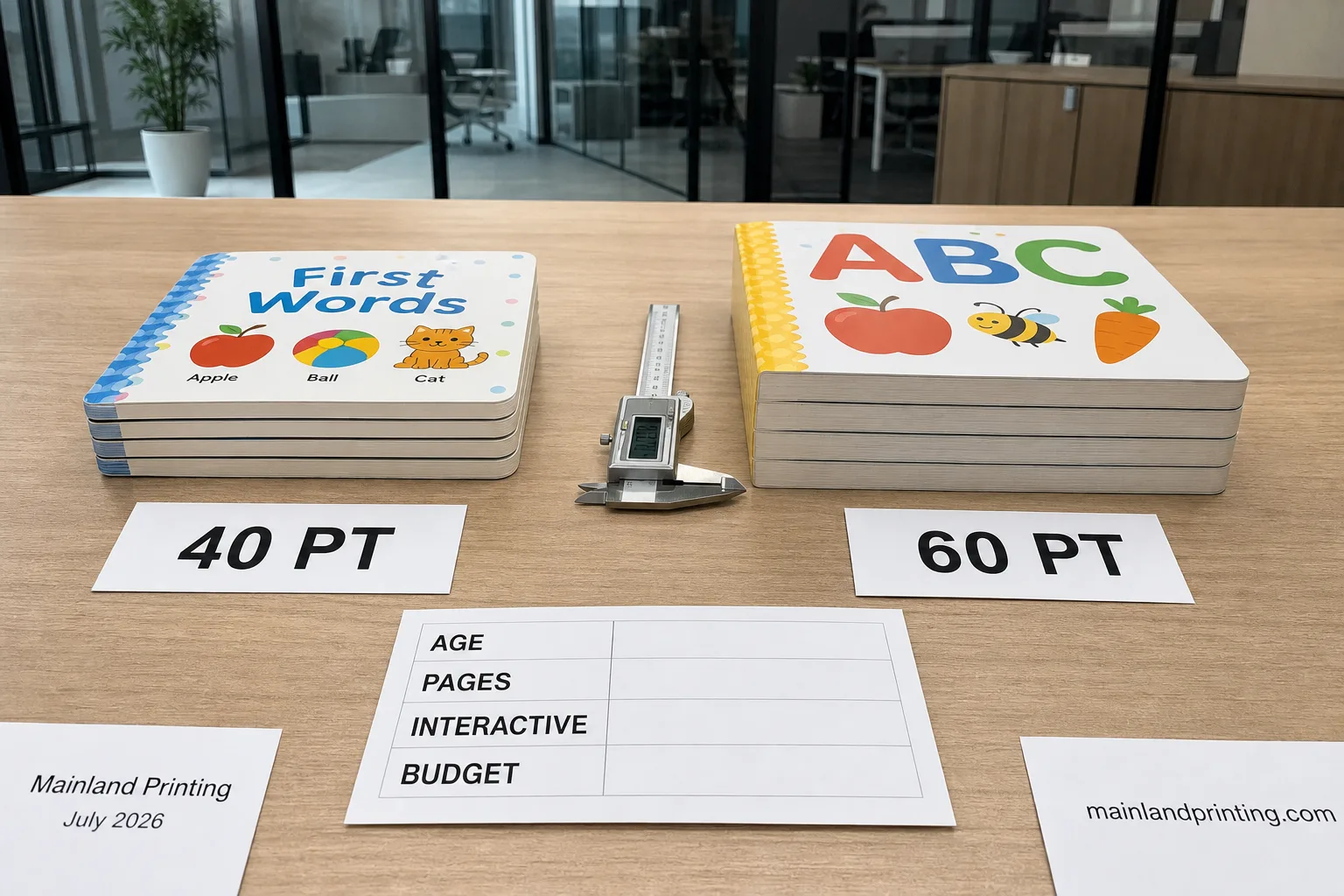
Le marketing axé sur le toucher (“ haut de gamme ”, “ épais ”) ne se résume pas à une question d’épaisseur. Ce sont l’âge du papier, le nombre de pages, le niveau d’interactivité et les contraintes budgétaires qui déterminent si un papier de 40 pt suffit ou s’il faut opter pour un 60 pt.
Les parents et les détaillants évaluent la rigidité dès les dix premières pages tournées. Les fabricants, quant à eux, l’évaluent en fonction de l’épaisseur du carton, du stratifié et de la colle ; votre guide d’achat doit donc traduire le langage utilisé en rayon en une indication de point qu’ils pourront accepter.
Utilisez le guide de décision sur l'épaisseur comme filtre de première sélection avant de modifier un devis signé. Si deux lignes sont en conflit — par exemple, un âge de papier faible mais un titre de 28 pages avec un volume de fret restreint —, privilégiez la ligne présentant le plus de risques (durabilité) et recalculez explicitement le volume du carton.
| Signal | Préférer 40 pt (≈1,0 mm) | Préférer 60 pt (≈1,5 mm) |
|---|---|---|
| Âge de l'école primaire | À partir de 2 ans environ : pour apprendre à tourner les pages | De 0 à 2 ans, tendance à mettre les objets dans la bouche, utilisation intensive |
| Contrainte de canal | Accueil / vente au détail d'articles cadeaux, manutention modérée | Crèche, bibliothèque, exemplaires communs en classe |
| Charge interactive | Motifs plats, petits rabats, empiècements légers | Coulisseaux, roues, matrices de grande taille nécessitant une bonne rigidité |
| Nombre de pages / dos | 8 à 20 pages, l'épaisseur du dos devant rester modérée | Des ouvrages courts qui se veulent néanmoins imposants sur les étagères |
| Itinéraire économique | Lancements de 300 à 1 000 unités à coût maîtrisé | Référence Premium pour laquelle le poids et le volume sont déjà acceptés |
Un éditeur a décidé d'augmenter l'épaisseur de toutes ses références à 60 pt à la suite d'une légère réclamation concernant le format 40 pt, puis a constaté que, dans le devis DDP suivant, la largeur du dos et la hauteur du carton d'un titre de 24 pages avaient considérablement augmenté. Le « Guide de décision sur l'épaisseur » aurait permis de conserver le format 40 pt pour les titres de la collection « Alphabet » et de réserver le format 60 pt exclusivement à la gamme de produits fantaisie pour bébés.
Règle générale à appliquer pour les appels d’offres Mainland Printing : commencer par du C1S monté à 40 pt pour les livres cartonnés destinés à la grande distribution, puis justifier le choix de 60 pt par une raison écrite — tranche d’âge, contraintes liées au canal de distribution ou rigidité interactive — et non par une remarque vague du type “ pour donner une impression haut de gamme ”.
Si vous ajoutez des rabats ou des curseurs, considérez l'épaisseur comme une contrainte de base à côté du tableau interactif des spécifications pour les appels d'offres— C’est la planche trop fine qui endommage les charnières avant même que la couleur de l’encre ne devienne un problème.
Prêt à conclure un contrat à 40 ou 60 points sur un devis pour un livre cartonné ?
Indiquez le format de coupe, le nombre de pages, la tranche d'âge cible et la ligne de demande de devis relative à l'épaisseur. Mainland Printing renvoie des devis comparables, avec des vérifications de l'épaisseur à l'aide d'échantillons blancs intégrées au processus.
Comment l'épaisseur influe sur le volume de la colonne vertébrale et le volume du carton
Chaque page est constituée de deux feuilles superposées. Le passage d'un grammage de 40 pt à 60 pt ajoute environ 0,5 mm par feuille ; ainsi, un livre de 16 pages gagne environ 4 mm d'épaisseur à l'état fermé avant la pose de la couverture et le pelliculage, ce qui suffit à modifier le motif du dos et la hauteur du carton.
Les concepteurs qui fixent très tôt la taille de la police du dos sur une maquette de 40 pt constatent souvent que le texte en 60 pt ne tient plus sur le panneau du dos une fois imprimé. Après tout changement d’épaisseur, recalculez les dimensions du dos à partir de la formule de calcul du nombre de pages fournie par l’imprimeur.
Les équipes chargées du fret constatent ce changement dans les programmes DDP lorsque les dimensions intérieures des cartons ont été calculées sur la base d'une épaisseur de 40 points. Il faut recalculer le volume si vous modifiez l'épaisseur en cours de route, sinon votre modèle de coût au dédouanement se détraquera sans que vous vous en rendiez compte.
| Variable | Que se passe-t-il généralement entre 60 et 40 points ? | Action préalable à la commande |
|---|---|---|
| Épaisseur du livre fermé | Le volume est nettement plus épais ; l'illustration du dos devra peut-être être réajustée | Demander une estimation de la largeur du dos en fonction du nombre de pages |
| Poids unitaire | Livre plus lourd ; les tranches de poids FBA / vente au détail peuvent varier | Demandez le poids de l'échantillon blanc |
| Cube en carton | Moins de livres par carton ou des cartons plus hauts | Vérifier à nouveau la liste de colisage avant de réserver le transport |
| Coût unitaire | Prix de la planche + frais de port en hausse ; bien plus qu’une simple “ sensation haut de gamme ” | Comparez avec votre Guide des prix des livres cartonnés valeur de référence |
Signaux d'alerte : modification de l'épaisseur après validation définitive du visuel du carton ; indication d'une épaisseur de 60 pt alors que le service logistique utilise toujours des données d'emballage pour 40 pt ; non-prise en compte des multiples du nombre de pages lors de l'ajout de volume.
Vérifier l'épaisseur indiquée sur le devis et sur l'échantillon blanc
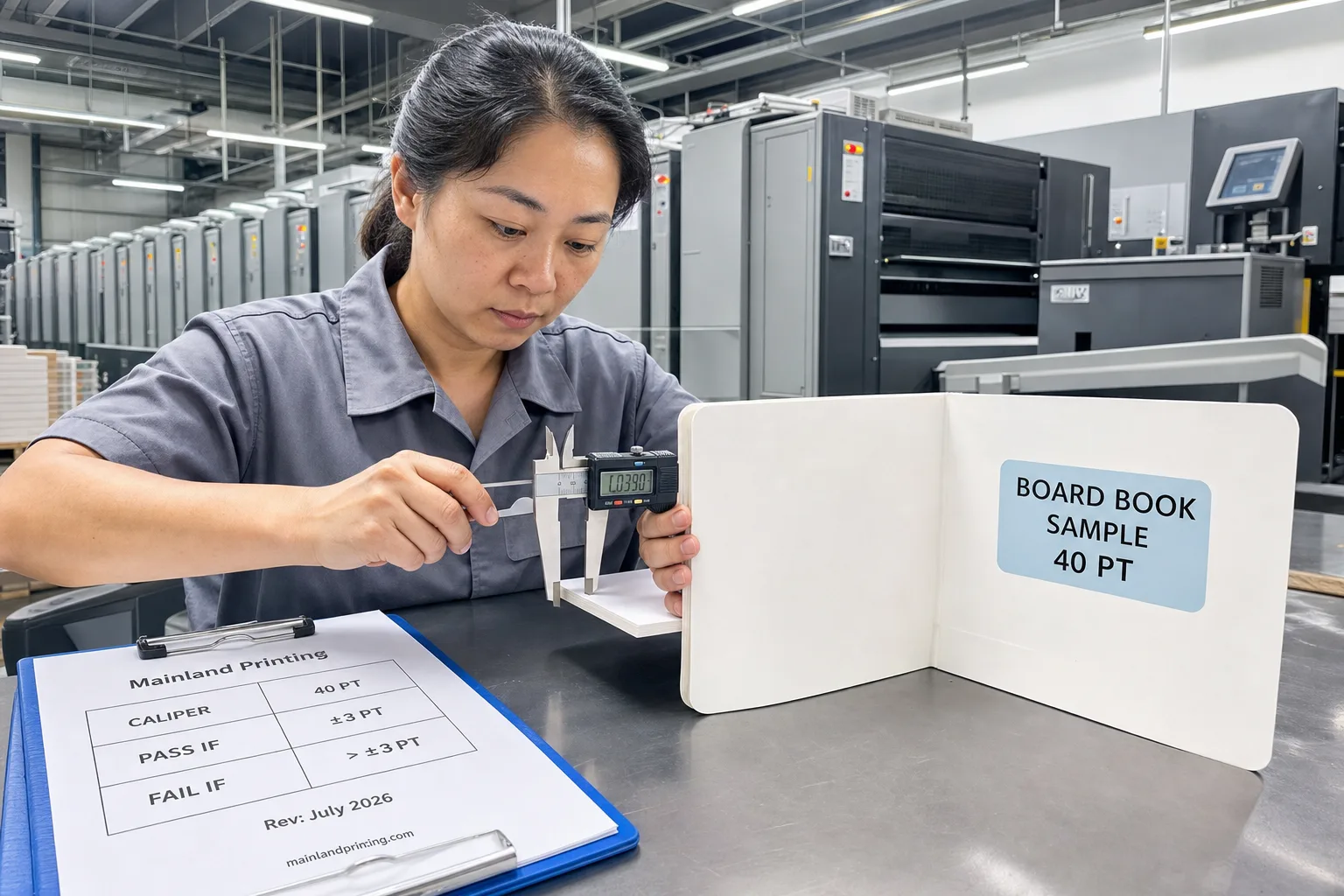
Une mention indiquant “ livre cartonné, pages épaisses ” n'est pas vérifiable. Le point de contrôle « Épaisseur – Devis et échantillon » est un audit de type « réussi/échoué » qui impose de regrouper sur une seule page les informations relatives au point, au millimètre, à la couleur du cœur et à l'épaisseur avant la production en série.
Mesurez à trois feuilles de distance des rainures et des chevauchements de laminage, puis calculez la moyenne des mesures. Un coin légèrement ramolli près d'une découpe ne constitue pas le même défaut qu'un livre entier dont la résistance est inférieure à la plage de points indiquée.
Exécutez ce cycle « Réussite si / Échec si » une fois par SKU. Associez-le à votre cycle habituel Validation d'un échantillon de livre cartonné étapes à suivre lorsque l'on passe de la structure à la couleur.
| Vérifier le devis / l'échantillon | Passer si | Échec si |
|---|---|---|
| Note relative au conseil d'administration | Format 40 pt ou 60 pt plus ≈ mm et montage C1S (ou grammage explicite de la couverture intégrée) | Uniquement “ carton épais ”, “ carton ” ou « mm » (sans « pt » ni « construction ») |
| Noyau / face | Nom du noyau blanc ou gris indiqué ; face imprimée C1S mentionnée | Partie centrale omise ; remplacement autorisé par un bouillon “ équivalent ” |
| Pince de mesure pour échantillons blancs | Épaisseur de la feuille comprise dans une tolérance de ±10% par rapport à la bande de points indiquée ; photos enregistrées | Pas de pied à coulisse ; flexibilité souple par rapport à l'échantillon de vente au détail convenu |
| Déformation / planéité | Les pages restent à plat après 24 heures d'acclimatation à l'intérieur | Présence de déformations ou de fissures en charnière visibles lors des 20 premières ouvertures |
| Voie de sécurité | Liste des tranches d'âge et des matériaux, conforme à la réglementation relative aux produits destinés aux enfants en vertu de 16 CFR, partie 1500 | Épaisseur verrouillée, mais champ « Matériaux/CPC » vide |
Un acheteur américain a signé un contrat “ 40 pt ” à un prix unitaire bas, puis s'est vu livrer un produit de substitution en carton gris souple dont l'épaisseur se rapprochait davantage de celle d'un papier plus fin. Le devis ne précisant ni la couleur de base ni de ligne « Pass If » relative à l'épaisseur, le litige s'est transformé en une dispute portant sur la texture du produit plutôt qu'en un rejet fondé sur des critères mesurables.
Mainland Printing enregistre l'épaisseur de la feuille sur l'échantillon blanc par rapport à la bande de référence indiquée avant la sortie de la plaque, afin que les litiges relatifs à l'épaisseur reposent sur des chiffres et non sur des adjectifs. Si l'échantillon ne satisfait pas aux critères de contrôle de l'épaisseur et de l'échantillon, suspendez la validation des couleurs jusqu'à ce que la pile de cartons soit refaite.
Lorsque l'épaisseur, la structure et le calibre sont tous conformes, envoyez la ligne de demande de devis verrouillée en indiquant la quantité et les dimensions de découpe pour impression de livres cartonnés. C'est là le passage en douceur de la décision de ce soir (40 points contre 60 points) à une estimation d'usine comparable.
Points à retenir pour l'acheteur
Indiquez « 40 pt » ou « 60 pt » avec « ≈mm » et la construction « C1S » sur la demande de devis, justifiez les mises à niveau à l'aide du guide de décision sur l'épaisseur, puis vérifiez que les lignes relatives au calibre dans la rubrique « Devis d'épaisseur et échantillons » sont bien cochées avant de graver les plaques.
Ne modifiez pas l’épaisseur une fois les plaques gravées, sauf si un échantillon blanc non conforme vous y oblige. Changer de papier en cours de production entraîne une réinitialisation des achats de carton, des dégagements des matrices et de l’emballage en carton — des coûts qui éclipsent largement l’impulsion initiale de “ mise à niveau pour un toucher haut de gamme ”.