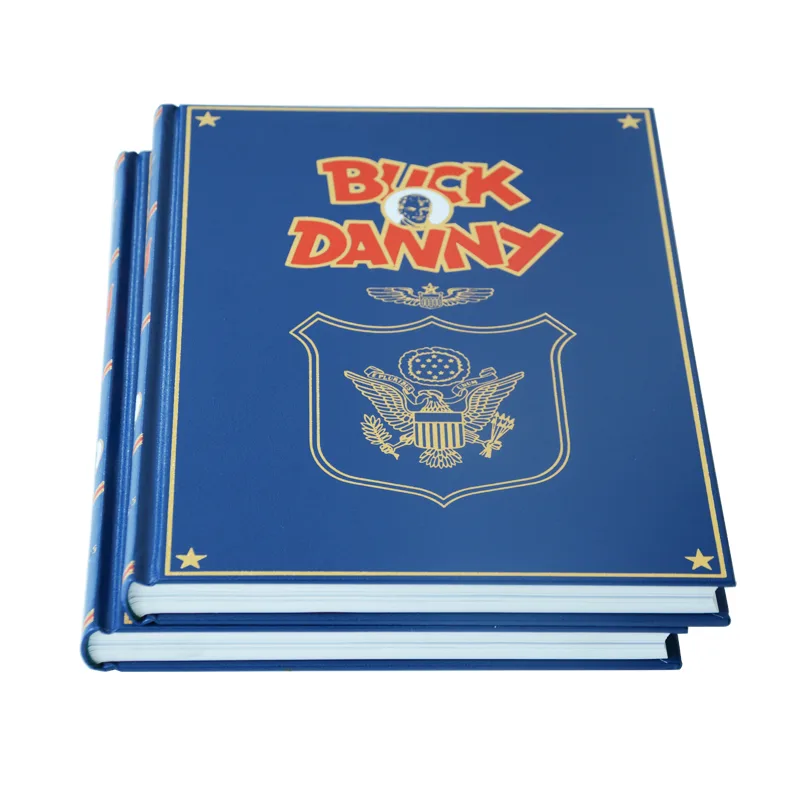
When a gallery catalog, monograph, or coffee-table art book carries images across the gutter, binding is a viewing decision—not a late production preference after files are “final.”
For a layflat vs smyth sewn art book choice, start with the spread job. True layflat protects continuous images; Smyth-sewn gives durable near-flat opens; perfect bound fits when some gutter loss is acceptable.
You will leave able to name when a full-open spread is mandatory, route layflat vs Smyth-sewn vs perfect bound without mixing labels, and freeze a bound-sample gate before page count and cover lock.

Decide When Cross-Spread Images Need Full Open
Cross-page images fail when the gutter swallows faces, horizons, or type that must read as one picture. If the creative brief treats the spread as a single canvas, you need a construction that opens far enough to keep that canvas intact—not merely a hardcover name on the quote.
Use this checklist when the layout still mixes full-bleed crossovers with text-only spreads. Read it as a job filter, then confirm what the plant can actually build for your trim and paper.
| Spread job | Binding direction to test first |
|---|---|
| Continuous photo/illustration across gutter (no hide allowed) | True layflat / seamless mount constructions |
| Mostly single-page images; occasional near-flat reading | Smyth-sewn casebind (durable near-flat) |
| Text-led with few crossovers; budget/page-band sensitive | Perfect bound if some gutter loss is acceptable |
| Mixed: hero crossovers + text chapters | Route by the heaviest crossover—not the average page |
Red flag: approving a softcover quote while the PDF still shows full-bleed crossovers that need a seamless open—those jobs fail in the gutter, not in ink density.
If run-size budget shape is still open while binding is undecided, park quantity math on the art book cost guide sibling—this guide stays on open performance and construction.
Count how many spreads truly cannot lose the gutter. One hero panorama can force layflat even when ninety percent of pages are single-sided. Write that count on the RFQ in one line so plants do not quote a “nice hardcover” that still hides the image.
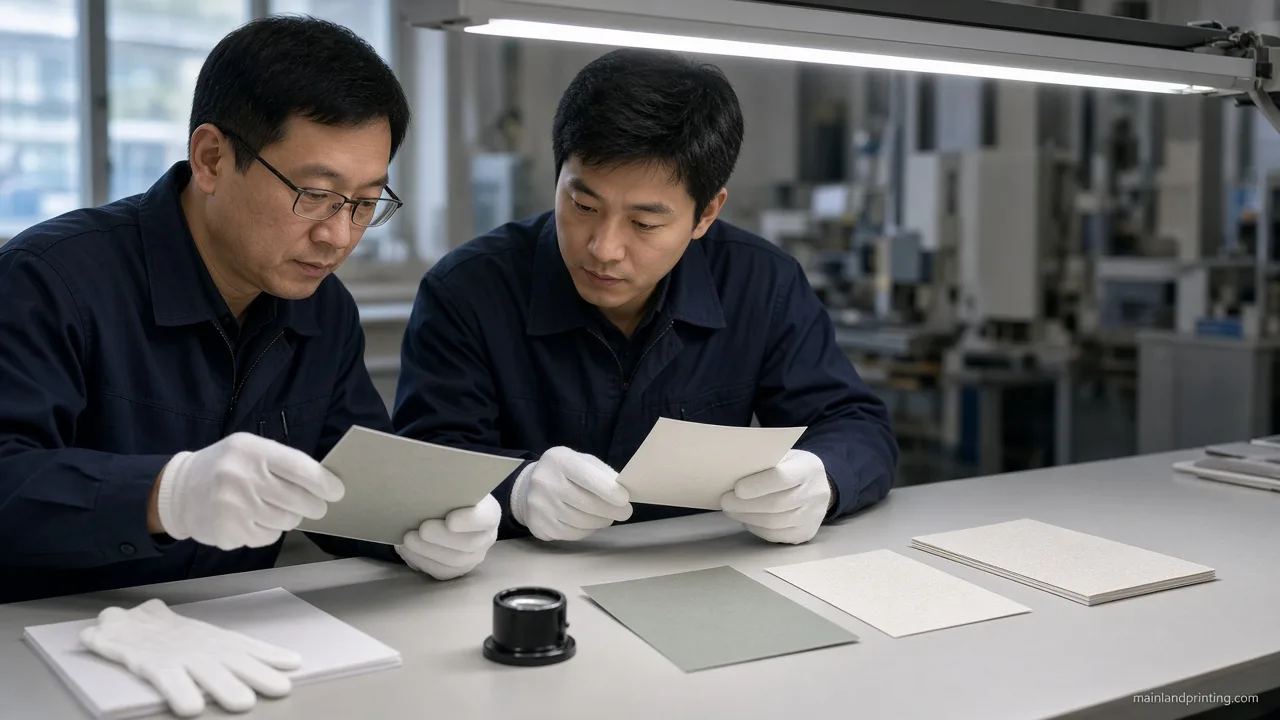
Measure the critical crossover under the same lamp angle you will use at the opening. Check whether type or a face falls inside 8–12 mm of the gutter fold. Inspect the dummy with the heaviest paper you plan to run—thicker sheets change how far a Smyth casebind will stay open without a hand.
Compare Layflat Smyth and Perfect Bound
Choose art book binding by the spread job first—true layflat when continuous images cannot lose the gutter; Smyth-sewn when you need durable near-flat opens; perfect bound when cost and page-count bands fit and some gutter loss is acceptable.Use this when locking binding for a gallery catalog, monograph, or coffee-table art book with cross-page images. This guide does not publish a universal page-count ceiling; confirm printable page bands and construction with the plant on the RFQ.
Use this matrix when stakeholders still argue brand names instead of open jobs. Columns are planning language—confirm the plant’s actual construction list on the RFQ.
| Binding family | Choose when / write this |
|---|---|
| True layflat (seamless / flush-mount style) | Continuous images cannot lose the gutter; write “seamless open for crossovers” |
| Reliure Smyth | Need durable section-sewn opens that stay mostly flat; write “Smyth-sewn, near-flat OK” |
| Perfect bound | Cost and page-count bands fit; some gutter loss acceptable; write “perfect bound OK with gutter loss” |
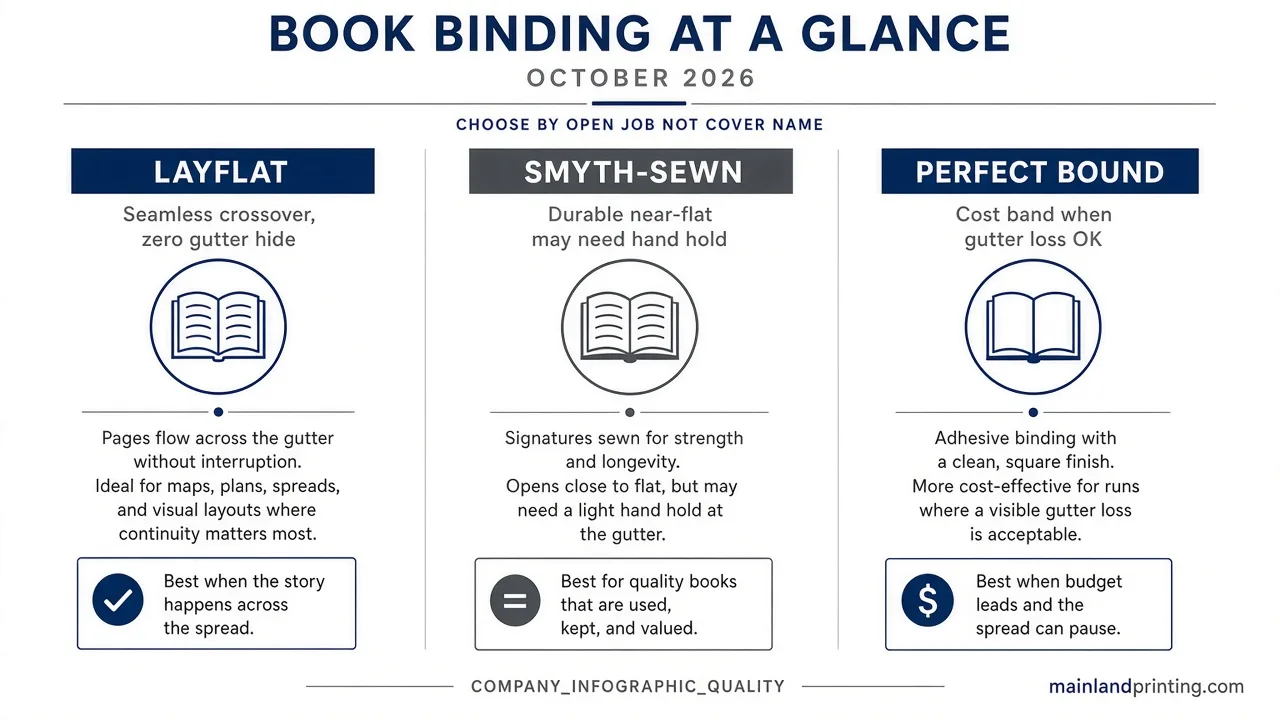
Durability and shelf life usually favor Smyth over adhesive-only perfect binding for heavy handling. Cost and schedule often favor perfect bound when the image job allows gutter loss.Layflat constructions sit in a different lane: they buy seamless viewing, not merely a hardcover wrap. For a short primer on how image-led editions sit in print culture, skim art book basics, then bring the talk back to your open requirement.
Pass / Fail cue: if two quotes use “layflat” for different constructions, freeze the open requirement before you compare unit prices.
Paper choice still matters for show-through and hand-feel—route stocks on the paper stock guide after binding family is shortlisted, not before.
Verify adhesive family when perfect bound is shortlisted—PUR usually opens flatter than EVA, but it is still not a seamless layflat mount.Test a 48-hour or plant-standard cure window before you judge open angle on a PUR sample. Measure open angle on the sample board if the plant offers a degree note; otherwise photograph the same spread under a fixed camera height for side-by-side quotes.
Separate True Layflat From Smyth Sewn
Treat layflat and Smyth-sewn as different constructions—Smyth can open mostly flat but may still need a hand hold; seamless layflat mounts spreads to cut gutter hide.Apply this when stakeholders say “layflat” but mean any book that opens easily, including sewn casebinds. Finish and cover names vary by plant; labels here are planning language, not a guarantee of an identical brand construction.
Watch-out: emailing “layflat please” often returns a Smyth casebind, a PUR softcover that opens better than EVA, or a true seamless mount—three different open results. Write the open job first, then the construction family.
Use this label checklist before you approve any quote that says “layflat”:
- Seamless / flush-mount layflat — near-zero gutter hide for continuous images
- Smyth-sewn casebind — durable near-flat; may still need a hand on thick or small books
- PUR perfect bound “layflat” marketing — better open than EVA, still adhesive gutter math
- Stay-flat language — stays open without snap-shut, not the same as 180° seamless
Smyth-sewn signatures flex and stay mostly open; small or thick books may still need a hand. Seamless layflat mounts spreads back-to-back so the gutter is engineered out of the viewing plane.Both can be “premium”; only one matches a no-gutter-hide brief. Keep one owner for the binding-family freeze so design cannot reopen “layflat” after cases are booked.
Cover cloth, foil, or jacket stories sit on different proof loops than the book-block open. Lock the open construction before you spend design time on spine foil that assumes a different case thickness. Inspect spine swell on the bound dummy after 24 hours in the same humidity band you expect at delivery.
Lock Page Count With a Bound Sample
Approve the binding on a bound sample of your heaviest cross-gutter spread before you freeze page count and cover.Use this after you shortlist a binding family and before the first production PO. Common art-book programs around 100–130 pages full color are program-dependent; confirm the band with the plant—do not treat page count alone as image quality.

Use this gate when the binding shortlist is down to one family and you still need a go/no-go before the first production PO. Page count alone does not prove image quality across the gutter—open the heaviest crossover under the light you will use at the opening.
Red flags before you freeze page count and cover:
- “Layflat” written without naming seamless vs Smyth vs PUR
- Page count approved from a soft proof only
- Hero crossover never bound as a physical sample
- Cover finish locked before book-block open is proven
- Assuming 100–130 pp full color is a universal plant band
Name an owner for bound-sample sign-off and an owner for binding-family freeze.If either is blank, pause the PO. Buyer RFQs for art books repeatedly surface material, sample, dimensions, and quantity—treat those as the minimum pack beside the open job. Check the sample again after 48 hours if the plant used PUR—early open tests can look flatter than the cured book.
Ready to plan an art book binding review?
Send trim, page count, binding family, how many spreads cannot lose the gutter, and whether you need a bound hardcopy sample—we align printable constructions before production.
Freeze Your Art Book Binding Spec
Freeze the art book binding spec when the spread job, the construction family, and the bound sample all name the same open result—and when page count is treated as a plant-confirmed band, not as a guarantee of image quality. That gate is what lets you brief covers and jackets without reopening the book block.
Keep the approved sample ID beside proof sign-off. If binding family or page count changes after approval, re-run the bound-sample checks before you enlarge the PO. For production-ready art book printing on that locked binding pack, send the review request above to Mainland Printing.