Shipping thousands of hardcover books across multiple 3PL warehouses is a logistical minefield. As a factory owner with over a decade of export experience, I know exactly why standard trade cartons fail. Here is the exact engineering blueprint we use to completely eliminate LTL transit damage.
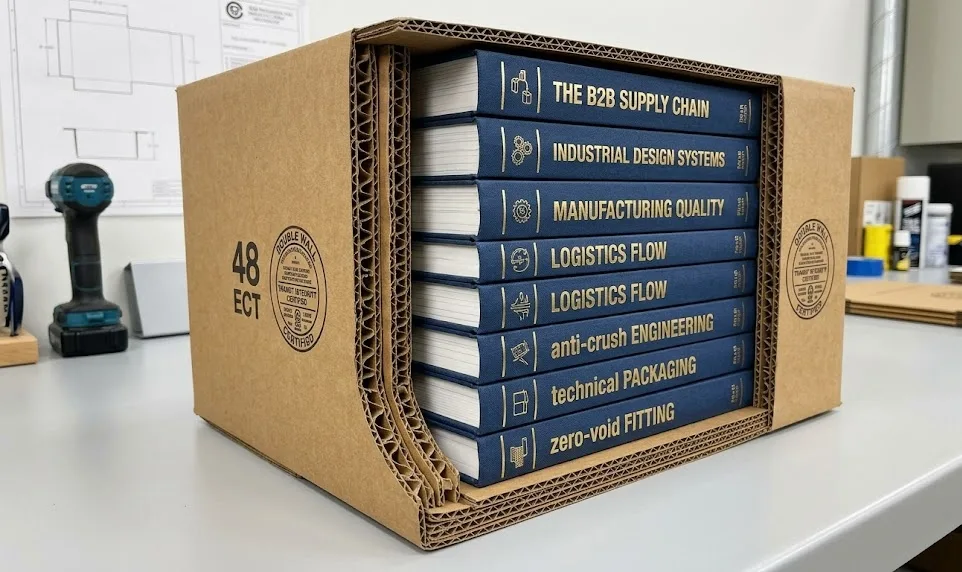
Designing bulk packaging for heavy books requires 48 ECT double-wall cartons with zero-void micro-tolerance. Sizing the box within two millimeters of the exact book dimensions creates a rigid load-bearing structure. This eliminates internal shifting and corner crush without using any bubble wrap.
But engineering the carton is only step one. Read on to discover the exact 50-inch pallet architecture required to pass strict US distribution guidelines and avoid thousands in 3PL rejection penalties.
Why Standard Corrugated Boxes Fail

When negotiating with an overseas supplier, procurement managers will frequently encounter a highly deceptive reassurance: “Our standard carton is rated for a 60-pound static load. Your 40-pound book shipment will be perfectly secure.”
This is one of the most fatal traps in international freight forwarding. Static compression—simply placing a heavy weight on a box resting on a flat, motionless factory floor—completely fails to simulate the violent, dynamic environment of multi-hub logistics.From the exact moment your shipment leaves a modernized Chinese printing facility equipped with advanced Heidelberg/Komori presses, to the second it is scanned into an Amazon FBA or independent 3PL warehouse, it will endure seven to eleven aggressive, distinct touchpoints. It will be subjected to forklifts, pallet jacks, conveyor belts, and the relentless reality of LTL highway shipping.
“Dynamic transit forces—specifically the continuous low-frequency vibrations generated by LTL trucks—cause severe structural fatigue in corrugated boxes. This vibration gradually loosens the internal structure of the box, drastically reducing its compression strength over long journeys.”
— Dr. S. Paul Singh, Professor Emeritus at the School of Packaging, Michigan State University.
As an LTL truck rumbles across hundreds of miles of highway, continuous low-frequency vibrations force the corrugated paper flutes inside the carton walls to compress and distort. Over a cross-ocean journey and subsequent cross-country routing, this dynamic shock causes severe structural fatigue.The result is a guaranteed 30% degradation in the carton’s overall compression strength. A box that felt incredibly sturdy and rigid at the port of origin will arrive at a Dallas distribution center soft, compromised, and structurally exhausted. If you design your bulk carton strategy without a dedicated buffer for this fatigue degradation, the bottom layers of your pallet will buckle like an accordion under the sheer dimensional weight.
Static Load vs. Multi-Hub Dynamic Reality
| Packaging Parameter | Standard Factory Assumption (Static) | The Multi-Node Logistics Reality (Dynamic) | The Engineering Solution |
|---|---|---|---|
| Weight Bearing | Tests cartons in a stationary warehouse. | Cartons endure continuous 30Hz LTL truck vibrations. | Fatigue Buffer: Assume a 30% loss in structural integrity over 30 days. |
| Impact Type | Single vertical drop test. | 7-11 forklift transfers and side-impact shocks. | 48 ECT Minimum: Upgrade to Edge Crush Test 48 double-wall fluting. |
| Material Degradation | Assumes climate-controlled transit. | Endures extreme temperature shifts on the ocean. | Moisture Sealing: Corrugated board requires external moisture barriers. |
Quick Guide: If your priority is cross-country shipping through multiple hubs, upgrade from standard cartons to 48 ECT double-wall fluting to survive dynamic vibration fatigue.
To safely navigate this multi-hub distribution system, you must deploy strict structural parameters before your books leave the plant floor. Enforcing these three core decision points will shield your inventory from dynamic failure:
- Discard Single-Wall Completely: For any high-density printed matter exceeding 25 pounds per carton, single-wall corrugated board is an immediate disqualifier.
- Enforce 48 ECT Double-Wall: Establish a non-negotiable baseline of 48 ECT (Edge Crush Test) or a 275 Mullen (burst strength) rating for all hardcover outer cartons.
- Mandate the 30% Redundancy: Calculate your maximum pallet load and mathematically add a 30% buffer to the required carton compression strength to account for highway vibration fatigue.
Eradicating Internal Shifting
If your current supplier is adding extra bubble wrap, styrofoam peanuts, or crumpled kraft paper to “cushion” your hardcover shipment, you are walking into a critical quality control crisis. Hardcover books possess incredibly high physical density—in packaging engineering, they must be treated as rigid, heavy bricks.
When 40 pounds of high-density printed matter is subjected to transit shock, the sheer kinetic energy will instantly pulverize standard void fill. Air pillows burst, and foam compresses into flat, useless sheets. The exact moment that cushioning fails, fatal shifting space is created within the carton.Even a few millimeters of internal movement allows the sharp, rigid corners of your books to repeatedly ram into the inner corrugated walls like industrial chisels. Corner crush, spine splitting, and scuffed covers are the inevitable physical consequences of internal movement.
An independent comic publisher successfully funded a premium, oversized anniversary hardcover (printed on dense 157gsm coated art paper, weighing 3.5 pounds per unit). To save on custom tooling, their previous trade printer used generic, oversized double-wall cartons, stuffing the remaining two inches of empty space with industrial bubble wrap.
During the final LTL transfer from Los Angeles to a Texas 3PL, the truck’s vibration ground the bubble wrap down to nothing. The heavy books began slamming against the carton walls. The shipment arrived with a 12% damage rate—featuring severe “V-shaped” corner indentations—and the 3PL halted intake, charging the publisher thousands in manual repacking fees.
In collaborative workflows spanning over a decade, taking over compromised projects requires an immediate halt to “cushioning.” The Senior Project Manager mandates a strict “Zero-Void” reverse-engineering protocol. By measuring the exact 28.4-millimeter spine thickness of the publication, custom double-wall cartons are manufactured with an internal dimensional tolerance of precisely 2 millimeters. Zero bubble wrap is utilized. The hardcovers slide in flush against the walls.
When books fit absolutely flush against the carton walls, the rigid products themselves become the internal load-bearing skeleton. By mathematically eliminating the physical space required for movement, you neutralize the internal impact forces completely.The packaging does not absorb the shock; the integrated solid mass deflects it. This internal architecture is highly critical if you plan to upgrade from simple offset vs POD printing to a full, large-scale commercial run where unit weights increase dramatically.
Eliminating internal movement requires strict adherence to custom manufacturing standards. Implement these three rules to ensure a flawless internal fit:
- Demand Custom Tooling: Never accept “off-the-shelf” carton sizes for bulk book shipping. The carton must be built around the book, not vice versa.
- The 3-Millimeter Rule: Write a strict tolerance limit into your vendor agreement. The physical gap between the books and the inner carton wall must not exceed 3 millimeters.
- Prohibit Void Fill for Structure: Explicitly ban the use of bubble wrap or air pillows as a method to compensate for incorrectly sized master cartons.
Ready to Secure Your Commercial Print Run?
Protect your publishing margins and completely eliminate distribution貨损. Our team custom-engineers heavy-duty, zero-void master cartons tailored to your precise book specifications.
Armor-Grade Palletization & 3PL Compliance
Cartons protect your books, but pallets protect your cartons. You can engineer the most robust, fatigue-resistant double-wall box in the industry, but a poorly configured pallet will still guarantee a disastrous receiving experience.
As automated fulfillment centers tighten their inbound freight guidelines, the leading cause of distribution failure is no longer ocean freight accidents.It is 3PL receiving docks rejecting unstable, non-compliant pallets, forcing procurement managers to pay extortionate relabeling, restacking, and secondary transport penalties. To survive the final mile, you must transition from basic warehouse shrink-wrapping to modular, armor-grade pallet architecture.
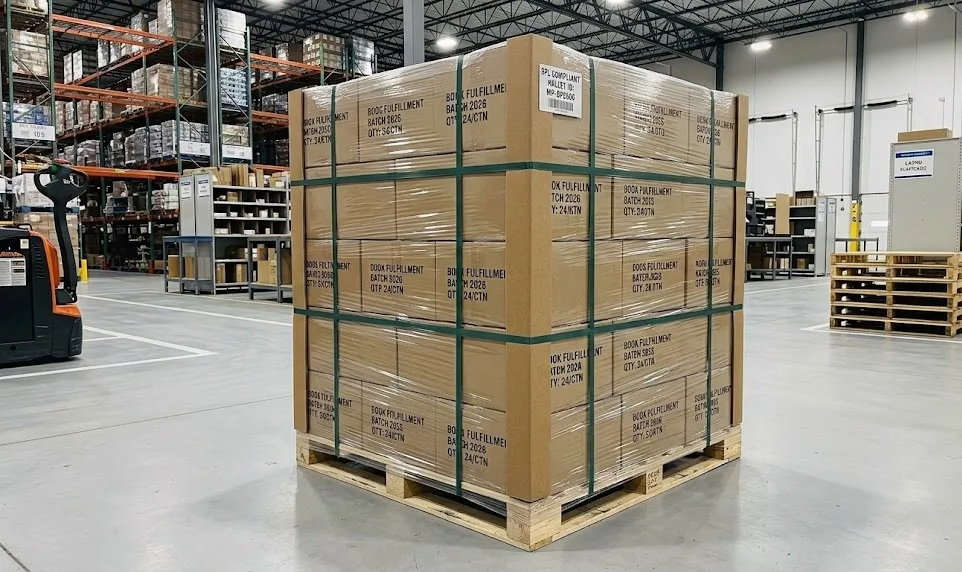
There is a persistent temptation in procurement to maximize shipping volume by building towering, 65-inch pallets to shave a fraction off ocean freight container costs. This is a false economy. Pushing past 50 inches (including the wooden base) creates a top-heavy load highly susceptible to tipping during sharp LTL transit turns.More importantly, it deliberately violates the automated sortation system limits of most major US distribution centers, guaranteeing immediate dock rejection. Ensuring transit compliance is just as vital as managing your upfront book printing cost calculation.
“An increase in relative humidity from 50% to 90% can cause a corrugated box to lose up to 60% of its stacking strength. Corrugated material is highly hygroscopic, making moisture defense a structural imperative, not an optional upgrade.”
— Prof. Diana Twede, Co-author of Cartons, Crates and Corrugated Board.
During a 30-day ocean transit, severe temperature fluctuations against the steel walls of a shipping vessel generate heavy condensation, industry-known as “container rain.” A few casual loops of thin plastic stretch film will not stop this moisture. You must implement a physical barrier.
Standard Warehouse Pallet vs. Armor-Grade Pallet Architecture
| Component | Standard Trade Pallet | Armor-Grade 3PL Compliant Pallet |
|---|---|---|
| Height Profile | 60+ inches (Maximized for sea freight). | Strictly under 50 inches (Compliant with US 3PL laser scanners). |
| Edge Protection | None, or thin plastic corner straps. | 4-mm heavy-duty V-board installed on all four vertical corners. |
| Stacking Method | Column stacking (prone to splitting). | Interlocked Cross-Stacking (distributes weight evenly). |
| Moisture Barrier | 1-2 layers of thin, hand-applied plastic. | 3 layers of 80-gauge industrial PE stretch film, plus a solid moisture-resistant top board. |
Quick Guide: If your priority is passing US 3PL compliance and preventing box collapse from humidity, mandate a strict 50-inch height limit paired with heavy vertical edge guards.
After you lock that pallet height for 3PL intake, reverse-plan printing to the dock with the US warehouse DDP plan so DDP delivery matches warehouse rules.
To implement this level of pallet integrity across your overseas distribution lines, you must integrate these three parameters into your shipping workflow:
- Enforce the 50-Inch Ceiling: Mandate that no pallet, including the wooden base, exceeds 50 inches in total height.
- Deploy Heavy-Duty V-Boards: Require 4-millimeter thick rigid V-board edge protectors. Without these, high-tension poly strapping will slice directly into your perimeter cartons, destroying the boxes before they even reach the port.
- Seal Against Container Rain: Specify three complete layers of 80-gauge stretch film, wrapping tightly from the bottom wooden runners up over the top edge, securing the load and physically blocking hygroscopic moisture absorption.
Hidden ROI and the Printer Vetting Checklist
In corporate procurement, focusing solely on the upfront invoice is a dangerous metric. Negotiating a $500 reduction in your corrugated carton budget might appear as a short-term financial victory, but it is a direct path to catastrophic margin erosion when executed within a complex logistics network.This hidden vulnerability is why experienced operators carefully plan how they ship books from China to dodge destination port failures.
The ISTA – International Safe Transit Association maintains a firm institutional stance on this issue: packaging must never be designed for the best-case scenario.It must be engineered for the most severe, worst-case hazards of your specific distribution channel. The financial Return on Investment (ROI) of over-packaging exponentially outweighs the compounding penalties of under-packaging. Testing your designs for true transit integrity performance is the only way to verify performance before container loading.
An upfront saving of $500 on cheap packaging materials routinely converts into over $5,000 in downstream penalties, product losses, and 3PL sorting surcharges once a compromised shipment arrives at a US dock.
Consider the true cost lifecycle. Opting for cheaper, single-wall cartons without corner protection often yields a conservative 5% transit damage rate across a 5,000-book run. That initial $500 savings immediately triggers a brutal chain reaction at the destination port.
The ROI Matrix of Structural Packaging
| Cost Category | Scenario A: Cheap Standard Packaging (Saved $500 upfront) | Scenario B: Anti-Crush Engineering (Invested $500 upfront) |
|---|---|---|
| 3PL Intake Status | Rejected due to shifted load and crushed bottom layers. | Seamlessly scanned and accepted into inventory. |
| Manual Labor Fees | $65/hour for 15 hours of repacking and sorting ($975). | $0 (No intervention required). |
| Demurrage/Storage | $1,200 (Pallets sit in receiving while awaiting your instructions). | $0 (Immediate deployment to active picking bins). |
| Product Loss | 250 damaged hardcover books at $15 landed cost ($3,750). | 5 damaged books ($75). |
| Net Financial Impact | Total Hidden Loss: $5,925 | Total Delivered Value Maintained. |
Quick Guide: Spending marginally more upfront on verified materials entirely neutralizes the threat of secondary labor, demurrage, and inventory destruction.
To protect your next production run and defend your margins, you must aggressively audit your printing partners before issuing a Purchase Order. Use this exact three-point checklist to screen your suppliers during the pre-contract phase:
- Audit 1: The Micro-Tolerance Standard. Ask your vendor: “What is your specific internal dimensional tolerance for hardcover carton design, and how do you handle physical gaps?” If they mention adding bubble wrap, air pillows, or kraft paper to fill the void, disqualify them. They do not understand book density physics.
- Audit 2: The 3PL Intake Protocol. Ask your vendor: “What are your specific height restrictions and structural reinforcement standards for US-bound pallets?” If they do not explicitly enforce the 50-inch maximum height limit and mandate 4-millimeter V-board edge guards, your shipment will inevitably get flagged or rejected at the destination dock.
- Audit 3: The Fatigue Buffer Requirement. Ask your vendor: “How do your carton specifications account for multi-hub transit fatigue and LTL vibration?” If they quote a static weight limit and suggest single-wall corrugated board for books, they are placing your entire inventory at risk. Demand 48 ECT double-wall construction as the absolute floor.
Securing the Final Mile
Executing a flawless press run is only half the battle. Razor-sharp color accuracy, perfectly aligned signatures, and pristine binding mean absolutely nothing if the physical product is destroyed on a highway somewhere between a coastal port and an inland fulfillment center.True commercial delivery is about controlling the physical lifecycle of the book until it securely reaches the final reader.
If your publishing team has previously suffered through the immense friction of multi-node distribution failures, it is time to stop accepting transit damage as an unavoidable cost of doing business.Demand zero-void engineering, enforce strict palletization compliance, and build your entire physical supply chain on calculated structural integrity.