The dealer meeting is Thursday, your catalog lands at fifty-six pages, and the question on the table is the one every buyer hits: stapled or glued? One vendor page says saddle stitch tops out at 60 pages, another says 64, a third refuses to give a number at all—and none of them mentions that two catalogs with the same page count can still need different bindings.
Catalog binding options split cleanly by page count first—saddle stitch owns roughly 8 to 64 pages, PUR perfect bound takes over from the high 20s to 300, and Wire-O and hardcover cover flat-open and premium work—but page count only shortlists the binding: SKU density and update cycle break the tie, so a 56-page dealer index and a 56-page lookbook can leave the same meeting with different bindings.
By the end of this guide you will have a page-count band table you can defend, a density test for the 48-to-64-page overlap zone, an update-cycle rule that stops you paying the glue premium four times a year, four sample checkpoints, and the actual boundaries one factory runs—enough to brief your printer in a single email.
Page Count Picks the Binding First
Page count picks the binding first: a catalog of roughly 8 to 64 pages can saddle stitch, and somewhere past 60 pages the job becomes perfect bound or coil.
The exact switch point moves with paper weight and with the printer — one vendor switches past 60 pages, and most saddle jobs top out around 60 to 64 on standard stock.
Treat those as planning bands, not physical laws: a thin-stock catalog can stretch saddle stitch a little further, but 100 pages is beyond its practical maximum at any stock.
Before you place your count in a band, make sure the count itself is honest.
Catalog page counts move in multiples of four because one folded sheet makes four pages, and the cover counts inside the total.
That is why an odd count like 30 pages cannot saddle stitch as-is — one more folded sheet gets it to 32.
Perfect binding is not locked to multiples of four, so a 50-page perfect-bound catalog is buildable; the padding rule is a saddle-stitch planning tool.
When your content lands on an off-count, pad with pages that earn their keep — an index, a size chart, a terms page — never blank sheets.
The reason the upper band exists is mechanical, and it is worth understanding before you fight it.
As more folded sheets nest inside each other, a saddle-stitched catalog starts to bulge at the spine, and the staples can no longer hold it flat.
The bulge depends on paper weight, not just page count — heavier stock reaches it earlier.
You cannot see creep on a PDF; it only shows in a bound dummy, which is why a physical sample matters before the run.
Between roughly 48 and 64 pages both bindings can physically do the job, and that overlap zone is where page count stops deciding—SKU density and update cycle take over the decision.For the general book-length treatment of the two methods, the perfect bound vs saddle stitch comparison covers mechanics and cost deltas; this page stays with the catalog decision.
The table below turns the bands into a working shortlist.
| Page band | Shortlisted binding | Boundary to respect |
|---|---|---|
| 8–48 pages | Sattelstich | Multiples of 4, covers counted; the comfortable zone |
| 48–64 pages | Both possible — overlap zone | Spine bulge grows with stock weight; decide on density and updates |
| ~28–300 pages | PUR perfect bound | Needs enough pages to form a square spine |
| 16–200 pages | Spirale/Draht-O | Chosen for flat-open use, not page rescue |
| 40+ pages | Hardcover (case bound) | Premium collections; the most expensive option |
Read the table as a shortlist, not a verdict: it names the bindings that can physically hold your page count, and the next two sections decide which one your catalog actually needs.
SKU Density Changes the Answer at the Same Page Count
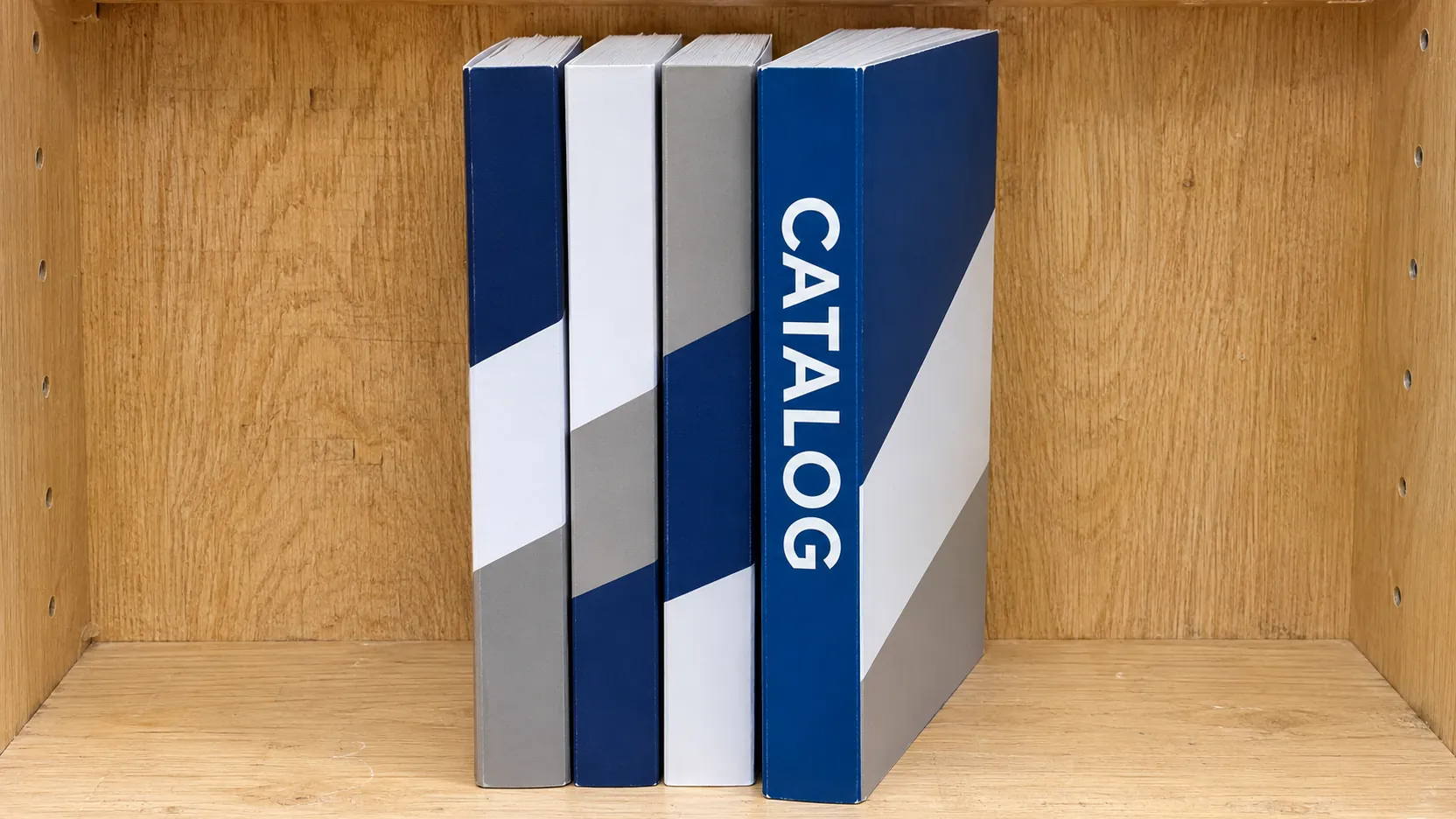
Put a trade-show lookbook and a parts catalog side by side at the same page count, and you can watch the same number ask for two different bindings.
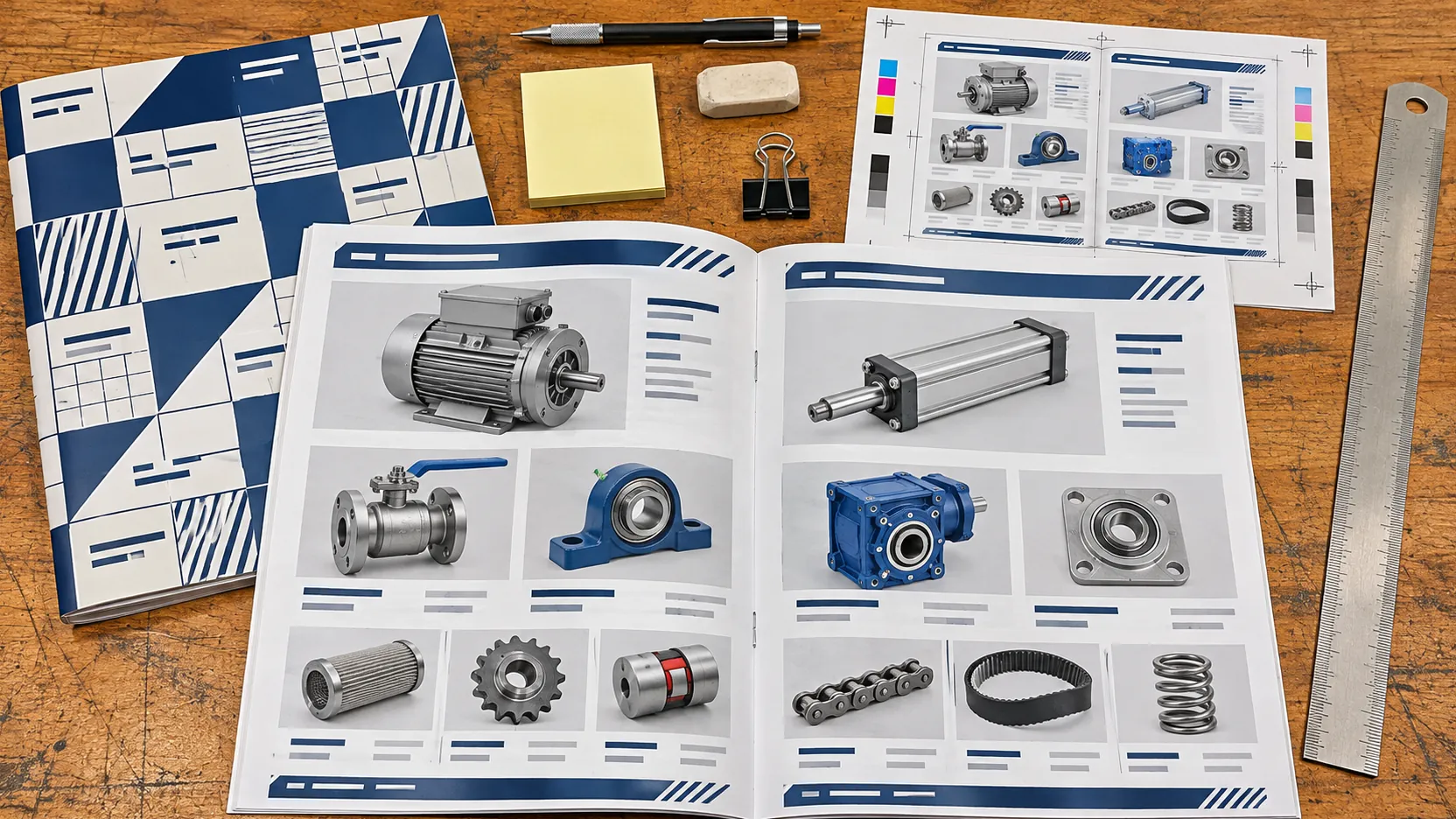
Two catalogs with the same page count can need different bindings when one shows thirty hero products and the other indexes nine hundred part numbers.
Density means SKUs per page plus how readers look things up — browsing spreads favor lay-flat, and part-number lookup favors an index with a printed spine.
Page-count bands still apply; density changes which binding serves the reader inside the same band, not the physics of the band.
Dense catalogs live or die by lookup, and lookup changes what the spine is for.
A perfect bound catalog gets a flat, printable spine, so a dealer book with a part-number index stays findable edge-on a shelf.
The spine needs enough pages to form a square edge — public guidance puts that at roughly 28 pages and up.
A stapled catalog disappears edge-on, and perfect bound pages typically resist lying completely flat, so counter-first use points back to coil.
The third pattern is the bench and counter catalog that has to stay open while hands are busy.
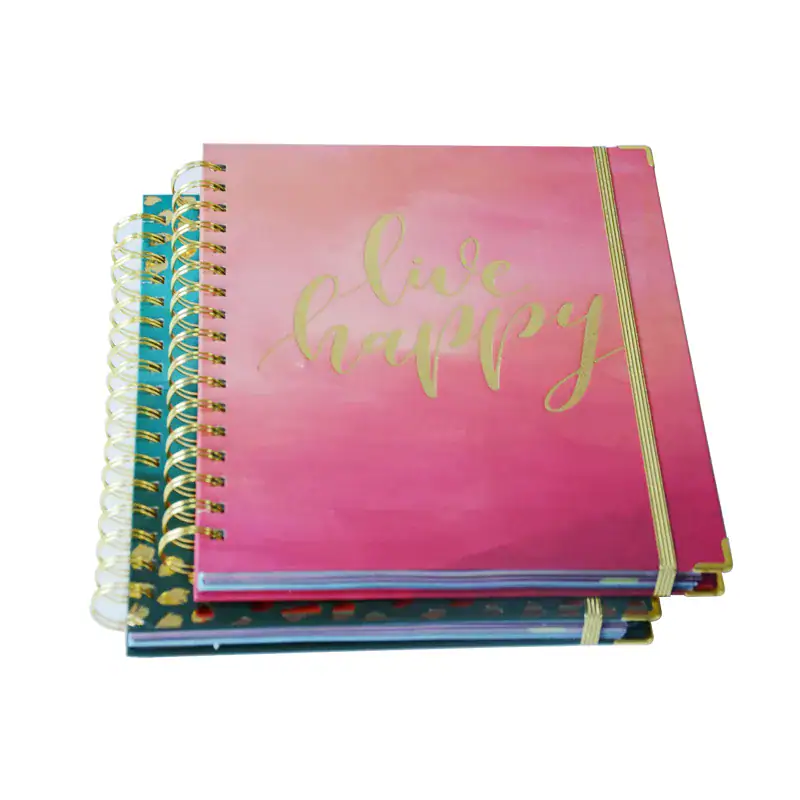
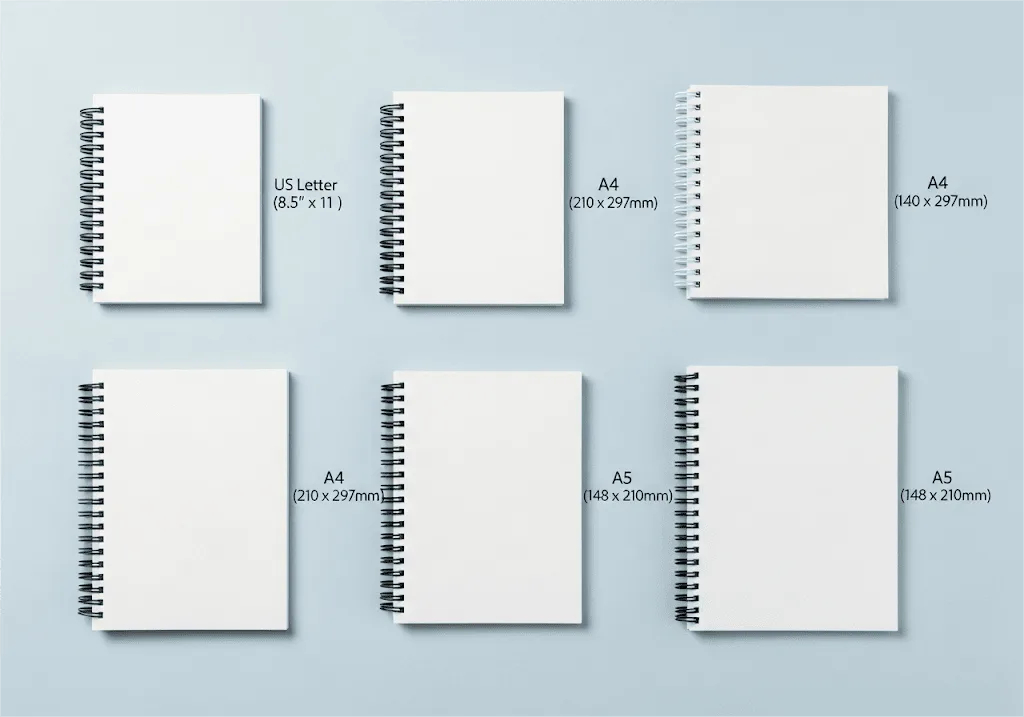
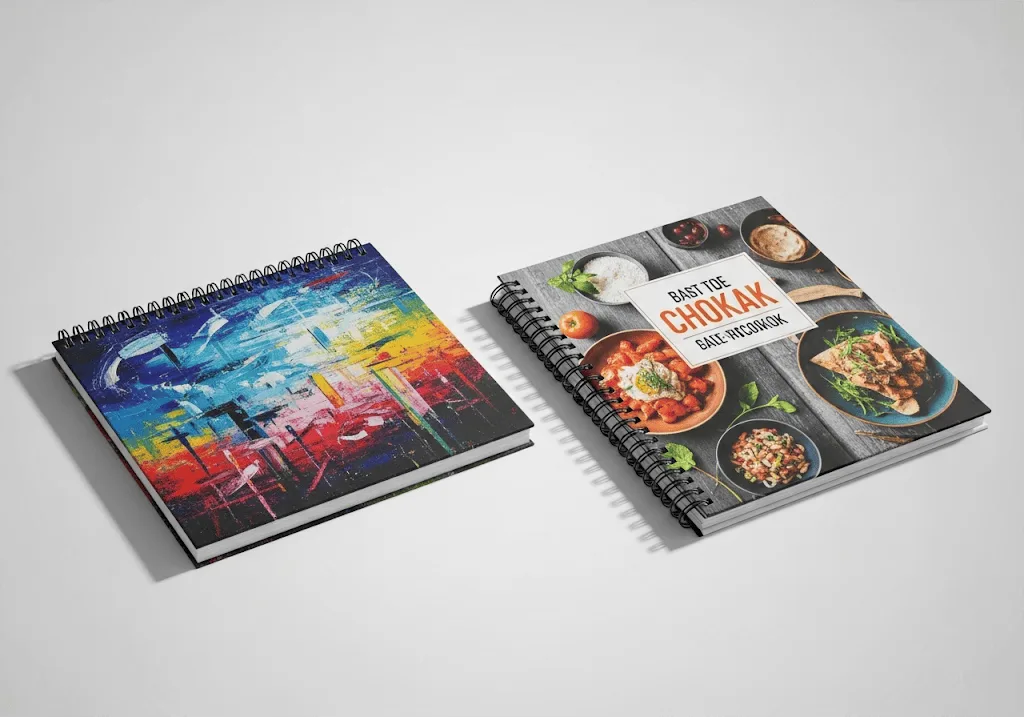
Wire-O and coil lie completely flat and wrap back on themselves, which is why they win for spec books that live open on a counter or bench.
That hands-free pattern matters most when a technician follows a parts list step by step.
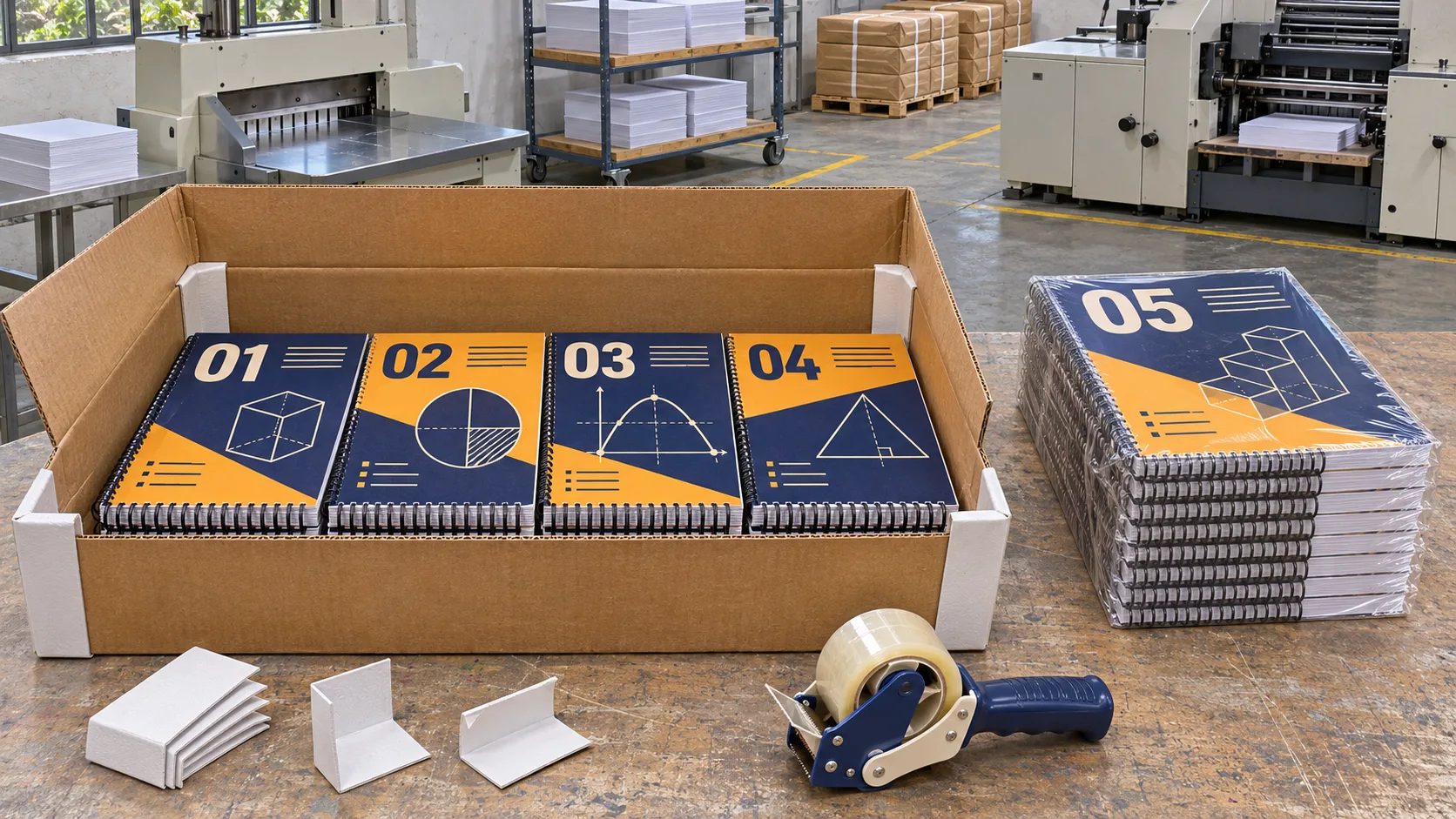
The exposed wire adds bulk and may need extra packaging attention when catalogs ship or mail in quantity.
Real catalog RFQs arrive with page counts from 24 to 1,992 pages and a binding already in mind — page count is the variable buyers bring to the quote.
The pattern comes from Mainland’s own inquiry record: seasonal booklets at 24 pages, dealer catalogs at 56 and 100, engineering references at 124, industrial part books near 2,000.
Inquiries show what buyers ask for, not market volume — no search-demand claim is made from them.
Those extremes also show why “which is cheaper” is the wrong first question: the 1,992-page tool catalog quoted perfect bound with a hardcover option, while the 24-page seasonal booklet never asked about glue at all.
Update Cycle — Quarterly Refresh vs Annual Reference
How long the catalog must stay true is a cost variable most buyers price too late.
Refresh the catalog every quarter and saddle stitch wins on setup cost; build a year-round dealer reference and PUR perfect bound pays for itself in durability.
The trade assumes you replace or reprint the whole catalog each cycle and that sales reps keep the reference in daily use.
When only prices change, keep prices off the bound pages on a dated sheet instead of rebinding — and small top-up reprints cost nearly a full run in plates, so batch them.
The glue premium is not a one-time fee: paying it four times a year for a catalog that changes every quarter is how annual budgets quietly double.
A seasonal line moves fast enough that a stapled catalog plus a dated price sheet keeps every refresh cheap, and the lighter piece also saves postage weight on every mailing.
When your refresh plan and your quantity plan start interacting, the cost side takes over: for how to plan catalog printing costs and edition updates, the companion cost guide walks quantity tiers, reprint plate economics, and edition structure in full.
Sample Checkpoints Before You Lock the Binding
A binding decision made only on screen is a decision made half-blind, because the two things that break bindings do not show on screen.
Check the binding on a physical dummy at your final page count and paper, because spine creep and lie-flat behavior only show in hand.
A useful sequence is a bound dummy, a paper swatch under the light the catalog will actually be read in, and a spine test for perfect bound.
Confirm the final binding choice with your printer before cover art and pagination are locked, not after.
In practice, four checks cover the failure modes that cost real money:
- Bound dummy at final page count and stock — does the spine bulge, does it still close flat?
- Paper swatch in real reading light — warehouse aisles and counter lamps are not office daylight.
- Printed-spine test for perfect bound — title legible edge-on, cover text clear of the spine fold.
- Open-flat test for Wire-O — at the page a technician would actually rest it on, not the center.
Each checkpoint maps to one failure you cannot see in a PDF, which is why proof-only approvals keep surprising buyers at 5,000 copies.
Not sure which band your catalog falls in?
Send page count, quantity, SKU count, and how the catalog gets used—Mainland’s catalog printing team replies with a binding recommendation on your actual spec, and the quote form takes “recommend for me” as the binding answer.
The Bindings and Boundaries We Actually Run
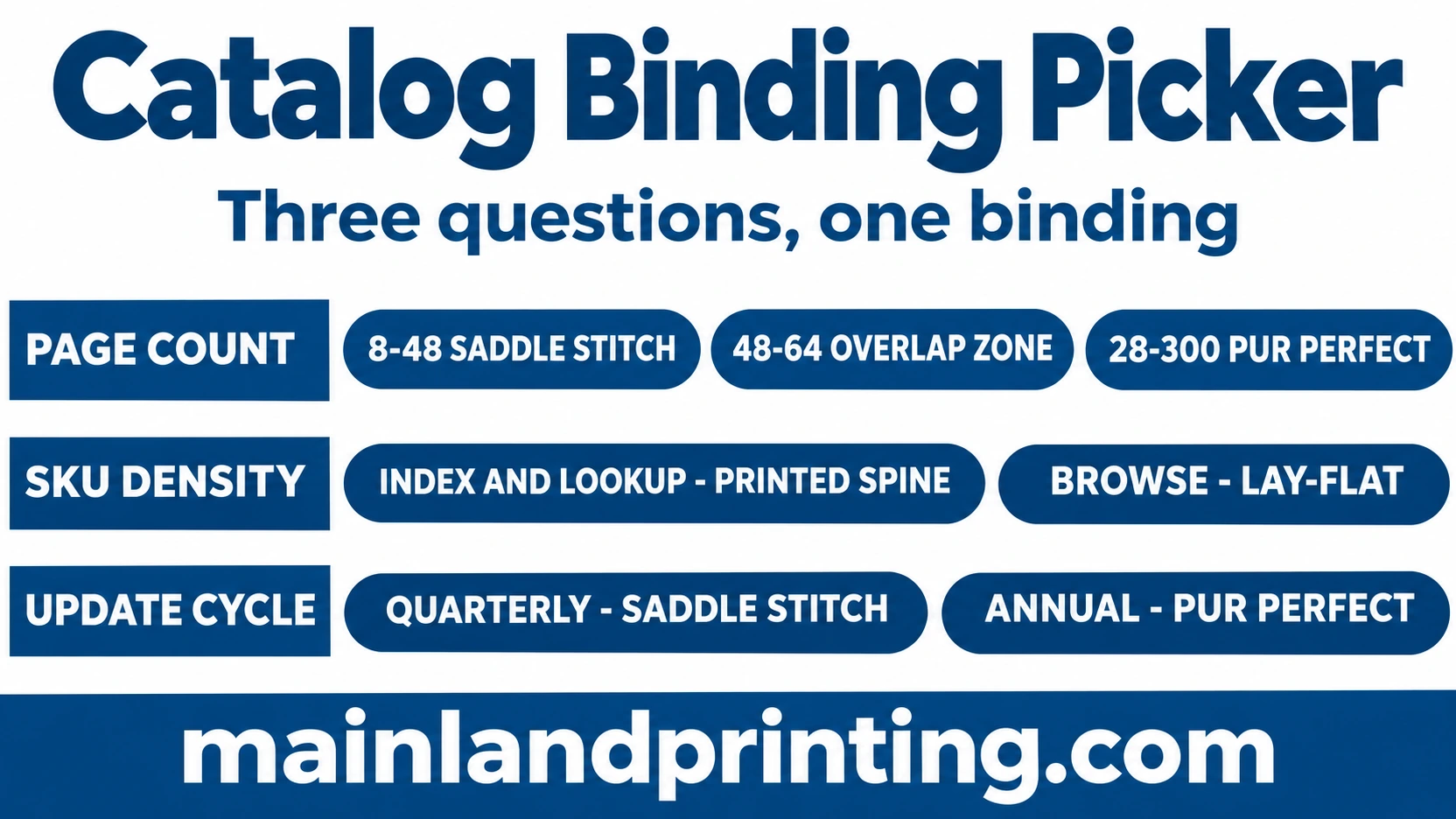
Planning against a real factory beats planning against a search result, so here are the working boundaries in one place.
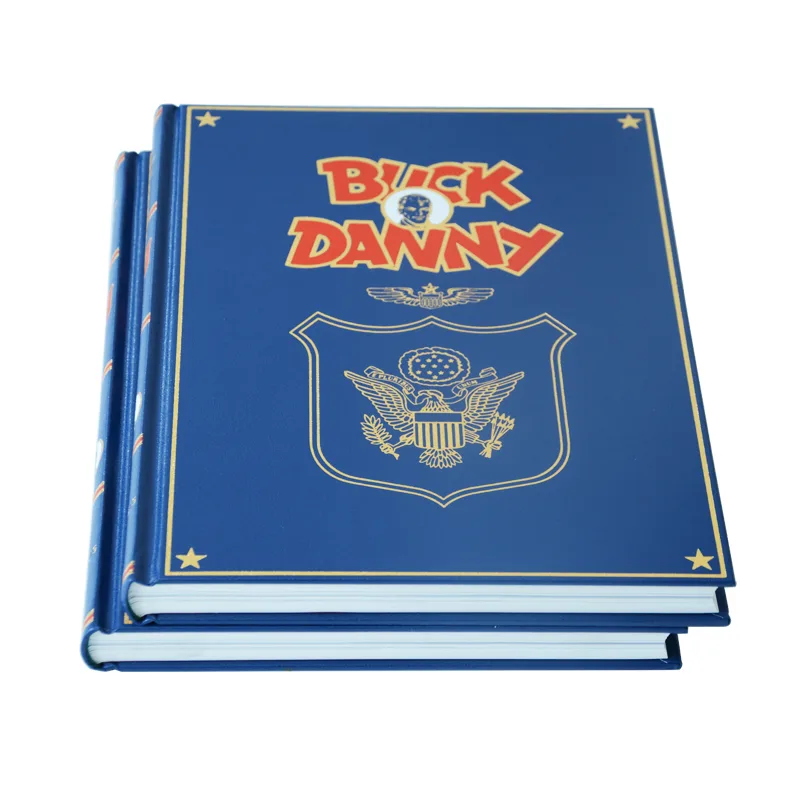
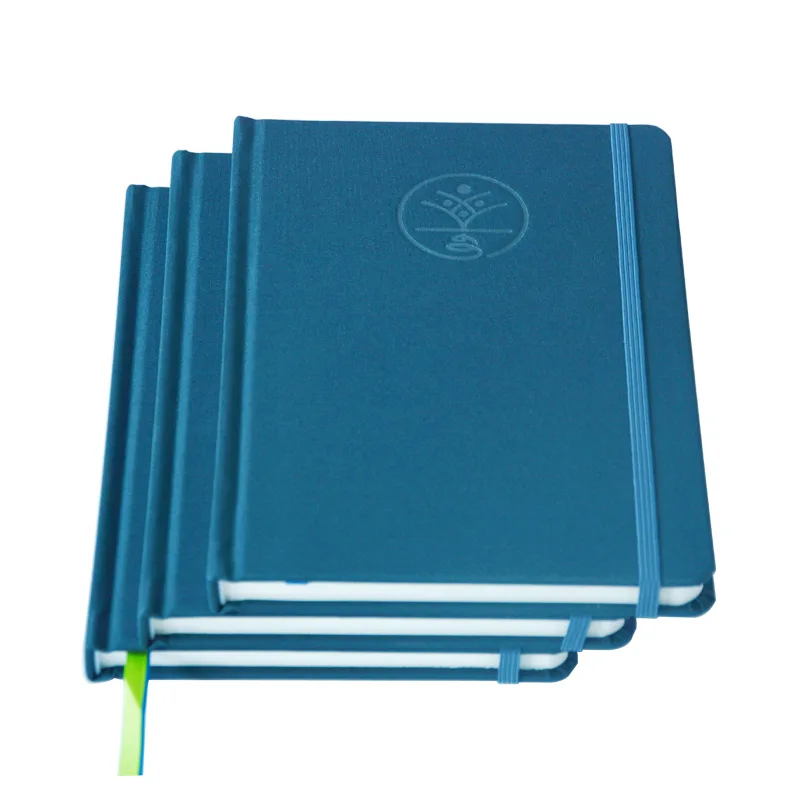
Mainland runs saddle stitch from 8 to 64 pages, PUR perfect bound from 28 to 300, spiral and Wire-O from 16 to 200, and hardcover from 40 pages up.
Those are the factory’s catalog-work boundaries, and every quote is built on your actual spec — page count, quantity, and use all enter the number.
Boundaries are practice for catalog work, not physics limits; unusual projects are judged on the spec, not the table.
| Verbindlich | Pages (Mainland) | Built for |
|---|---|---|
| Sattelstich | 8–64 | Wholesale line sheets, trade-show handouts, seasonal refreshes |
| Perfect bound (PUR) | 28–300 | Dealer references with indexes; the catalog default |
| Spirale/Draht-O | 16–200 | Spec books that live open on a counter or bench |
| Hardcover (case bound) | 40+ | Premium collections and commemorative brand catalogs |
Two planning notes travel with the table: offset runs start making unit-price sense around 500 copies, and layouts should be built in 4-page multiples because the press folds in 4, 8, and 16-page signatures—both details your designer will thank you for early.
Send Your Spec, Lock Your Binding
You now hold the whole decision on one page: a page-count shortlist, a density test for the overlap zone, an update-cycle rule that prices the glue premium honestly, four checkpoints that catch what PDFs cannot, and factory boundaries to plan against.
What ships with the inquiry is short—page count, quantity, SKU count, update cadence, and how your sales team actually uses the piece—and the binding recommendation comes back on your spec, not on a generic chart.