Stop overpaying for local printing and start mastering your supply chain with total confidence. This guide shows you exactly how to move your production to China while using the “Genoa Shortcut” to slash delivery times and avoid costly tax traps.
Shipping books from China to Switzerland is most efficient via the Port of Genoa. This “Southern Gateway” reduces inland transit to Zurich by 400km compared to Northern ports. By using a T1 Transit Document, importers bypass EU VAT and only pay the 2.6% reduced Swiss VAT upon border entry.
But picking the port is only half the battle. You also need to protect your books from the Alpine climate and navigate non-EU customs laws like a pro.
Why China is the Engine of 2026 Publishing

When you look at a local quote for 1,000 hardcover art books, you aren’t just paying for paper and ink; you are paying for Swiss labor, Swiss energy, and Swiss overhead.
By moving production to a specialized manufacturing hub, you are leveraging an ecosystem designed for scale.
The Break-Even Reality
For most Swiss-based projects, the financial “tipping point” occurs much earlier than you might think.
Even when accounting for premium sea freight, import duties, and inland trucking, the Total Cost of Ownership (TCO) favors international production for almost any run exceeding 300 copies.
“Supply Chain Diversification and Global Sourcing are no longer optional for high-cost sectors like publishing. To remain competitive, Swiss firms must integrate efficient international production hubs while maintaining logistical precision.”
— Dr. Patrick Zenhäusern, Director and Head of Industry & Strategy at BAK Economics AG.
Swiss Local Printing vs. China SCM Strategy
| Factor | Swiss Local Printing | China SCM Strategy (via Genoa) |
|---|---|---|
| Average Unit Cost (1k copies) | $25.00 – $32.00 | $6.50 – $8.50 |
| Logistics Lead Time | 2 – 3 Weeks | 5 – 6 Weeks |
| Import VAT (MWST) | 0% (Domestic) | 2.6% (Reduced Rate) |
| Sustainability | High (Local) | High (FSC Certified + Low Sea Carbon) |
The “Genoa Shortcut” to Zurich
The most common mistake in shipping books from China to Switzerland is following the “Northern Route.”
Most freight forwarders default to Hamburg or Rotterdam simply because they are the largest ports in Europe. But for your Swiss business, these ports are a logistical detour.
Choosing the Port of Genoa in Italy as your entry point is a move of geographical logic that brings your books directly to the foot of the Alps.
The Natural Port of Switzerland
Choosing the Port of Genoa (Porto di Genova) in Italy as your entry point is a move of geographical logic. It is the “Southern Gateway” that brings your books directly to the foot of the Alps.
- Distance to Zurich from Hamburg: ~850 km (The “Long Haul” trap).
- Distance to Zurich from Genoa: ~450 km (The “Same-Day” loop).
By choosing Genoa, you cut the inland road transit distance by nearly 47%. In an era of rising fuel surcharges, this distance reduction translates directly into 15% to 20% lower trucking costs and significantly higher delivery certainty.
Strategic logistics rely on understanding the Mediterranean shipping routes that bypass Northern European congestion.
“The Mediterranean route via Genoa is not just a secondary option; it is a primary, high-efficiency corridor that reduces the last-mile carbon footprint and transit time for Swiss importers.”
— Soren Toft, CEO of MSC (Mediterranean Shipping Company), headquartered in Geneva.
Choosing Your Entry Point
- Choose Genoa if: Your destination is Zurich, Basel, Lugano, or Chur. You want to avoid Northern port congestion and minimize Alpine transit time.
- Choose Northern Ports only if: Your distributor is located in Northern Germany or if sea freight rates to the Mediterranean are temporarily and significantly inflated (rare in the 2026 market).
The biggest “fatal pain point” for Swiss importers is the fear of getting caught in the European Union’s tax web.
Because Switzerland is not an EU member, your goods are effectively “in transit” when they move through Italy or Germany.
Ready to Lower Your Print Logistics Costs?
From vacuum sealing to the Genoa shortcut, our book printing experts handle every technical detail to ensure your project arrives in Zurich flawlessly.
The “Bonded Bubble” (T1 Transit Document)
If you clear your books for entry into the EU at an Italian port, you may be forced to pre-pay 22% Italian VAT. This can freeze tens of thousands of dollars of your cash flow. To avoid this, we utilize the T1 Transit Document.
- Origin: Your container is loaded in Shanghai or Shenzhen.
- Transshipment: The ship arrives at Genoa Port.
- The T1 Filing: Instead of final customs clearance, we open a T1 document. This places your goods in a “customs seal” state.
- Inland Transit: The truck moves through Italy without paying EU duties.
- Final Clearance: The seal is only broken at the Swiss border (Chiasso/Lugano), where you pay the reduced Swiss VAT of 2.6%.
How to Calculate Your “At-Your-Door” Cost
Forget complex equations. To find the real price of your book, think of your Total Cost of Ownership (TCO) as three simple building blocks:
| Category | What’s Included | Pro Tip |
|---|---|---|
| 1. Production | Unit Price × Quantity | Locked at your quote. |
| 2. Logistics | Sea Freight + T1 Fees + Trucking | Genoa route saves ~20% here. |
| 3. Swiss Tax | 2.6% of Declared Value | The T1 avoids 22% EU VAT. |
Practical Example (1,000 Art Books):
If your print cost is $7.00/book and total logistics to Zurich is $1,800, your final landed cost (including tax) would be roughly $9,030 ($9.03 per book). Compare that to the $25.00+ local Swiss quote!
Surviving the Alpine Transit
Shipping books is not like shipping electronics. Paper is a “living” organic material that reacts to its environment.
When your books travel from the sea-level air of the Mediterranean, through the cold tunnels of the Alps, and into the dry plateau of Zurich, they undergo massive “climatic stress.”
The “Deformity Trap”
As the truck climbs in altitude, air pressure changes and humidity fluctuates. If your books are loosely packed, the paper fibers will absorb moisture and then rapidly release it once they reach your heated warehouse.
This pressure and humidity imbalance leads to the most common quality complaint in the industry: cover warping and spine cracking.
The Mainland Printing Standard: 360° Shielding
To ensure your books arrive in “Swiss quality” condition, we have established a mandatory packaging protocol for all Alpine shipments:
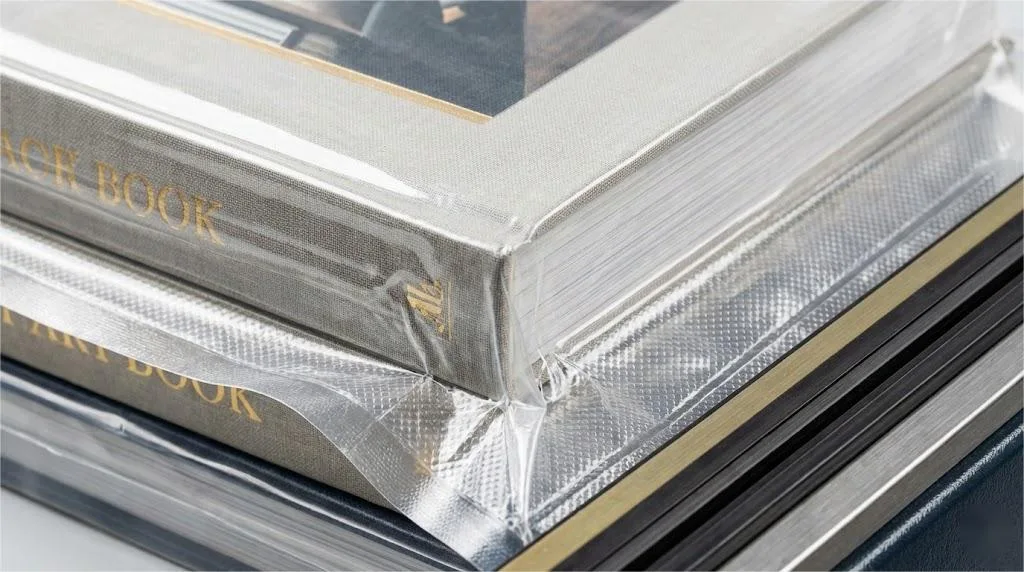
- 100μm Vacuum Barrier Bags: We don’t just shrink-wrap; we vacuum-seal each bundle. This locks the paper’s moisture content at an ideal 8%–10%, making the books “immune” to external humidity changes.
- Double-Wall BC-Flute Cartons: These provide the structural rigidity needed to survive the vertical pressure of a stacked container.
- Vertical Corner Protectors: We reinforce every pallet corner with high-density board to prevent “strap crush” during the turbulent segments of the sea journey.
- UV-Resistant Stretch Wrap: This protects the pallets from the intense Alpine sun and potential rain during the final-mile unloading.
A 24,000 Euro Cautionary Tale

In 2024, a boutique art book publisher in Zurich decided to manage their own logistics for a 2,500-copy run. They followed a “平庸 (mediocre)” advice to use a general freight forwarder who routed the cargo through Hamburg.
The Trap: The ship was delayed due to a labor strike in Northern Germany. Because the forwarder did not understand the non-EU status of Switzerland, they failed to file a T1 document.
The publisher was hit with a 24,000 EUR pre-payment for EU Import VAT just to move the books out of the port.
The Fallout: Their cash flow was crippled for four months while they fought for a tax refund. Furthermore, because they used standard “loose” packaging, the books arrived in Zurich with wavy pages due to the temperature swings of the 900-km journey.
The Lesson: When they switched to our Genoa Shortcut for their 2025 catalog, we bypassed the North entirely. We secured a T1 document 48 hours before docking, and the books were in Zurich within 33 days of leaving Shanghai—perfectly flat, with zero tax surprises.
The FSC “Green Bridge”
The Swiss reader is a discerning one. They value the environment as much as the aesthetic. If your books are printed in China but lack environmental certification, you risk a PR backlash.
We treat FSC (Forest Stewardship Council) certification as the “entry ticket” for the Swiss market. We ensure that:
- The paper is sourced from responsibly managed forests.
- The Chain of Custody (CoC) is maintained through the entire manufacturing process.
- The FSC logo is printed on your copyright page with a valid license code.
This transparency bridges the gap between the efficiency of Chinese production and the values of the Swiss consumer.
Your 30-Day Transition Plan
If you are ready to stop overpaying for domestic production and start shipping books from China to Switzerland, follow this rigorous execution path:
Phase 1: Pre-Production (Week 1-2)
- [ ] Request a quote inclusive of FSC certified paper options.
- [ ] Confirm the factory’s ability to provide 100μm vacuum packaging.
- [ ] Obtain your Swiss EORI number if you don’t already have one.
Phase 2: Logistics Setup (Week 3)
- [ ] Designate Genoa as the port of discharge in your contract.
- [ ] Confirm your freight forwarder has a partner in Italy capable of opening a T1 Transit Document.
- [ ] Verify the inland trucking route via the Gotthard or San Bernardino tunnels.
Phase 3: Shipping & Tracking (Week 4-8)
- [ ] Monitor the vessel’s progress toward the Mediterranean.
- [ ] Ensure the T1 is opened immediately upon unloading in Italy.
- [ ] Prepare for final-mile delivery and 2.6% VAT settlement at the Swiss border.
Readability is the New ROI
In the B2B world, the “best” supply chain is the one that is invisible. You want your books to arrive on time, in perfect condition, and at a cost that allows your business to scale.
By mastering the Genoa Port entry, the T1 document flow, and the vacuum-sealed packaging standards, you are no longer just ordering books—you are managing a high-performance global asset.
The transition from a local Swiss printer to a Chinese-Genoa-Zurich supply chain is not a leap of faith; it is a calculated move based on geography, tax law, and physics.
Are you ready to reclaim your 40% margin? Let’s build your customized logistics blueprint for 2026. Reach out to our team at Mainland Printing to discuss your next sea freight China to Switzerland project. We don’t just print your vision; we protect it every kilometer of the way.