When your softcover quote already names binding and interior stock, the cover line is still where wear, shelf feel, and unit cost quietly drift. You can lock weight, finish, and flaps against how readers will actually handle the book—before you approve the print run.
Paperback cover options are the cover stock weight, the lamination (gloss, matte, or soft-touch), and whether you add French flaps. Match weight to handling wear, choose finish for shelf look versus scuff risk, and add flaps only when extra presence is worth the paper and packaging cost.
You’ll be able to freeze a cover line that survives warehouse handling and still looks intentional on the shelf—then reuse the same checks the next time a finish upgrade appears on a quote.
Match Cover Weight to How Hard Readers Handle Your Book

When you only ask for a “nice thick cover,” you skip the question that actually protects the run: how hard will people bend, stack, and ship these books?
Cover weight is the stiffness of the wrap around your text block—usually spoken as gsm or as “point” thickness for coated one-side stock.Heavier stock resists crease and corner crush; lighter stock stays flexible and cheaper to ship. Your job is to match weight to use intensity, not to chase the highest number on a menu.
| How readers will handle your paperback | Cover weight to lock |
|---|---|
| Trade novel / light shelf use, gentle bag travel | About 250 gsm C2S or 10 pt C1S is usually enough when lamination is confirmed |
| Bookstore trade paperback with regular browsing and restocking | ~300 gsm or 12 pt — more corner strength without turning the wrap into a board |
| Training pack, workbook, or classroom set opened daily | 300–350 gsm (or 12 pt+) — treat bend and desk wear as a cover requirement |
| Large trim or thick text block that needs a stiffer wrap | 350 gsm class when the plant confirms the binder can still score and wrap cleanly |
| Short-life promo paperback with light handling | Stay at the lighter end if lifetime is short—do not buy “premium weight” for a one-event book |
When you once paid for 350 gsm on a 180-page trade novel because a catalog called it “premium,” the books felt stiff in the hand and the carton weight rose without changing returns. Name the handling line on the RFQ first, then let the plant recommend a weight that still scores cleanly for your glue choice.
C1S (coated outside, uncoated inside) often helps glue grab the wrap; C2S prints both sides when you need inside-cover art.Either way, write the gsm or point value—not “thick cover.” For how that cover wraps into a perfect-bound spine with the right adhesive, keep the project aligned with your EVA vs PUR binding decision so weight and glue are one system.
A paperback cover is still a flexible wrap, not a case board. If you truly need rigid boards, step out of this article and compare formats on the hardcover path—do not try to fake a hardcover with extreme softcover weight.
Pick Gloss, Matte, or Soft-Touch for Wear and Shelf Look
When the quote only says “matte cover,” you still have not locked how light hits the art or how the film behaves in a warehouse.
Lamination is a thin protective film applied after print. Gloss boosts color pop and wipes cleaner; matte cuts glare for a quieter look; soft-touch adds a velvet feel that reads premium in the hand.The trap is treating soft-touch as a free upgrade—its scuff and fingerprint behavior can fail faster in high-touch retail or training rooms.
- Gloss when you need saturated art, easy wipe-down, and lower fingerprint drama.
- Matte when glare under store lights matters more than shine—and you want a calmer literary or brand look.
- Soft-touch when tactile premium is a sales tool y you accept higher scuff watch during packing and shelf restock.
- Red flags: soft-touch after rough conveyor contact, face-to-face stacking without slip sheets, or wet-wipe cleaning routines.
| Finish you are considering | When to lock it—and when to change |
|---|---|
| Gloss lamination | Lock for color-forward covers and wipeable surfaces; change if glare makes back-cover type hard to read under bright retail lights |
| Matte lamination | Lock for low-glare literary/brand covers; change if you need maximum color pop or frequent wet wipe cleaning |
| Soft-touch lamination | Lock only when hand-feel is a buying reason; change to matte or gloss when scuff marks or fingerprints show up on early samples |
When a soft-touch sample looked stunning on a desk but showed rub marks after a short carton ride, the right move was not “better packing forever”—it was switching the finish for that SKU while keeping the same cover weight. protective lamination films protect ink, but each film type fails differently under friction.
Finish also moves unit cost. If you are still balancing cover upgrades against run size, revisit paperback printing cost drivers so soft-touch or heavier stock does not silently erase your quantity savings.
Add French Flaps Only When Shelf Presence Pays Off
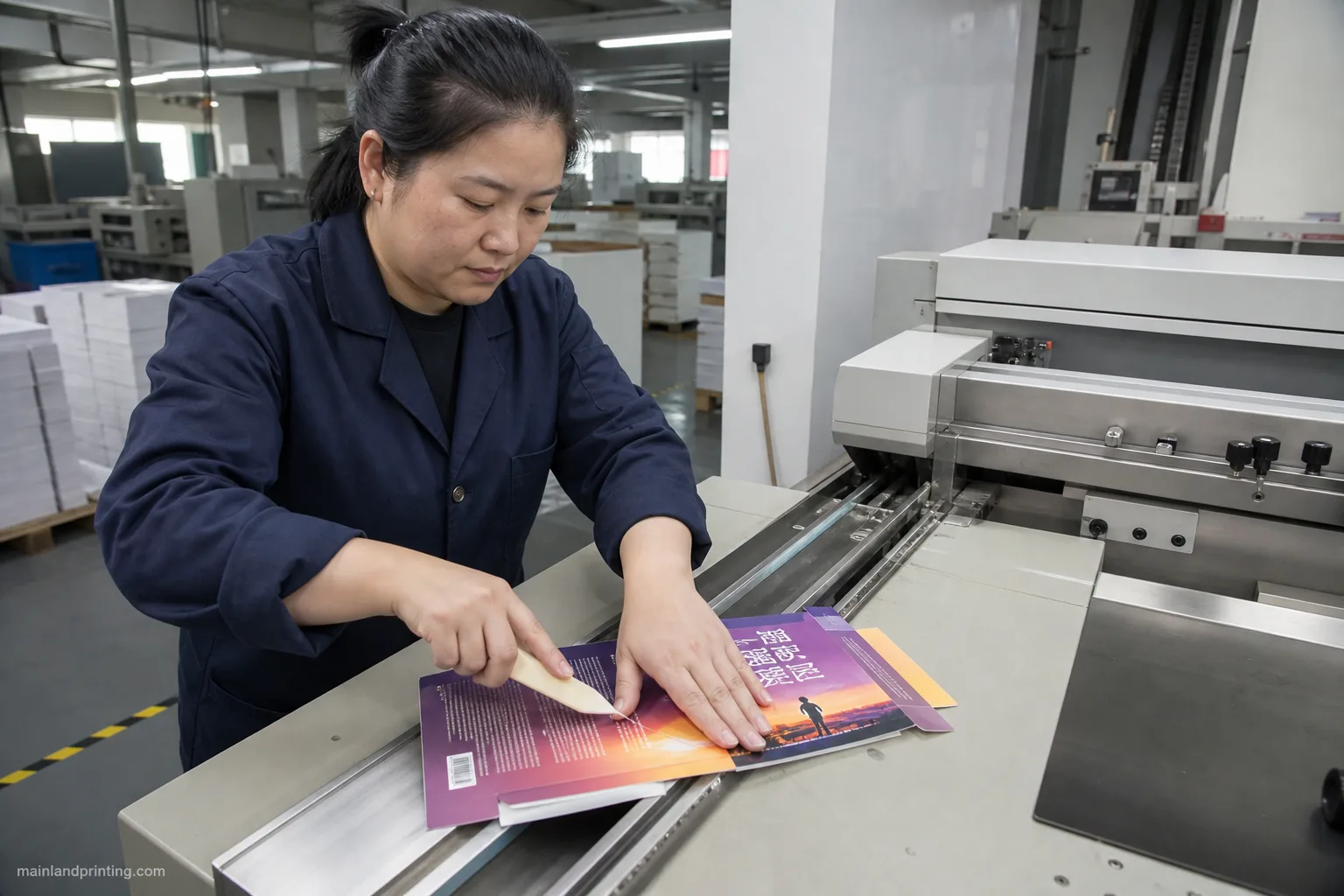
When someone asks for French flaps “to look more premium,” you need a sharper test: will the extra panel space and wrap weight earn their keep on your shelf and in your carton?
French flaps (also called flap covers) extend the front and back covers so they fold inward. You gain room for blurbs, bios, or series notes and a heavier hand-feel—at the cost of more cover paper, scoring, and a thicker package profile.
- Write the job the flaps must do (bio space, bookmark feel, retail differentiation).
- Confirm flap width with the plant (often ~2.5–3.5 in) and keep type away from score lines.
- Ask how flaps change cover sheet size, scoring steps, and carton count per case.
- Hold flaps if the title is already over budget on soft-touch plus heavy stock with no retail need for flap copy.
- Approve only after a folded sample shows clean scores without cracking on your chosen weight.
| Your publishing situation | Keep flaps or skip |
|---|---|
| Literary or brand title sold face-out with blurb/bio on flaps | Keep — flaps carry the sales copy you cannot fit on the back alone |
| High-volume education pack where durability beats jacket-like feel | Skip — spend the money on weight and finish that survive desks and bags |
| Short promo run with no flap copy prepared | Skip — blank flaps add cost without a marketing job |
| Premium trade paperback competing with hardcover presence on a budget | Keep if sample scores clean and packaging plan absorbs the bulk |
When flaps were added late on a 2,000-copy training title “for prestige,” carton densification dropped and corner crush rose because the thicker wrap took more space. You can still run flaps on the trade edition and keep a straight cover on the classroom edition—just do not force one wrap for both intents.
Flaps sit on the softcover path. Keep the full project brief on impresión de libros de tapa blanda so cover weight, finish, and flaps are quoted as one wrap—not three afterthoughts.
Choose a Paperback Cover Specification
Send cover weight, finish, and flap intent with your softcover planner so the plant can return a wrap you can sample and ship.
Write Cover Fields Into Comparable Quotes
When two plants both answer “matte softcover,” you still cannot compare wear risk or flap cost. Put the cover into fields both sides must fill.
| Campo «Solicitud de presupuesto» | Write this on every quote |
|---|---|
| Cover stock | gsm or pt + C1S/C2S (example: 300 gsm C1S)—never “thick cover” |
| Laminación | Gloss / matte / soft-touch named; note if soft-touch is optional or required |
| Flaps | None / French flaps + target flap width; say if flap print is one-side or two-side |
| Handling note | Shelf / classroom / warehouse intensity in one line so weight advice is grounded |
| Sample plan | Digital proof vs physical cover sample—and which scuff/open checks you will run |
- Refuse quotes that only say “matte cover” with no gsm/pt.
- If soft-touch is a sales ask, mark it optional so you can swap after sample scuff checks.
- Keep interior paper on its own line—cover and text stock are different decisions (see softcover interior paper when insides still need locking).
Industry groups such as the Book Manufacturers’ Institute treat cover construction as a manufacturing specification, not a mood word. Your RFQ should read the same way.
Check Cover Samples Before You Approve Production
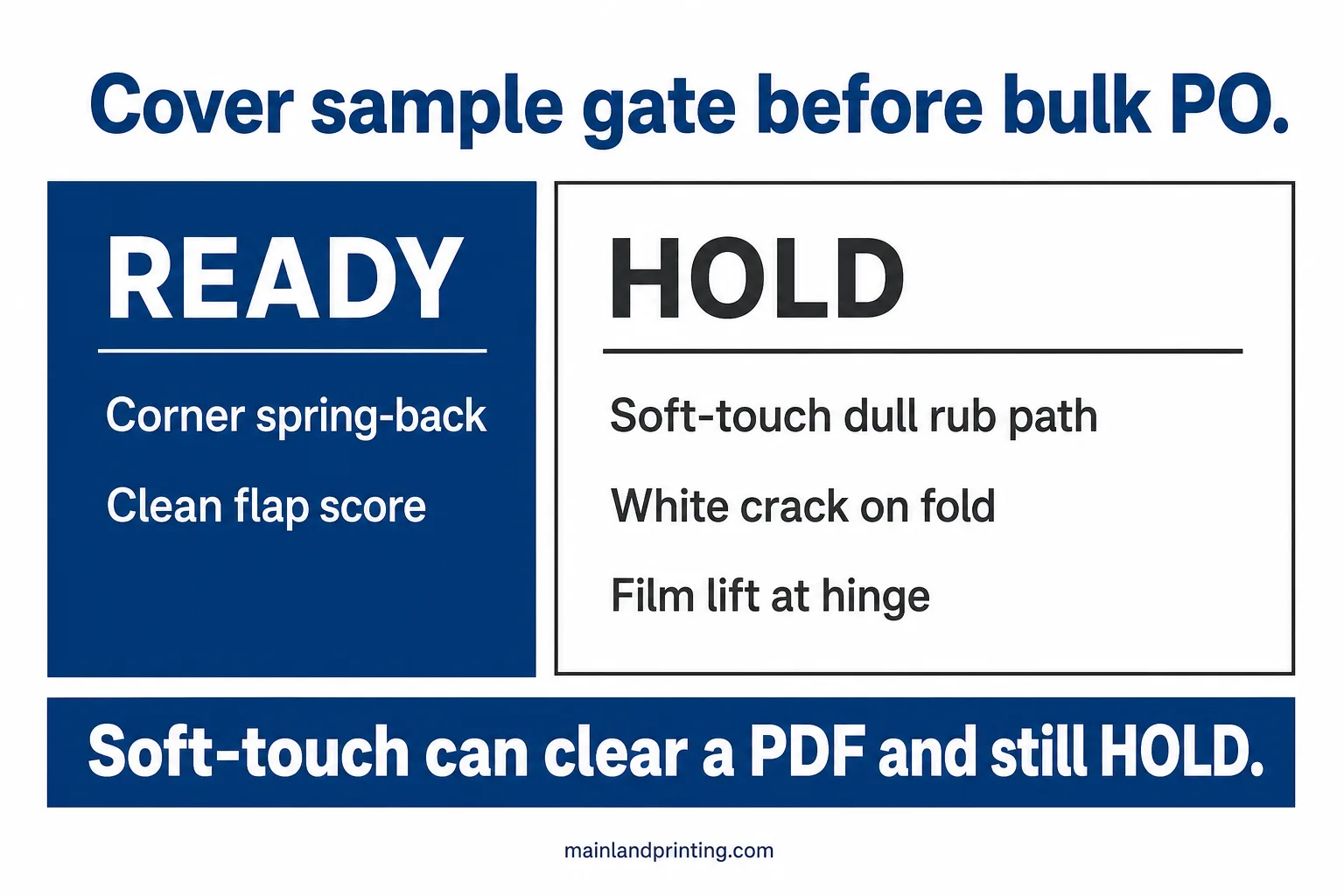
When the PDF looks perfect, the film and flaps can still fail in your hand. Run a short physical gate before you release the bulk PO.
| What you check on the cover sample | Listo | Esperar |
|---|---|---|
| Corner bend and wrap stiffness | Corners spring back; wrap feels right for your trim and page count | Easy crease or limp feel under light finger pressure |
| Lamination rub / fingerprint | Light rub leaves no obvious burnish; fingerprints wipe or stay acceptable | Soft-touch shows dull rub paths after a short fingernail or cloth pass |
| Flap score (if used) | Fold is clean; ink does not crack along the score | White break lines or wavy flap after one fold cycle |
| Spine hinge with your glue plan | Open-close cycles do not delaminate the wrap at the hinge | Film lift or crack at the hinge before you reach normal open stress |
- Open and close the sample hard ten times at the hinge—listen for crack and watch the film.
- Rub the front panel with a clean cloth; photograph any dull path on soft-touch.
- If flaps exist, fold them in and out twice and check score color break.
- Stack two books face-to-face for a minute; look for transfer or stick before you approve packing without slip sheets.
- Only then mark the cover line Ready on the PO.
When a soft-touch flap sample passed the PDF but failed the rub test, you still saved the run by swapping to matte on the same weight and keeping flaps. That is the point of the gate: change one cover variable, not the whole title plan.
Lock Your Paperback Cover Spec for This Print Run
You now have a cover path that ties weight to handling, finish to wear versus shelf look, and flaps to a real marketing job—backed by RFQ fields and a short sample gate.
Approving production on that line means you are not gambling on a mood word like “premium cover.” You are releasing cash against a wrap that should survive cartons and still feel intentional when a reader picks it up.
Send the locked gsm or pt, the named lamination, and flap yes/no with your softcover planner. If the plant returns a sample that fails rub or score checks, swap one variable and re-approve—then let the rest of the paperback move.
After the wrap materials are frozen, clear spine width, bleed, and proof type with the paperback file checklist before you upload print-ready PDFs.