A training rollout, a semester start, or a client program has a fixed first day—and the workbooks are still on a press line in China with four weeks of ocean between them and the people who need them.
Spiral bound workbook shipping to USA offices, schools, and warehouses works when you plan it backward from the launch date: lock the schedule first, protect the coil edge in the carton, collect receiving details per destination, and split air and sea when the date is tight.
By the end of this guide you will have a backward schedule you can hand to a printer, a four-point coil protection check to run before cartons close, and a receiving checklist that keeps offices, schools, and warehouses from turning a good print job into a dock dispute.
Build the Schedule Backward From Your Launch Date
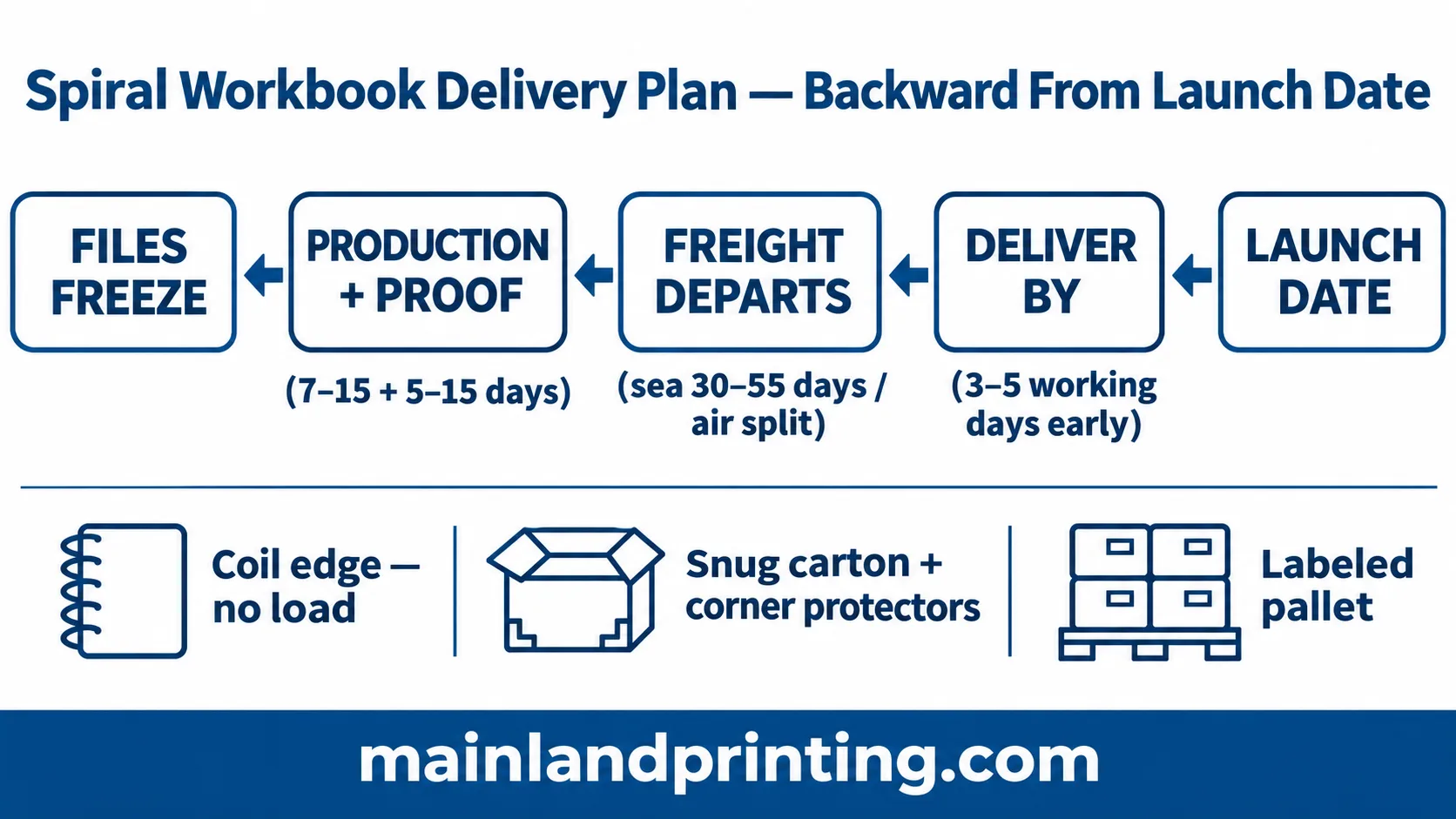
Start from the day the workbooks must be in hands, and let every earlier date fall out of it: file freeze, proof approval, production completion, and the freight departure that still lands in time.
One China printer publishes a 60–80 day standard window from artwork to U.S. delivery: roughly 3–7 days of prepress, 5–15 days of sampling, 7–15 days of production, and 30–55 days of sea freight.
Those are that printer’s published windows — peak-season queues and routing choices can move the total by weeks, which is why the schedule has to be built backward from your launch date.
Use the structure as the planning tool, not a promise; your real dates come from your printer’s confirmed schedule, and this page does not guarantee any fixed transit time.
For the stage-by-stage version of that structure, see Yuen Printing’s China-to-US book timeline—their windows are their own service, not Mainland’s.
The table below turns that structure into the five dates a workbook order actually needs. Each row names the stage and what has to be locked before the next stage can start.
| Date to fix | Locked when |
|---|---|
| Launch date | First training day, semester start, or client kickoff named in writing |
| Delivery date | Arrival set 3–5 working days before launch, so receiving and unpacking have room |
| Freight departure | Sailing or flight booked against the printer’s confirmed completion date |
| Production and proofing | Proof rounds and the run scheduled to hit the freight date, with revision rounds counted in |
| File freeze | Artwork locked so prepress starts on time—run the spiral file checklist before this date, not after |
If the launch date is closer than the full structure allows, do not compress proofing—move the freight decision instead, which is what the split-delivery section below is for.
Protect the Coil Edge: Deformation, Punch Holes, Corners, Stacking
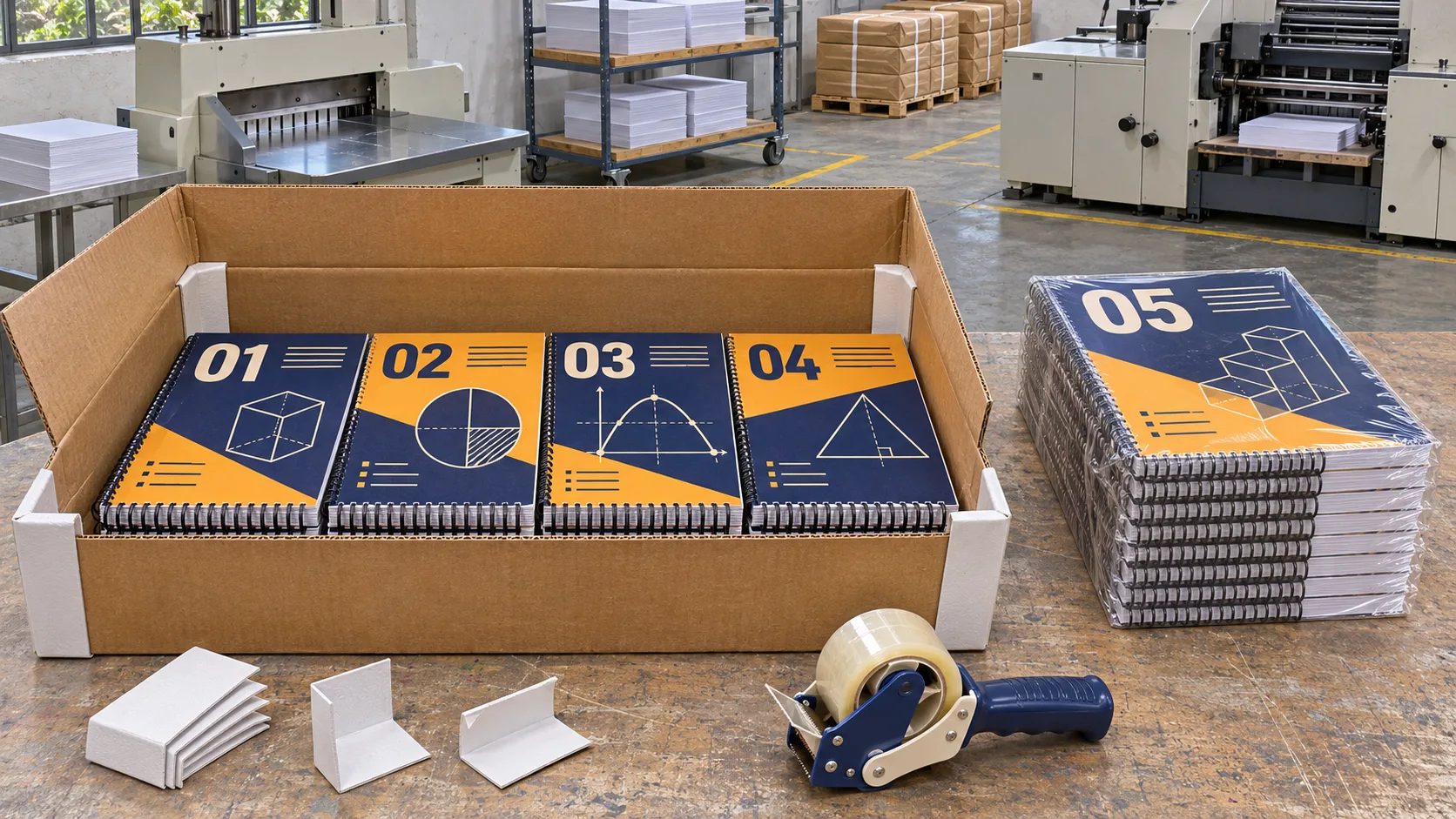
Before any carton closes, four spiral-specific failure points deserve a named check—generic “strong box” instructions miss all of them.
- Coil deformation: what bending does the coil take, and does it spring back or stay bent?
- Punch-hole stress: is anything pressing on the bound edge so holes tear toward the page edge?
- Corner damage: are the fragile page corners protected against bumps?
- Stacking: which face of the carton below carries the weight of the carton above?
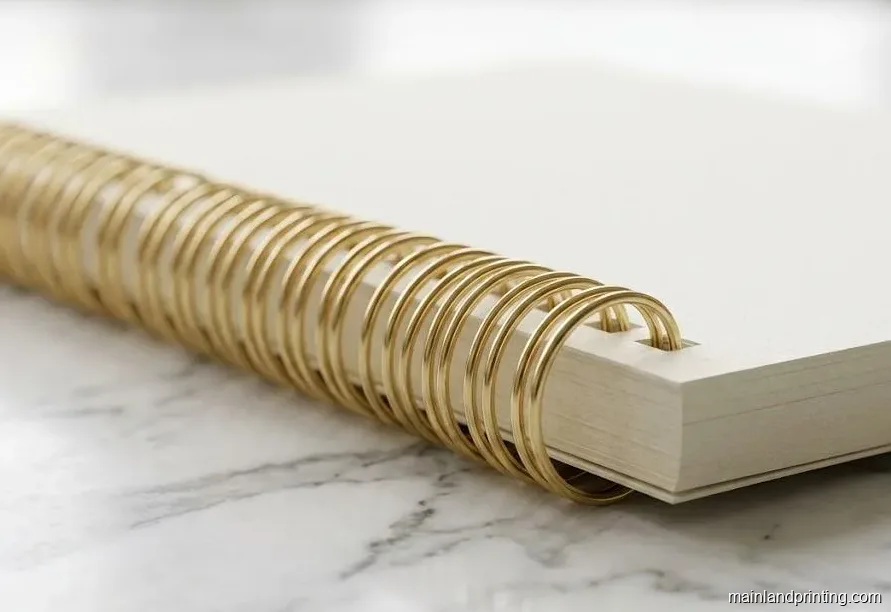
Plastic coil springs back after a crush; metal Wire-O can stay bent if a carton is mishandled in transit.
That split sits on Mainland’s own binding FAQ for workbooks and training manuals, so match the coil to the handling your cartons will actually face.
Order a physical sample before you lock Wire-O for a shipment that will be stacked and re-handled many times on its way to a warehouse.
Stacking weight belongs on the page faces, not on the coil edges. Punch holes tear when the bound edge carries load, so cartons should sit flat with covers facing up—run the same orientation inside the carton as on the pallet.
Real workbook buyers already write reinforcement into their specs — one spiral inquiry asked for reinforced holes and layered edge protection so pages do not tear.
That wording came from an actual buyer inquiry, so treat hole strength as a live requirement to plan for, not a nice-to-have.
Exact reinforcement options — a heavier inner sheet or a reinforced strip along the punch line — depend on your paper and page count, so confirm them on the quote instead of assuming.
Which coil material fits the program is its own decision; the material fork between metal and plastic lives on the Wire-O vs plastic coil binding guide once page count and use are settled.
Choose Packaging Layers: Shrink-Wrapped Bundles, Cartons, Pallets
Bulk workbook shipments do their protective work in three layers, and each layer answers a different risk: moisture and scuffing, crush and corner damage, and handling at the warehouse.
Heavy-duty corrugated cartons stop crushing and corner damage, and shrink wrap keeps bundled copies clean and held together against dust and moisture.
Those are the standard layers China book printers publish for bulk shipments, and sizing cartons snugly keeps the copies from shifting inside.
Snug sizing beats thick walls with empty space; before committing a full order, run a small shipping test the way your freight will actually be handled.
A published packing walkthrough shows the full sequence: bubble wrap folded up the sides and taped, heavy-duty paper as a second layer, the order dropped into a sturdy corrugated box, and bands reinforcing the seal.
Corner protectors on each corner guard the page edges against bumps, and once an order goes pallet-scale the protection shifts to the whole pallet rather than the individual boxes.
That layered practice — wrap, corner protectors, a sturdy box, bands — is how one book printer documents its own packing line for orders that have to arrive clean.
Which layers make sense depends on carton size and destination; small cartons into an office or school mailroom ship differently from full pallets into a warehouse dock.
Collect Destination and Receiving Details Before Cartons Are Sealed
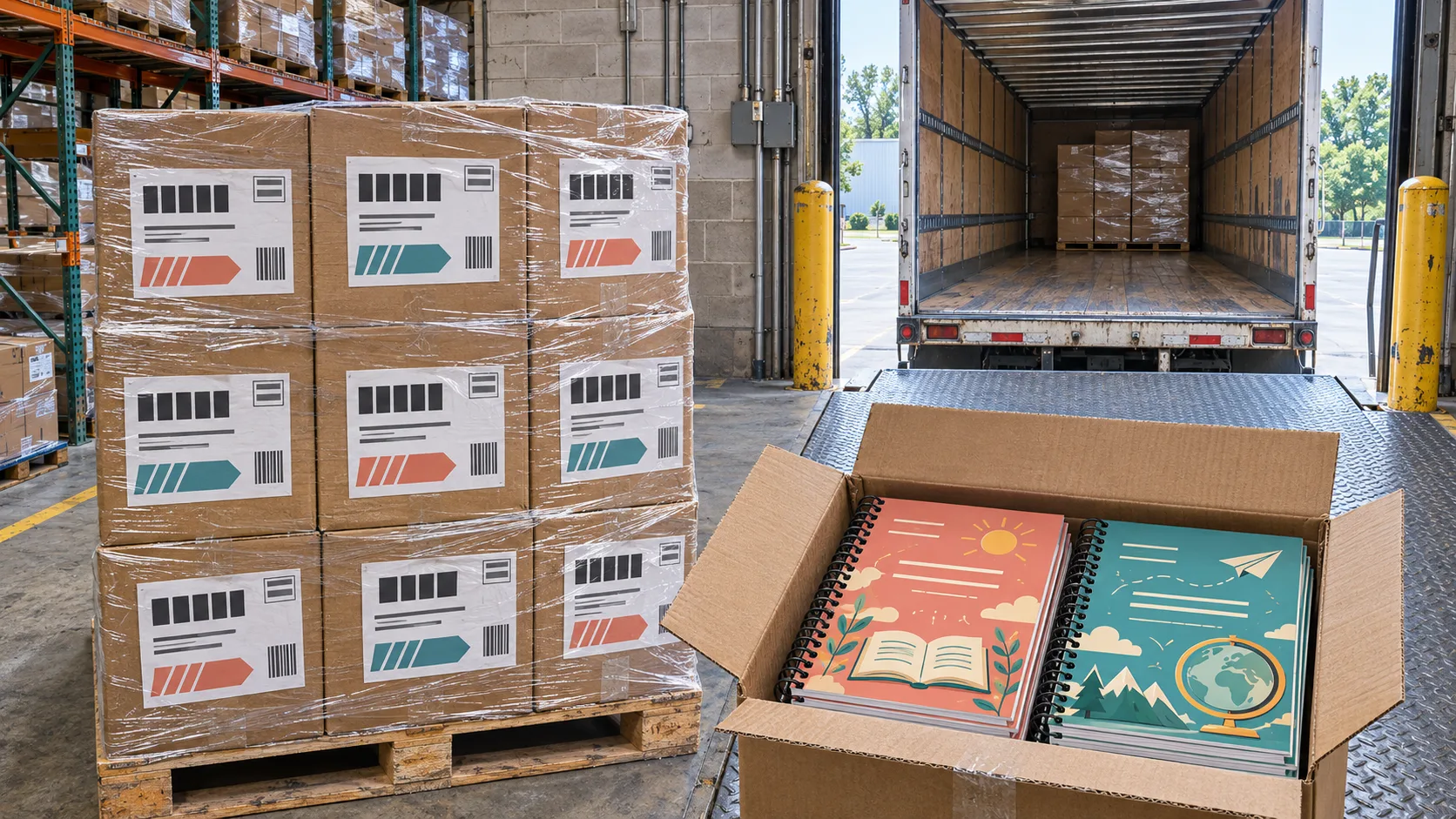
Every delivery address is also a set of receiving rules, and the cheapest time to learn them is before the cartons are sealed and labeled.
- Address and contact: the delivery address plus a named person and phone for the dock or mailroom
- Hours and appointments: receiving hours, appointment requirements, and cutoff times for booking a dock slot
- PO or requisition numbers: the reference numbers that must appear on labels so the shipment matches paperwork
- Pallet and liftgate needs: palletized or loose cartons, dock height, and whether a liftgate is required at addresses without a dock
- Signatory: who accepts and signs on arrival, and where cartons go after the signature
Offices and schools usually receive small cartons through a mailroom or front desk on business hours, while a warehouse books dock appointments and may refuse unlabeled pallets—so one order going to all three needs three receiving plans, not one.
Ready to plan the print and delivery together?
Send the launch date, first-batch quantity, destinations, and coil protection requirements—Mainland will schedule production, packaging, and freight against your dates.
Split the First Batch and the Bulk When the Launch Date Is Tight
When the full order cannot sail and still land before day one, the decision is not “faster freight for everything”—it is which copies actually need to be there first.
Air freight is fast but costly, while sea freight is more economical but significantly slower.
When the launch date is tighter than a full sea shipment allows, split the order — air-freight the copies that must be there on day one and let the bulk sail.
Splitting only pays when the day-one quantity is small and clearly defined; label cartons per destination so each arrival can be received without repacking.
Name the day-one list before you price the split: trainer sets, kickoff-event copies, or the first classrooms—everything else belongs to the sea batch.
Know What DDP Covers for Workbook Deliveries — and What It Doesn’t
DDP sounds like “delivered anywhere,” and that misunderstanding is what turns a smooth print project into a refused delivery at a school gate.
Under DDP the seller carries the maximum responsibility — transport, export paperwork, U.S. customs clearance, and duties or taxes — and the buyer’s default job is only to unload.
That is the Incoterms 2020 definition a freight forwarder spells out: DDP is the only term where the seller acts as the importer of record in your country.
DDP does not mean every school, office, or warehouse can receive freight; confirm each address is commercial, whether a dock or liftgate is needed, and who pays any local receiving fees.
For the full Incoterms walkthrough—including when DDP stops being the right term—see BSI Freight’s DDP guide.
The workbook-specific version: one real buyer asked for 300–500 paperbacks delivered DDP straight to a fulfillment warehouse, which is exactly the case where receiving rules and dock appointments decide whether DDP ends well.For the full term-by-term comparison—DDP against FOB and CIF for US book buyers—see Mainland’s DDP shipping from China to the US guide; this page keeps only the workbook-delivery application.
Send One Delivery Brief With the Print RFQ
You now hold the four planning pieces this page promised: a backward schedule anchored on the launch date, a coil-protection check that runs before cartons close, a receiving checklist per destination, and a split-delivery decision rule.
A delivery-ready RFQ is short: launch date, day-one quantity and total quantity, destination list with receiving details, coil material and any hole reinforcement, and the DDP or term question for each address.
Send that brief with the print RFQ to Mainland’s spiral bound book printing team, so production, packaging, and freight are scheduled against the same dates.If page structure or file readiness is still open, close those first on the file-checklist spoke—then this delivery plan holds without reopening the print conversation.