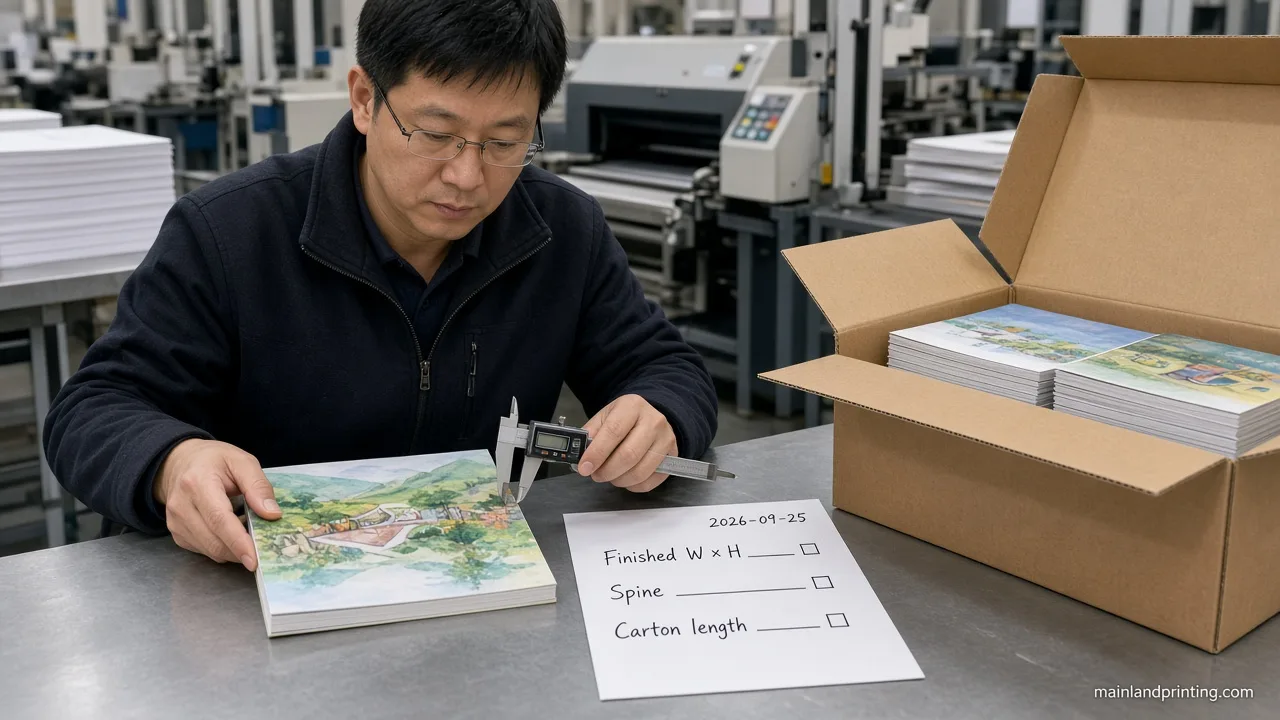
When paperback quotes look cheap on unit price but quantity, page count, and ship-to fields do not line up, the “cheaper” line often hides a different book. You can still force a budget view that weighs total cash, unit cost, and shelf risk before you raise the print run.
Paperback book printing cost moves with quantity, page count, interior color, paper, binding, cover finish, and ship-to plan—not a single per-copy number. Compare total cash, unit cost, and inventory risk across 300, 500, 1,000, and 5,000 before you lock a run.
Keep reading and you will leave able to size a paperback run against cash and inventory—and send one spec sheet that makes the next two quotes actually comparable.
Map the Cost Drivers Before You Pick a Run Size

When you open with “what’s the per-book price?”, you skip the levers that actually move a paperback quote.
Lock the drivers first. Quantity only makes sense after page count, color, paper, binding, and delivery are the same on every line you compare.
| Factor de coste | What you freeze on the RFQ |
|---|---|
| Rango de cantidades | 300 / 500 / 1,000 / 5,000 (or your real target) |
| Trim + page count | Finished size and exact page count (not “about 200”) |
| Interior color | B&W text, spot color, or full color—and which pages |
| Paper + cover | Text gsm/opacity class; cover weight + lamination |
| Binding path | Perfect-bound softcover vs stitch booklet vs other |
| Ship-to plan | Country, warehouse vs residential, target in-hand week |
Commercial commercial offset presses spread plate and make-ready cost across the run, so quantity changes unit economics more than a POD calculator implies. That is why a KDP-style page formula is a poor stand-in for a 500–5,000 education or trade paperback project.
If you still need a wide “all book types” overview, use the generic book printing cost guide—then come back here to size a paperback run with matching specs.
Paper choice is not a vanity upgrade. Heavier or more opaque stock raises both print and freight weight; confirm opacity needs against your interior ink load before you chase a “cheaper” sheet that show-through will reject later. Measure show-through on a 48-hour ink-dry sample before you lock gsm.
Compare 300 to 5,000 Paperback Runs Without Guessing
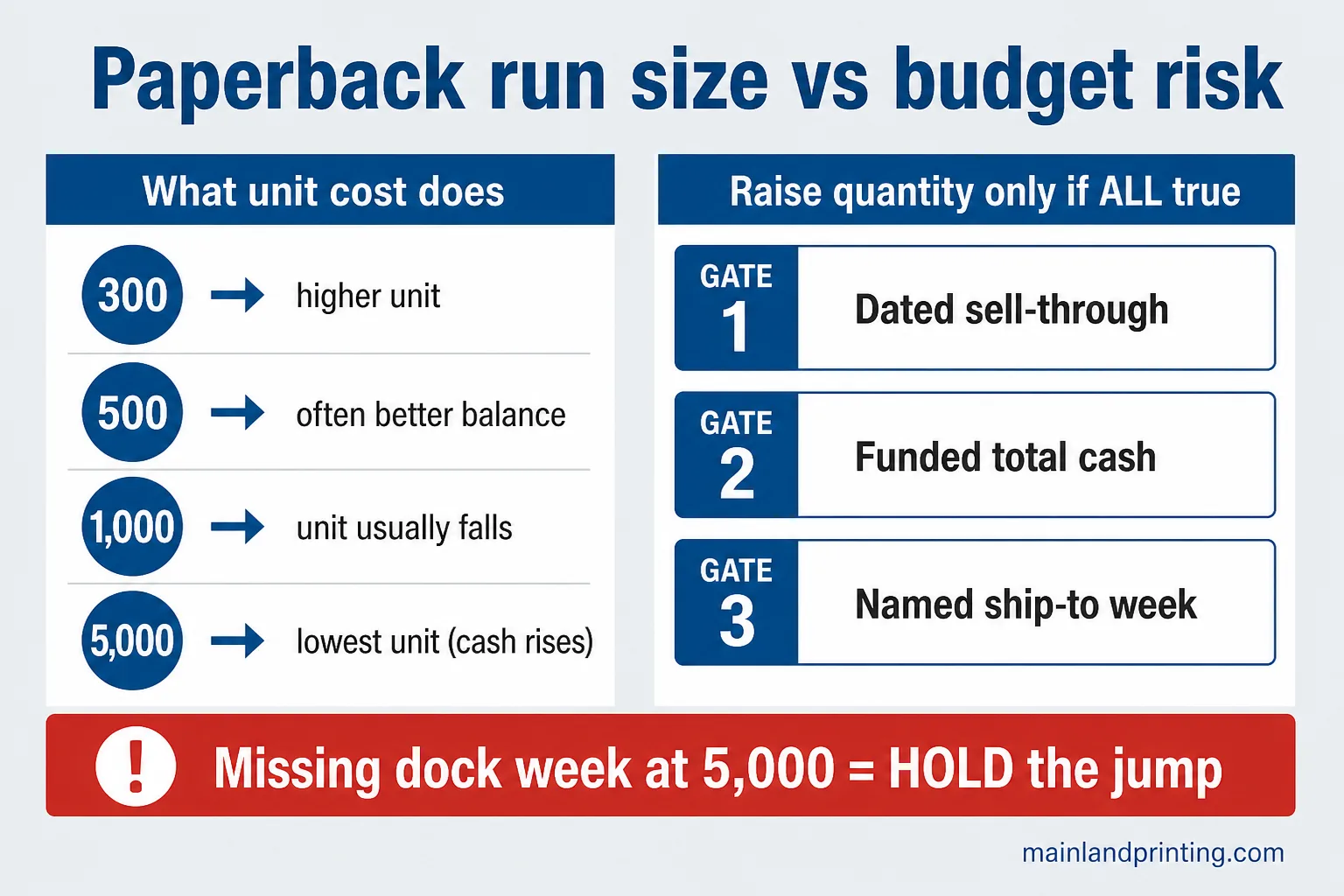
When finance only asks for a lower unit cost, you can “win” the meeting and still lose cash if the next quantity band buys inventory you cannot move in time.
Use one ladder. Score each band on total cash out, unit cost direction, and shelf risk—not unit price alone.
| Tamaño de la tirada | Choose this when… |
|---|---|
| About 300 | You need a first sellable batch, a course pilot, or proof the market before cash locks into stock |
| About 500 | You have a dated launch or training window and can name where every carton goes in 60–90 days |
| About 1,000 | Unit savings matter and your sell-through or distribution plan already covers the extra cartons |
| About 5,000 | You have warehouse capacity, a firm in-hand week, and a written plan for first wave vs remainder |
When you once jumped from 500 to 5,000 because the unit line looked irresistible, the extra cartons sat through a curriculum refresh and the “savings” turned into write-down risk. Put sell-through or class count next to quantity on the same RFQ line before you approve the jump.
Ask for the same trim, pages, and color on every band. If the 5,000 line quietly drops cover weight or switches paper class, you are not measuring quantity savings—you are measuring a cheaper book.
Moving 500 → 1,000 often changes unit economics more than 1,000 → 5,000 once storage and freight enter—so ask for both bands on identical specs before you celebrate the lowest unit cell.If binding is still open, separate perfect-bound softcover from short stitch booklets with the binding path guide so you are not comparing two products under one “paperback” label.
POD stays useful for testing demand with almost no inventory. It does not replace a comparable offset quote when you already know you need hundreds or thousands for schools, warehouses, or a trade release. Keep a 10–15% cash buffer on first offset runs so proof revisions within 5 days do not erase the unit savings.
Weigh Unit Savings Against Cash and Shelf Risk
When unit cost is your only KPI, every larger band looks like progress—until cash and carton space say otherwise.
| Signal on your desk | What you do |
|---|---|
| Unit down, total cash up sharply | Keep the smaller band unless sell-through is dated and funded |
| Launch window < freight + press lead | Split first wave vs remainder; do not buy the full 5K “because it is cheaper” |
| No named ship-to / dock week | Hold the quantity jump; freight mode talk is premature |
| Content may revise in <6 months | Prefer 300–1,000; treat 5K as a reprint decision later |
A common stall is approving the lowest unit cell while the warehouse aisle for that title is still undefined. You then pay for cartons that cannot book a dock appointment without rush fees. Write the in-hand week and storage owner on the quote before you raise quantity.
If your real question is how often to reorder versus how large this PO should be, use the separate reorder vs run size playbook—this page only freezes the paperback budget math for one run.
Red flags before you raise quantity: no named dock week, content revise window under 6 months, or total cash up more than 2× while sell-through is still a guess. Treat those as watch-outs, not “later sales problems.”
Compare paperback print runs with your real specs
Bring quantity band, page count, interior color, and ship-to week into one Softcover planner so the next quote lines up with the budget you just locked.
Send Specs That Make Paperback Quotes Comparable
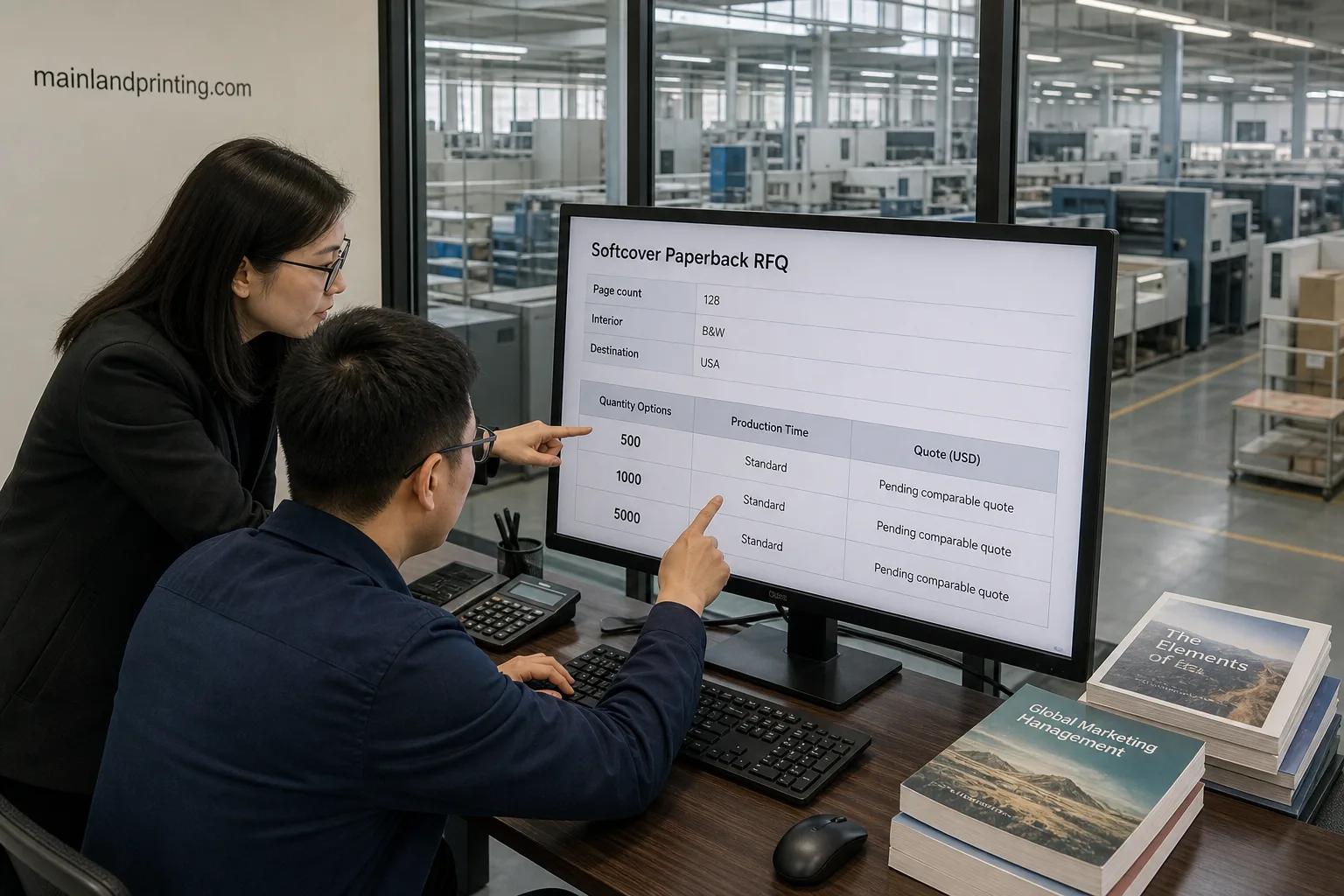
When you ask two plants for “paperback pricing” with different page counts or missing destinations, you are not comparing cost—you are comparing two projects.
| Minimum field | Write it like this |
|---|---|
| Rango de cantidades | Same three options on every quote (e.g. 500 / 1,000 / 5,000) |
| Finished size + pages | Exact trim and page count; note inserts separately |
| Interior + cover | Color mode; text stock class; cover weight + finish |
| Encuadernación | Perfect-bound softcover (and glue family if already chosen) |
| Destination + date | Country, warehouse vs door, target in-hand week |
| File / sample state | PDF ready / cover open / sample needed—same status both sides |
When you once compared a “landed” softcover line to an EXW line with no duty assumption, the cheaper cell won the spreadsheet and lost the budget review. Mark Incoterms and destination on both quotes before you rank unit cost.
If sample status differs—one plant includes a physical proof and the other assumes PDF only—write that gap on the sheet. Proof cost is part of paperback book printing cost when you are approving a first US education or trade run.
Send the same field list to every supplier. If a plant cannot fill ship-to week or interior color, treat that quote as incomplete—not as a bargain. Route the comparable pack into your impresión de libros de tapa blanda planner so sales sees one project, not three vague emails.
- Same quantity options on every quote revision
- Same trim, page count, and color mode
- Same cover finish language (matte / gloss / soft-touch)
- Same destination country and in-hand week
- Reject any line that still says “TBD” on pages or ship-to
Keep cover weight and flaps out of this cost freeze if they are still open—those decisions belong with cover options later. For now, freeze only what makes unit and total cash comparable.
When those cover lines reopen later, clear spine and proof rules with the paperback pre-press file gate so you do not export a guessed wrap into the quote.
When those cover lines reopen, lock weight, lamination, and flaps with the paperback cover options checklist before you reprice the run.
Read Spec Ranges Without Treating Them as Fixed Prices
When a blog posts a fixed dollar per copy with no trim, pages, or destination, treat it as a mood board—not a budget. paper permanence guidance reminds you that stock choice is a performance decision, not only a price cell.
Use anonymous ranges only as direction: more pages, full-color interiors, heavier covers, and longer freight lanes usually raise both unit and total cash; larger matching runs usually lower unit cost while raising cash at risk. Never paste a public table into a PO.
Ask the plant for two or three quantity bands on one frozen spec sheet. Rank lines by total project cash and in-hand risk, then by unit cost.If a quote still refuses to state page count or color mode, you do not have paperback book printing cost—you have a placeholder. Verify spine width after final paper is named—do not approve cover spreads on a ±2 mm guess.
For text vs color interiors, keep gsm next to your softcover interior paper notes so opacity stays on the same quote line.
Keep Softcover Specs Inside a Paperback Budget Path
When your project is a novel, workbook, training manual, or trade paperback with perfect binding, stay on the softcover path and finish the budget math here.
Step off this page when page counts are booklet-low and stitch is the honest bind, when board books or case-bound hardcovers are the product, or when the buyer only wants a one-off POD copy with no inventory plan. Those are different quotes—not “cheaper paperbacks.”
Hardcover durability or collector positioning changes the cost story entirely. If shelf life or gift positioning is the real driver, branch to the paperback vs hardcover decision before you keep optimizing softcover unit cells.
Before you release artwork spend, confirm the bind and paper class still match the quantity band you just chose. A 5,000-run budget with an unfinished cover brief is how reprints absorb the “savings” you thought you locked.
Lock Your Paperback Run Budget Before the Next Quote
Paperback book printing cost is a matched-spec problem: quantity, pages, color, paper, binding, and ship-to have to sit on one sheet before any unit cell is trustworthy. You now have a ladder for 300 through 5,000 and a field list that keeps two plants honest.
That means the next approval should change. Do not raise the run on unit price alone, and do not accept a quote that still leaves pages or destination blank. Cash, shelf risk, and in-hand week belong on the same line as quantity.
When those fields are frozen, carry them into the Softcover planner and ask for the same bands again—so the number you defend in the budget meeting is the number the plant can actually print.