Die Fabrik gibt an, dass die Mindestbestellmenge bei 500 Pappbilderbüchern liegt, aber Ihr Budget sieht offenbar immer noch nur 100 bis 200 Exemplare vor – und heute Abend müssen Sie entscheiden, ob Sie die Stückzahl erhöhen, einen anderen Weg einschlagen oder ein Angebot mit “flexibler Mindestbestellmenge” unterzeichnen, das später nicht mehr gilt.
Betrachten Sie 500 Exemplare als den tatsächlichen Ausgangspunkt für die Massenproduktion von Offset-Pappbilderbüchern; leiten Sie Projekte mit einer Auflage unter 300 Exemplaren von falschen Versprechungen bezüglich niedriger Mindestbestellmengen ab, verwenden Sie die Menge 300–499 nur mit ausdrücklichen Aufschlägen im Angebot und klären Sie die Zeilen „Mindestbestellmenge erfüllt“ bzw. „Mindestbestellmenge nicht erfüllt“ ab, bevor Sie die Bestellung genehmigen.
Nutzen Sie die „Why-500“-Ausgangstabelle, den Leitfaden zu Mengenstufen, die Hinweise zu Staffelrabatten und den MOQ-Angebots-Checkpoint, damit Ihre nächste Anfrage den tatsächlichen Produktionsmöglichkeiten einer Leiterplattenlinie entspricht.
Warum 500 Exemplare der eigentliche Ausgangspunkt für die Großauflage von Pappbilderbüchern sind
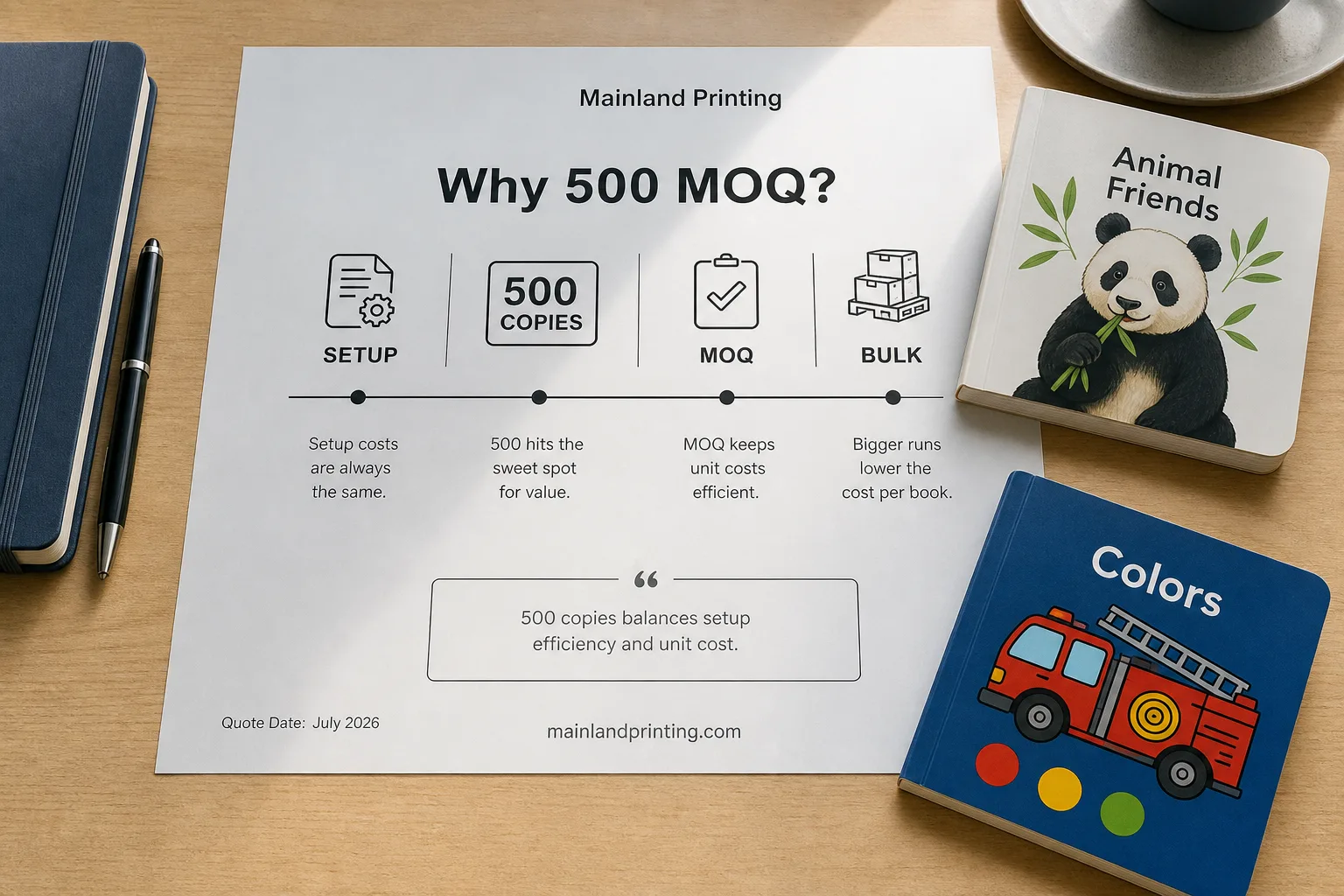
Pappbilderbücher sind keine Nachdrucke mit Softcover. Jedes Blatt wird bedruckt, auf Karton aufgezogen, zugeschnitten, abgerundet und oft vor dem Binden laminiert – daher sind Rüstzeiten und Materialverschwendung bei kleinen Auflagen besonders hoch.
Offsetplatten, die Einrichtungskosten und Stanzwerkzeuge oder Eckwerkzeuge amortisieren sich bei Auflagen unter einigen hundert Exemplaren nur schlecht. Aus diesem Grund geben viele chinesische OEM-Druckereien 500 Exemplare als erste wirtschaftliche Mindestauflage an, selbst wenn ein Vertriebsmitarbeiter sagt: “Wir können auch über niedrigere Stückzahlen sprechen.”
Fragen Sie im Kostenvoranschlag nach den Rüstzeiten und der Pauschale für Verschnitt. Wenn diese Zeilen leer sind, taucht ein “freundliches” Versprechen von unter 500 später meist in Form von Überstunden, überstürzter Qualitätskontrolle oder einem angepassten Stückpreis wieder auf.
Digitale oder POD-Kanäle können zwar mehrere Dutzend Exemplare drucken, erreichen jedoch in der Regel nicht die Steifigkeit von Offset-Karton, die gleichbleibende Qualität der abgerundeten Ecken oder die interaktiven Zusatzfunktionen bei gleicher Stückkostenwirtschaftlichkeit. Der Vergleich des Preises für ein POD-Taschenbuch mit einer Auflage von 100 Exemplaren mit einem Angebot für 500 Exemplare auf Karton bedeutet, dass zwei unterschiedliche Produkte miteinander verglichen werden.
Skaleneffekte kommen nach Deckung der Fixkosten weiterhin zum Tragen – dieselbe Logik, die auch hinter allgemeinen Skalenvorteile in der Fertigung – doch die Leiterplattenbestückung verursacht höhere Fixkosten als bei einfachen, im Bogenoffsetverfahren gedruckten Lehrbüchern.
| Kostenblock | Was passiert unterhalb von ~500 | Was 500+ freischaltet |
|---|---|---|
| Druckplatten / Einrichten | Die Einrichtung bestimmt den Stückpreis; farbige OK-Blätter belasten das Budget | Die Einrichtung verteilt sich auf genügend Exemplare, um die Stückkosten zu stabilisieren |
| Leitung zur Leiterplattenmontage | Kleinserien führen dazu, dass die Anlage zwischen den Umrüstungen stillsteht | Durchlaufmontage mit weniger Umrüstungen |
| Weißes Muster / Qualitätskontrolle | Die Kosten für die Muster erscheinen im Vergleich zu 100–200 Einheiten enorm | Mustergebühren sinnvoll gegen Großbestellungen verrechnen |
| Frachtkosten pro Buch | Karton- und DDP-Mindestmengen treiben die Stückkosten nach Ankunft in die Höhe | Kartonwürfel werden befüllt; Logistikkosten pro Einheit sinken |
Ein Kickstarter-Team bestand einst auf 200 Pappbilderbüchern, “um den Markt zu testen”. Das Angebot wirkte zunächst günstig, bis die Mindestmengen für Einrichtung, weiße Muster und Kartons einzeln aufgeführt wurden – daraufhin lagen die Stückkosten nur geringfügig unter denen ihres Plan B, dem Print-on-Demand-Taschenbuch, bei gleichzeitig höherem Terminrisiko.
Die Lehre lautete nicht: “Teste niemals.” Sondern: “Teste die Wirtschaftlichkeit von Offset-Platten nicht in einer Stückzahl, die die Montagelinie nicht bewältigen kann.” Später wurde eine Auflage von 500 Stück nachgedruckt, mit günstigeren Stückkosten und einem weißen Muster, das tatsächlich dem Massenkleber und dem Eckenradius entsprach.
Leiten Sie die Tabelle “Why-500 Starting Point” in derselben E-Mail wie Ihre Angebotsanfrage an die Finanzabteilung weiter. Wenn die Beteiligten die Abschreibung der Einrichtungskosten schwarz auf weiß sehen, klingt „einfach 150 ausdrucken“ nicht mehr wie eine kostenlose Option.
Mainland Printing behandelt 500 als Standard-Startwert für den Massenwert bei Pappbuchdruck Angebotsanfragen, es sei denn, der Käufer akzeptiert einen schriftlichen Aufschlag für Kleinserien und einen längeren Rüstzeitrahmen. Verwenden Sie diese Zahl in E-Mails an die Beteiligten, damit “MOQ” nicht länger nur ein vages Versprechen bleibt.
Ordnen Sie Ihr Projekt nach Mengenstufen zu
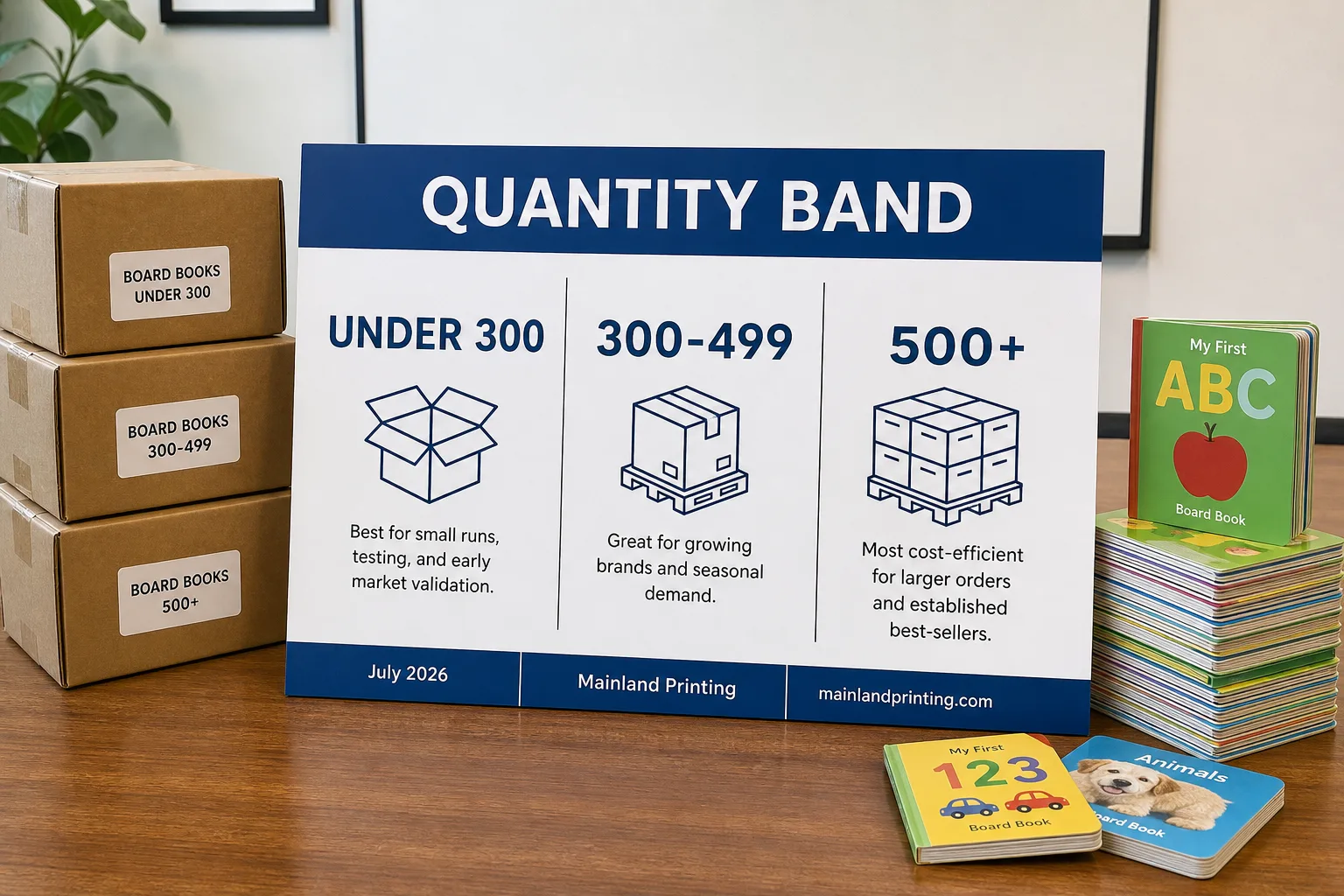
Nicht jede geringe Stückzahl ist falsch – aber jede Bandbreite erfordert einen anderen Ansatz. Der unten stehende Leitfaden zur Stückzahlbandbreite dient als Filter, den Sie anwenden sollten, bevor Sie mit einem Vertriebsmitarbeiter über “flexible Mindestbestellmengen” diskutieren.”
Wenn Ihr tatsächlicher Bedarf unter 300 Exemplaren liegt, geben Sie dies bitte frühzeitig an. Die Anfrage nach den Konditionen für den Offsetdruck bei einer Auflage von 150 Stück führt in der Regel entweder zu einer höflichen Absage oder zu einem Angebot, das mit versteckten Aufschlägen gespickt ist.
Verkaufsformulierungen wie “wir können es versuchen” sind keine Option. Eine Option ist eine Mengenspanne, eine Prozessentscheidung und eine schriftlich festgehaltene Kostenauswirkung, die Sie der Finanzabteilung vorlegen können.
| Mengenstufe | Empfohlene Route | Was ist in der Angebotsanfrage anzugeben? |
|---|---|---|
| Unter 300 | Versuchen Sie nicht, Großauflagen von Offset-Platten durchzusetzen; nutzen Sie stattdessen POD/lokale Kleinauflagen oder warten Sie ab, bis die Nachfrage klarer ist. | “Keine Mindestbestellmenge für Offsetdrucke unter 300 Exemplaren; Suche nach einem alternativen Format oder einem späteren Nachdruck” |
| 300–499 | Nur mit ausdrücklichem Kleinmengen-Zuschlag und längerer Vorlaufzeit möglich | “Anfrage 400, wobei der Aufschlag für Kleinauflagen in einer eigenen Zeile aufgeführt ist” |
| 500–999 | Standard-Startbereich für die meisten Titel für Kleinkinder | “Mindestbestellmenge 500 Offset-Karten; Angebot für 500, 750 bzw. 1.000 Stück” |
| 1,000+ | Beste Stückkosten; feste Mindestbestellmenge für Nachdrucke und Eigentum an den Druckformen | “Grundmenge 1.000; bitte die Mindestbestellmenge für Nachdrucke und die Bedingungen für die Lagerung der Druckplatten angeben” |
Verlage, die die Routingtabelle überspringen, verschwenden oft eine Woche damit, Angebote für “100-Exemplar-Auflagen” einzuholen, die von vornherein nicht realisierbar waren. Ein Einkäufer verglich fünf Druckereien bei einer Auflage von 200 Exemplaren und begann dann bei 500 von vorne, nachdem sich hinter jedem Angebot eine Einrichtungsgebühr verbarg – wodurch der Einführungszeitplan, den er eigentlich sichern wollte, ins Wanken geriet.
Standard-Mainland Printing-Richtlinie für neue Board-Modelle: Beginnen Sie die Angebotsanfrage mit den Stufen 500 / 1.000 / 3.000, auch wenn Sie später möglicherweise geringere Stückzahlen ausliefern möchten. Wenn Sie die Entwicklung frühzeitig erkennen, vermeiden Sie Panikbestellungen in letzter Minute in Stückzahlen von 250 ohne „Pass If“-Klausel.
Wenn das Format noch nicht feststeht, lesen Sie Softcover vs. Hardcover-Einband Zuerst das, dann kehren Sie hierher zurück, um die Menge festzulegen. Die Struktur beeinflusst die Wirtschaftlichkeit der Mindestbestellmenge fast ebenso stark wie die Seitenzahl.
Sind Sie bereit für ein Angebot ab 500 Pappbilderbüchern?
Geben Sie das Format, die Seitenzahl, die Altersempfehlung und Ihre Zielstufe (500 / 1.000 / 3.000) an. Mainland Printing liefert vergleichbare Einträge für das Angebotsformular auf der Produktseite für Pappbilderbücher.
Was ist der Unterschied zwischen 500, 1.000 und 3.000 Exemplaren?
Ab einer Stückzahl von 500 gelangt man in den Mengenrabattbereich. Bei Stückzahlen von 1.000 und 3.000 verbessern sich die Stückkosten in der Regel erneut – allerdings nur, wenn die Spezifikationen unverändert bleiben und die Kartonplanung realistisch ist.
Nutzen Sie die Preisangaben der verschiedenen Stufen als Entscheidungsgrundlage und nicht als Druckmittel. Falls sich das Bildmaterial nach Erreichen der Kickstarter-Stretch-Ziele noch ändern sollte, tun Sie nicht so, als gelte der Preis von 3.000 für eine noch nicht endgültige Datei.
Dickenanpassungen, interaktive Klappen und spezielle Oberflächenveredelungen können einen Mengenrabatt zunichte machen, wenn Sie diese nach dem ersten Kostenvoranschlag hinzufügen. Legen Sie diese Variablen fest, bevor Sie sich über eine Stückzahl von 3.000 aus einem früheren Kostenvoranschlag für flache Druckvorlagen freuen.
| Stufe | Typische Auswirkung | Was man beachten sollte |
|---|---|---|
| 500 | Erste praktikable Stückkosten für Großmengen; Probenahmepfad wird sauber gutgeschrieben | Nach wie vor wichtig sind Seitenzahl, Dicke und Oberflächenausführung |
| 1,000 | Deutlicher Rückgang der Stückzahlen; bessere Kartonauslastung | Bestandsrisiko bei ungewisser Nachfrage |
| 3,000 | Höchste Stückkosten bei stabilen Einzelhandelsprogrammen | Kasse und Lager; Fragen zur Nachdruckplanung |
Die Berechnungen für die Stufen mit den Angaben in der Kostenübersicht für Pappbilderbücher So bleiben Entscheidungen zur Mindestbestellmenge an die tatsächlichen Kostenblöcke gebunden und nicht an einen einzelnen Listenpreis.
Wenn Sie sich noch nicht für einen Bremssattel entschieden haben, sollten Sie diese Entscheidung bezüglich der Mindestbestellmenge mit der Leitfaden zur Dicke von Pappbilderbüchern—Bei 60 pt und einer Auflage von 500 Exemplaren ändern sich die Rückenstärke und das Kartonvolumen, bevor der Transport gebucht wird.
Warnsignale: ein Einheitspreis ohne Staffelpreistabelle; “Mindestbestellmenge 100” auf dem Offset-Karton ohne Zeile für einen Aufschlag; Frachtkosten für 500 angegeben, obwohl Sie über 200 verhandeln.
Überprüfung der Angaben zur Mindestbestellmenge im Angebot
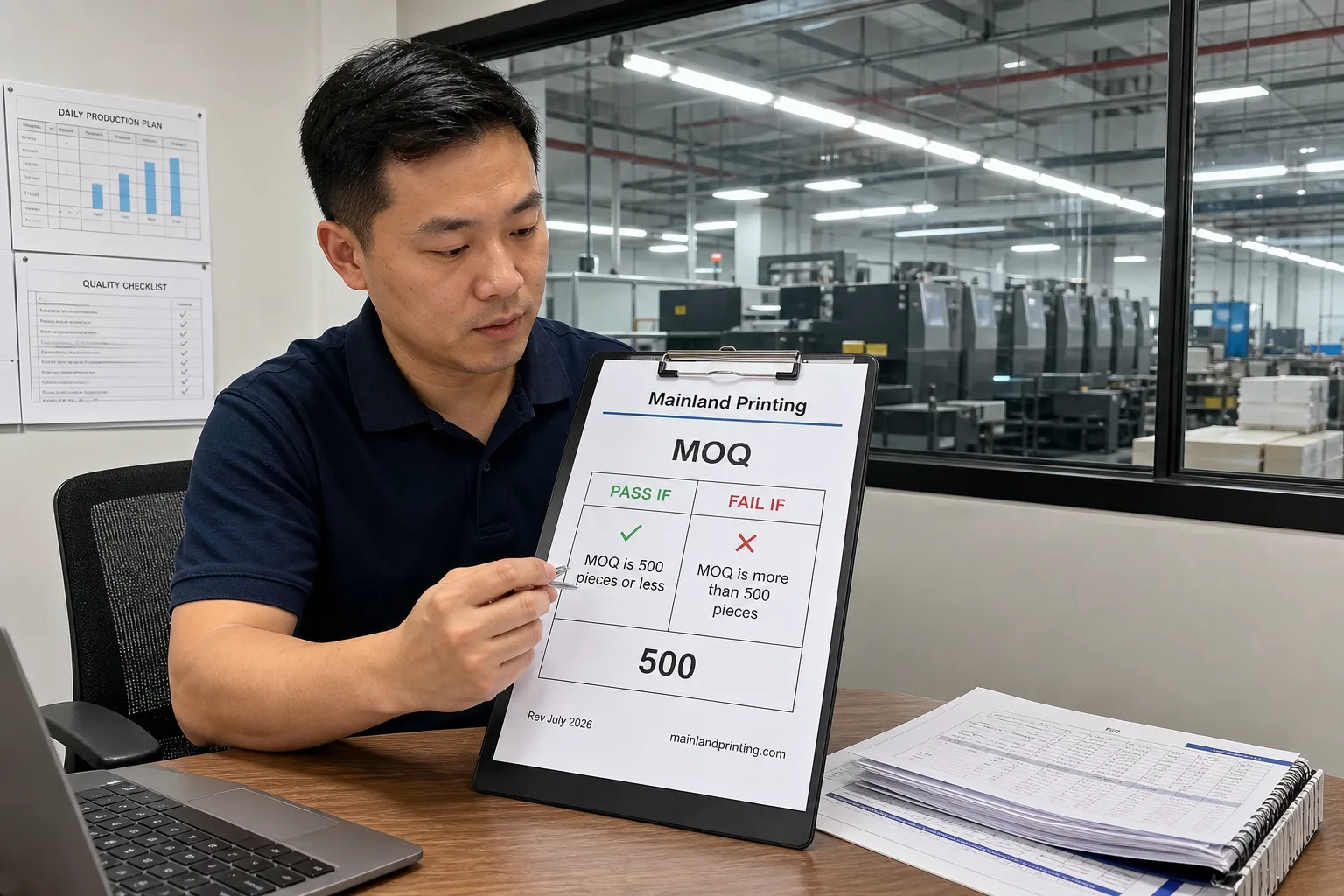
Ein Angebot mit der Angabe “niedrige Mindestbestellmenge” ist nicht überprüfbar. Der Prüfpunkt „Mindestbestellmenge“ fasst die Bedingungen hinsichtlich Menge, Zuschlag, Mustergutschrift und Nachdruck in einer einzigen „Bestanden/Nicht bestanden“-Bewertung zusammen.
Führen Sie dies einmal pro SKU durch, bevor Sie Fabriken vergleichen. Für Pappbilderbücher für Kleinkinder im Einzelhandel sind weiterhin Materialien und Prüfverfahren gemäß 16 CFR Teil 1500—Die Menge hat keinen Einfluss auf den Geltungsbereich der Vorschriften.
| Im Angebot überprüfen | Weiter, wenn | Fehler, wenn |
|---|---|---|
| Angegebene Mindestbestellmenge | Mindestbestellmenge in Stückzahl (z. B. 500) plus Verfahren (Offsetdruck auf Karton) | Nur “flexibel”, “niedrig” oder “diskutieren” |
| Option für Mengen unterhalb der Mindestbestellmenge | Kleinauflagenzuschlag als eigene Zeile mit Lieferzeitaufschlag | Preis bei Mengen unter der Mindestbestellmenge ohne Aufschlag |
| Stufentabelle | Mindestens zwei Stufen über der Mindestbestellmenge (z. B. 500 / 1.000) | Einzelstückpreis verdeckt Mengenbrüche |
| Beispiel für eine Gutschrift | Die Gebühr für das weiße/bedruckte Muster wird gutgeschrieben, sofern die Spezifikationen unverändert bleiben | Muster im Stückpreis enthalten, ohne Genehmigungsstufe |
| Mindestbestellmenge für Nachdrucke | Angabe der Mindestauflage für Nachdrucke und der Eigentumsverhältnisse an Druckplatten/Stempeln | Nur Mindestbestellmenge für die Erstauflage; Bedingungen für Nachdrucke: keine Angaben |
Ein US-Käufer bestätigte per E-Mail “Mindestbestellmenge 300 verfügbar” und erhielt anschließend einen Produktionsplan, bei dem sich die Rüstzeit um zwei Wochen verzögerte. Da im Angebot kein Aufschlag für Kleinserien aufgeführt war, entwickelte sich der Streit zu einer Auseinandersetzung zwischen den Geschäftspartnern, anstatt zu einem messbaren „Fail If“-Fall.
Ein weiterer häufiger Fehler: In Fracht- und Kartonzeilen wird nach wie vor von 500 ausgegangen, während in der geschäftlichen E-Mail 200 “vereinbart” wurde. Die Einheitskosten bei Ankunft überraschen dann die Wareneingangsabteilung, selbst wenn der aufgedruckte Stückpreis ausgehandelt schien.
Mainland Printing listet in den Angeboten die numerischen Mindestbestellmengen (MOQ), Staffelgrenzen und Mustergutschriften auf, sodass der MOQ-Prüfpunkt in einem Durchgang überprüft werden kann. Sollte eine Zeile mit dem Status „Fail If“ ausgelöst werden, wird der Vergleich der Stückpreise unterbrochen, bis der Text umformuliert wurde.
Das Wichtigste für Käufer
Planen Sie Großauflagen von Pappbilderbüchern ab 500 Exemplaren, leiten Sie Projekte mit einer Stückzahl unter 300 von der falschen „niedrige Mindestbestellmenge“-Strategie ab und passieren Sie den „Mindestbestellmenge-Prüfpunkt“, bevor Sie einen Stückpreis als verbindlich betrachten.
Wenn Menge, Preisstufen und Musterguthaben alle den Anforderungen entsprechen, reichen Sie die Angebotsanfrage über Pappbuchdruck mit Ihrem festgelegten Band. Das ist der nahtlose Übergang von der heutigen MOQ-Diskussion zu einer Fabrikschätzung, die Sie verteidigen können.
Öffnen Sie die Mindestbestellmenge (MOQ) nach dem Brennen der Druckplatten nicht erneut, es sei denn, eine “Fail If”-Zeile wurde übersehen. Eine Änderung von 500 auf 200 während des laufenden Programms führt zu einer Neuanpassung der Einkaufs-, Termin- und Kartonpläne – Kosten, die den ursprünglichen Wunsch, „etwas weniger zu drucken“, bei weitem übersteigen.”